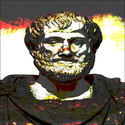
Aristotle
Biography of Aristotle
Full Name and Common Aliases
Full Name: Aristotle
Common Aliases: None, though often referred to simply as "The Philosopher" in medieval times.
Birth and Death Dates
Birth Date: 384 BCE
Death Date: 322 BCE
Nationality and Profession(s)
Nationality: Greek
Profession(s): Philosopher, Scientist, Teacher, Writer
Early Life and Background
Aristotle was born in 384 BCE in the small town of Stagira, located in the northern region of Greece known as Macedonia. His father, Nicomachus, served as the personal physician to King Amyntas of Macedonia, which afforded Aristotle a privileged upbringing. This early exposure to the Macedonian court likely influenced his later connections and opportunities. At the age of seventeen, Aristotle moved to Athens to study at Plato's Academy, where he remained for twenty years. His time at the Academy was formative, as he was deeply influenced by Plato's teachings, although he would later diverge from his mentor's ideas.
Major Accomplishments
Aristotle's contributions to philosophy and science are vast and varied. After leaving the Academy, he spent time traveling and studying in Asia Minor and the island of Lesbos, where he conducted research in biology and natural sciences. In 343 BCE, he was invited by King Philip II of Macedonia to tutor his son, Alexander the Great. This role not only solidified his status as a leading intellectual but also allowed him to influence one of history's greatest military leaders.
Upon returning to Athens in 335 BCE, Aristotle founded his own school, the Lyceum. Here, he developed a comprehensive system of Western philosophy that encompassed ethics, politics, metaphysics, logic, and natural sciences. His method of empirical observation and systematic classification laid the groundwork for the scientific method.
Notable Works or Actions
Aristotle's body of work is extensive, with many of his writings surviving to this day. Some of his most notable works include "Nicomachean Ethics," where he explores the nature of human happiness and virtue; "Politics," which examines the role of the state and the individual; and "Metaphysics," a foundational text in Western philosophy that investigates the nature of reality. His "Poetics" is one of the earliest surviving works of dramatic theory, and his "Rhetoric" remains a seminal text on the art of persuasion.
Aristotle's contributions to logic, particularly through his work "Organon," established the framework for deductive reasoning that would dominate Western thought for centuries. His classification of living organisms in "History of Animals" and other biological texts laid the groundwork for modern taxonomy.
Impact and Legacy
Aristotle's influence on Western thought is immeasurable. His works were preserved and studied by Islamic scholars during the Middle Ages, which later reintroduced them to Europe during the Renaissance. This revival of Aristotelian thought played a crucial role in the development of modern science and philosophy. His ideas on logic and empirical observation became foundational to the scientific revolution, and his ethical and political theories continue to be studied and debated.
Aristotle's impact extends beyond philosophy and science; his ideas have permeated literature, art, and education. The Aristotelian method of inquiry, which emphasizes observation and classification, remains a cornerstone of scientific investigation.
Why They Are Widely Quoted or Remembered
Aristotle is widely quoted and remembered for his profound insights into human nature, ethics, and the natural world. His ability to synthesize knowledge across various disciplines and his commitment to empirical observation have made his works timeless. Quotes from Aristotle often reflect his belief in the potential for human excellence and the pursuit of knowledge, making them relevant across cultures and eras.
His exploration of topics such as virtue, happiness, and the role of the state resonate with fundamental human concerns, ensuring his continued relevance. Aristotle's legacy as a thinker who sought to understand the world in a systematic and comprehensive way makes him a perennial source of wisdom and inspiration. His teachings continue to challenge and inspire those who seek to understand the complexities of life and the universe.
Quotes by Aristotle
Aristotle's insights on:
Metaphysics is universal and is exclusively concerned with primary substance. And here we will have the science to study that which is, both in its essence and in the properties which it has.
The wise man does not expose himself needlessly to danger, since there are few things for which he cares sufficiently; but he is willing, in great crises, to give even his life -- knowing that under certain conditions it is not worthwhile to live.
Happiness is something final and complete in itself, As being the aim and end of practical activities whatever... Happiness then we define as the active exercise of the mind In conformity with perfect goodness or virtue.
For contemplation is both the highest form of activity since the intellect is the highest thing in us, and the objects that it apprehends are the highest things that can be known, and also it is the most continuous, because we are more capable of continuous contemplation than we are of any practical activity.
The good of man is the active exercise of his souls faculties in conformity with excellence or virtue, or if there be several human excellences or virtues, in conformity with the best and most perfect among them.