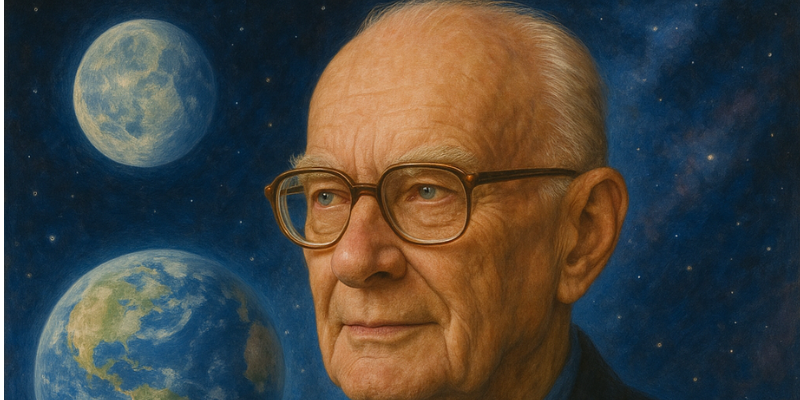
150 Best Quotes by Arthur C. Clarke: Wisdom from a Visionary of Science and Imagination
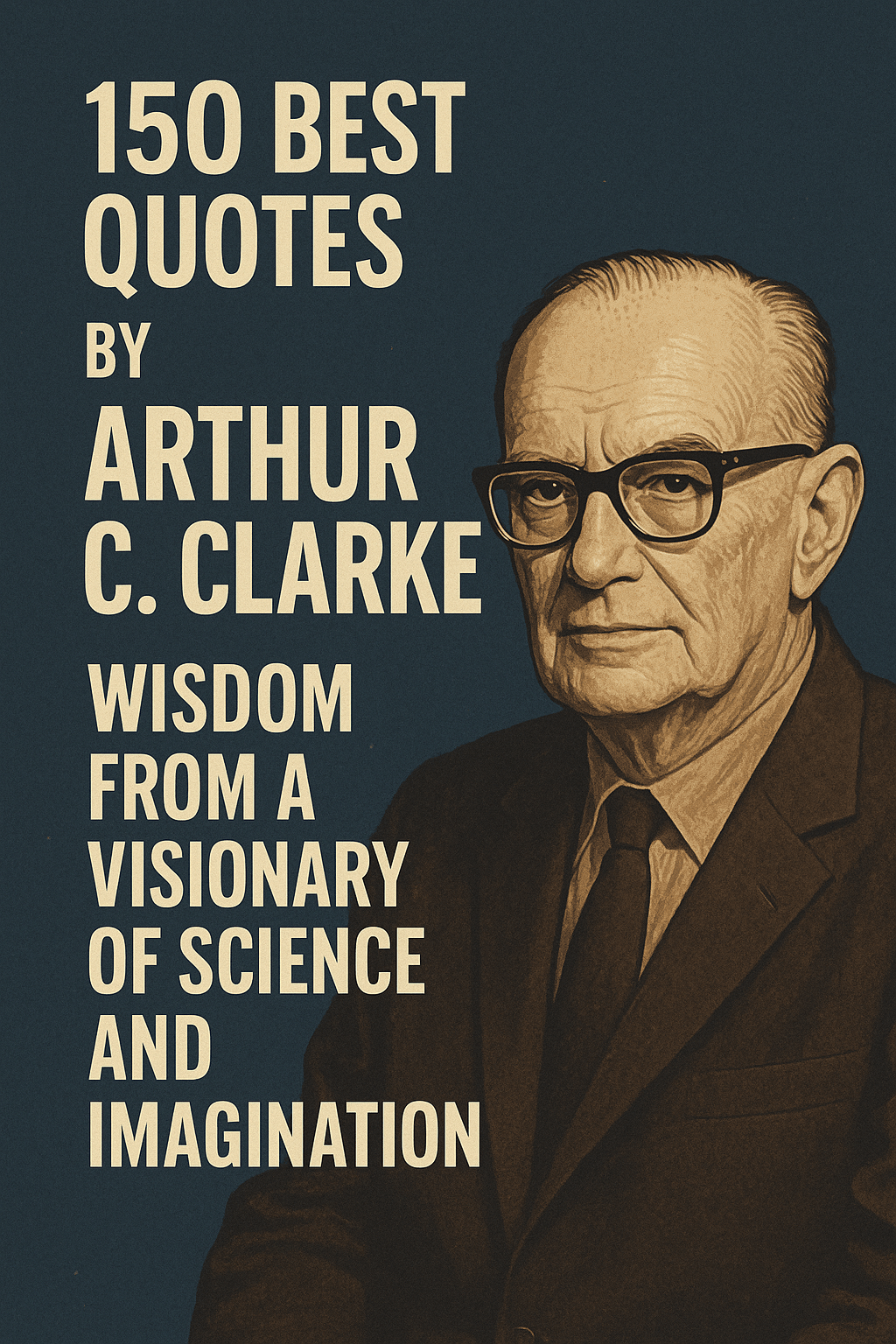
Arthur C. Clarke (1917-2008) was one of the most influential science fiction writers and futurists of the 20th century. Best known for co-writing the screenplay for 2001: A Space Odyssey and for formulating Clarke's Three Laws of scientific prediction, he was a visionary who bridged the gap between science and imagination. His profound insights into technology, humanity, and the cosmos continue to inspire readers, scientists, and dreamers worldwide. From his home in Sri Lanka, Clarke gazed at the stars and pondered humanity's place in the universe, leaving us with a treasury of wisdom that remains remarkably relevant today.
Table of Contents
- 150 Best Quotes by Arthur C. Clarke: Wisdom from a Visionary of Science and Imagination
- Table of Contents
- Section 1: Science, Technology, and the Future
- Section 2: The Universe and Our Place In It
- Section 3: Religion, Faith, and Philosophy
- Section 4: Human Nature and Intelligence
- Section 5: Life, Death, and Existence
- Section 6: Knowledge, Wisdom, and Learning
- Section 7: Science Fiction and Imagination
- Section 8: Hope, Progress, and the Human Spirit
- Conclusion
- Check out our quote collections
Section 1: Science, Technology, and the Future
Arthur C. Clarke's most famous contributions to human thought revolve around his prescient understanding of technology and scientific progress. His Three Laws remain cornerstones of futuristic thinking.
"Any sufficiently advanced technology is indistinguishable from magic." - Arthur C. Clarke
"When a distinguished but elderly scientist states that something is possible, he is almost certainly right. When he states that something is impossible, he is very probably wrong." - Arthur C. Clarke
"The only way of discovering the limits of the possible is to venture a little way past them into the impossible." - Arthur C. Clarke
"Magic's just science that we don't understand yet." - Arthur C. Clarke
"When, taking all factors into account, anything can be proved to be impossible, that usually means that it will be done in some different manner and employing a new and unforeseen technique." - Arthur C. Clarke
"Before you become too entranced with gorgeous gadgets and mesmerizing video displays, let me remind you that information is not knowledge, knowledge is not wisdom, and wisdom is not foresight. Each grows out of the other, and we need them all." - Arthur C. Clarke
"It is a good principle in science not to believe any 'fact'---however well attested---until it fits into some accepted frame of reference. Occasionally, of course, an observation can shatter the frame and force the construction of a new one, but that is extremely rare. Galileos and Einsteins seldom appear more than once per century, which is just as well for the equanimity of mankind." - Arthur C. Clarke
"Personally, I refuse to drive a car - I won't have anything to do with any kind of transportation in which I can't read." - Arthur C. Clarke
"Now, before you make a movie, you have to have a script, and before you have a script, you have to have a story; though some avant-garde directors have tried to dispense with the latter item, you'll find their work only at art theaters." - Arthur C. Clarke
"The future isn't what it used to be." - Arthur C. Clarke
"CNN is one of the participants in the war. I have a fantasy where Ted Turner is elected president but refuses because he doesn't want to give up power." - Arthur C. Clarke
"The limits of the possible can only be defined by going beyond them into the impossible." - Arthur C. Clarke
"We have to abandon the idea that schooling is something restricted to youth. How can it be, in a world where half the things a man knows at 20 are no longer true at 40 - and half the things he knows at 40 hadn't been discovered when he was 20?" - Arthur C. Clarke
"New ideas pass through three periods: 1) It can't be done. 2) It probably can be done, but it's not worth doing. 3) I knew it was a good idea all along!" - Arthur C. Clarke
"Politicians should read science fiction, not westerns and detective stories." - Arthur C. Clarke
"The greatest tragedy in mankind's entire history may be the hijacking of morality by religion." - Arthur C. Clarke
"If we have learned one thing from the history of invention and discovery, it is that, in the long run - and often in the short one - the most daring prophecies seem laughably conservative." - Arthur C. Clarke
"Every revolutionary idea seems to evoke three stages of reaction. They may be summed up by the phrases: 1) It's completely impossible. 2) It's possible, but it's not worth doing. 3) I said it was a good idea all along." - Arthur C. Clarke
"The Information Age offers much to mankind, and I would like to think that we will rise to the challenges it presents. But it is vital to remember that information - in the sense of raw data - is not knowledge, that knowledge is not wisdom, and that wisdom is not foresight. But information is the first essential step to all of these." - Arthur C. Clarke
Section 2: The Universe and Our Place In It
Clarke's contemplation of the cosmos and humanity's position within it produced some of his most profound and haunting observations.
"Two possibilities exist: either we are alone in the Universe or we are not. Both are equally terrifying." - Arthur C. Clarke
"I'm sure the universe is full of intelligent life. It's just been too intelligent to come here." - Arthur C. Clarke
"How inappropriate to call this planet 'Earth,' when it is clearly 'Ocean.'" - Arthur C. Clarke
"In this single galaxy of ours there are eighty-seven thousand million suns. ... In challenging it, you would be like ants attempting to label and classify all the grains of sand in all the deserts of the world. ... It is a bitter thought, but you must face it. The planets you may one day possess. But the stars are not for man." - Arthur C. Clarke
"There is no reason to assume that the universe has the slightest interest in intelligence—or even in life. Both may be random accidental by-products of its operations like the beautiful patterns on a butterfly's wings. The insect would fly just as well without them." - Arthur C. Clarke
"They will say that the Universe has no purpose and no plan, that since a hundred suns explode every year in our Galaxy, at this very moment some race is dying in the depths of space. Whether that race has done good or evil during its lifetime will make no difference in the end: there is no divine justice, for there is no God." - Arthur C. Clarke
"It goes on forever and forever, and perhaps Something made it. But how you can believe that Something has a special interest in us and our miserable little world—that just beats me." - Arthur C. Clarke
"Shuttling back and forth in the equatorial plane where the brilliant stars of Io, Europa, Ganymede, and Callisto - worlds that elsewhere would have counted as planets in their own right, but which here were merely satellites of a giant master." - Arthur C. Clarke
"Does it not seem strange to you, began Yarlan Zey, that though the skies are open to us, we have tried to bury ourselves in the Earth? It is the beginning of the sickness whose ending you have seen in your age. Humanity is trying to hide; it is frightened of what lies out there in space, and soon it will have closed all the doors that lead into the Universe." - Arthur C. Clarke
"Meteorites don't fall on the Earth. They fall on the Sun and the Earth gets in the way." - Arthur C. Clarke
"This had not endeared him to exobiologists such as Dr Perera, who took exactly the opposite view. To them, the only purpose of the Universe was the production of intelligence, and they were apt to talk sneeringly about purely astronomical phenomena, 'Mere dead matter' was one of their favourite phrases." - Arthur C. Clarke
"The universe is not only queerer than we suppose, but queerer than we can suppose." - Arthur C. Clarke
"Sometimes I think we're alone in the universe, and sometimes I think we're not. In either case the idea is quite staggering." - Arthur C. Clarke
"We are just tenants on this world. We have just been given a new lease, and a warning from the landlord." - Arthur C. Clarke
"The Earth is the cradle of humanity, but mankind cannot stay in the cradle forever." - Arthur C. Clarke
"Behind every man now alive stand thirty ghosts, for that is the ratio by which the dead outnumber the living." - Arthur C. Clarke
"The moon is the first milestone on the road to the stars." - Arthur C. Clarke
"There is hopeful symbolism in the fact that flags do not wave in a vacuum." - Arthur C. Clarke
"The universe must be full of voices, calling from star to star in a myriad tongues. One day we shall join that cosmic conversation." - Arthur C. Clarke
Section 3: Religion, Faith, and Philosophy
Clarke's views on religion and spirituality were complex and often controversial, reflecting his scientific worldview while acknowledging the human need for meaning.
"I don't believe in astrology; I'm a Sagittarius and we're skeptical." - Arthur C. Clarke
"A faith that cannot survive collision with the truth is not worth many regrets." - Arthur C. Clarke
"One of the greatest tragedies in mankind's entire history may be that morality was hijacked by religion." - Arthur C. Clarke
"The rash assertion that 'God made man in His own image' is ticking like a time bomb at the foundation of many faiths." - Arthur C. Clarke
"Science can destroy religion by ignoring it as well as by disproving its tenets. No one ever demonstrated, so far as I am aware, the nonexistence of Zeus or Thor, but they have few followers now." - Arthur C. Clarke
"These leaders must not believe they are actually being watched, for their behavior in no way reflects the possible existence of a set of values or ethical laws that supersedes their own dominion." - Arthur C. Clarke
"Religion is a byproduct of fear. For much of human history, it may have been a necessary evil, but why was it more evil than necessary? Isn't killing people in the name of God a pretty good definition of insanity?" - Arthur C. Clarke
"I would defend the liberty of consenting adult creationists to practice whatever intellectual perversions they like in the privacy of their own homes; but it is also necessary to protect the young and innocent." - Arthur C. Clarke
"The greatest tragedy in mankind's entire history may be the hijacking of morality by religion." - Arthur C. Clarke
"It may be that our role on this planet is not to worship God - but to create him." - Arthur C. Clarke
"Perhaps our role on this planet is not to worship God - but to create him." - Arthur C. Clarke
"I don't believe in God but I'm very interested in her." - Arthur C. Clarke
"God has no place within these walls, just as facts have no place within organized religion." - Arthur C. Clarke
"I have encountered a few 'creationists' and because they were usually nice, intelligent people, I have been unable to decide whether they were really mad or only pretending to be mad." - Arthur C. Clarke
"The fact that we have not yet found the slightest evidence for life - much less intelligence - beyond this Earth does not surprise or disappoint me in the least. Our technology must still be laughably primitive, we may be like jungle savages listening for the throbbing of tom-toms while the ether around them carries more words per second than they could utter in a lifetime." - Arthur C. Clarke
"Atheists have as much conscience, possibly more, than people with deep religious conviction." - Arthur C. Clarke
"Belief in God is apparently a psychological artifact of mammalian reproduction." - Arthur C. Clarke
"Human judges can show mercy. But against the laws of nature, there is no appeal." - Arthur C. Clarke
"Whether we are based on carbon or on silicon makes no fundamental difference; we should each be treated with appropriate respect." - Arthur C. Clarke
Section 4: Human Nature and Intelligence
Clarke's observations on human nature, intelligence, and behavior reveal both his optimism and his skepticism about our species.
"It has yet to be proven that intelligence has any survival value." - Arthur C. Clarke
"My favourite definition of an intellectual: 'Someone who has been educated beyond his/her intelligence." - Arthur C. Clarke
"A truly intelligent race is not likely to be unfriendly." - Arthur C. Clarke
"But the characteristic that is truly special about our species...is our ability to model our world and understand both it and where we fit into its overall scheme...." - Arthur C. Clarke
"What was more, they had taken the first step toward genuine friendship. They had exchanged vulnerabilities." - Arthur C. Clarke
"After their encounter on the approach to Jupiter, there would aways be a secret bond between them---not of love, but of tenderness, which is often more enduring." - Arthur C. Clarke
"Humor was the enemy of desire." - Arthur C. Clarke
"He had sometimes wondered if the real reason why men sought danger was that only thus could they find the companionship and solidarity which they unconsciously craved." - Arthur C. Clarke
"It must be wonderful to be seventeen, and to know everything." - Arthur C. Clarke
"The trouble with cliché's, some philosopher remarked, probably with a yawn, is that they are so boringly true. But 'love at first sight' is never boring." - Arthur C. Clarke
"He had a suspicion of plausible answers; they were so often wrong." - Arthur C. Clarke
"They had not yet attained the stupefying boredom of omnipotence; their experiments did not always succeed." - Arthur C. Clarke
"'The Devil in the Dark' impressed me because it presented the idea, unusual in science fiction then and now, that something weird, and even dangerous, need not be malevolent. That is a lesson that many of today's politicians have yet to learn." - Arthur C. Clarke
"There were, however, a few exceptions. One was Norma Dodsworth, the poet, who had not unpleasantly drunk but had been sensible enough to pass out before any violent action proved necessary. He had been deposited, not very gently, on the lawn, where it was hoped that a hyena would give him a rude awakening. For all practical purposes he could, therefore, be regarded as absent." - Arthur C. Clarke
"Human beings, who are almost unique in having the ability to learn from the experience of others, are also remarkable for their apparent disinclination to do so." - Arthur C. Clarke
"The best measure of a man's honesty isn't his income tax return. It's the zero adjust on his bathroom scale." - Arthur C. Clarke
"It is not easy to see how the more extreme forms of nationalism can long survive when men have seen the Earth in its true perspective as a single small globe against the stars." - Arthur C. Clarke
"The intelligent minority of this world will mark 1 January 2001 as the real beginning of the 21st century and the Third Millennium." - Arthur C. Clarke
"I'm sometimes asked how I would like to be remembered. I've had a diverse career as a writer, underwater explorer, space promoter and science populariser. Of all these, I want to be remembered most as a writer - one who entertained readers, and, hopefully, stretched their imaginations as well." - Arthur C. Clarke
Section 5: Life, Death, and Existence
Clarke's contemplations on mortality, consciousness, and the nature of existence reveal a philosopher as much as a scientist.
"When the reality was depressing, men tried to console themselves with myth." - Arthur C. Clarke
"He did not know that the Old One was his father, for such a relationship was utterly beyond his understanding, but as he looked at the emaciated body he felt a dim disquiet that was the ancestor of sadness." - Arthur C. Clarke
"When the barriers were down at last, loneliness would vanish as personality faded." - Arthur C. Clarke
"Imagine that every man's mind is an island, surrounded by ocean. Each seems isolated, yet in reality all are linked by the bedrock from which they spring. If the ocean were to vanish, that would be the end of the islands. They would all be part of one continent, but the individuality would have gone" - Arthur C. Clarke
"He found it both sad and fascinating that only through an artificial universe of video images could she establish contact with the real world." - Arthur C. Clarke
"Jan had always been a good pianist, and now he was the finest in the world." - Arthur C. Clarke
"Death focuses the mind on the things that really matter: why are we here, and what should we do?" - Arthur C. Clarke
"As our own species is in the process of proving, one cannot have superior science and inferior morals. The combination is unstable and self-destroying." - Arthur C. Clarke
"The goal of the future is full unemployment, so we can play. That's why we have to destroy the present politico-economic system." - Arthur C. Clarke
"There is the possibility that humankind can outgrow its infantile tendencies, as I suggested in 'Childhood's End.' But it is amazing how childishly gullible humans are." - Arthur C. Clarke
"I have great faith in optimism as a guiding principle, if only because it offers us the opportunity of creating a self-fulfilling prophecy." - Arthur C. Clarke
"Perhaps, as some wit remarked, the best proof that there is Intelligent Life in Outer Space is the fact it hasn't come here. Well, it can't hide forever - one day we will overhear it." - Arthur C. Clarke
"The creation of wealth is certainly not to be despised, but in the long run the only human activities really worthwhile are the search for knowledge, and the creation of beauty. This is beyond argument, the only point of debate is which comes first." - Arthur C. Clarke
"We seldom stop to think that we are still creatures of the sea, able to leave it only because, from birth to death, we wear the water-filled space suits of our skins." - Arthur C. Clarke
"What we need is a machine that will let us see the other guy's point of view." - Arthur C. Clarke
"In the long run, there are no secrets. Nature does not hide its fundamental mechanisms." - Arthur C. Clarke
"If children have interests, then education happens." - Arthur C. Clarke
"Reading computer manuals without the hardware is as frustrating as reading sex manuals without the software." - Arthur C. Clarke
"I don't pretend we have all the answers. But the questions are certainly worth thinking about." - Arthur C. Clarke
Section 6: Knowledge, Wisdom, and Learning
Clarke's insights into the nature of knowledge and the importance of continuous learning reflect his lifelong commitment to education and discovery.
"But please remember: this is only a work of fiction. The truth, as always, will be far stranger." - Arthur C. Clarke
"The only real problem in life is what to do next." - Arthur C. Clarke
"I am an optimist. Anyone interested in the future has to be otherwise he would simply shoot himself." - Arthur C. Clarke
"Sometimes a decision has to be made by a single individual, who has the authority to enforce it. That's why you need a captain. You can't run a ship by a committee - at least not all the time." - Arthur C. Clarke
"Training was one thing, reality another." - Arthur C. Clarke
"The entire sweep of human history from the dark ages into the unknown future was considerably less important at the moment than the question of a certain girl and her feelings toward him." - Arthur C. Clarke
"No communication technology has ever disappeared, but instead becomes increasingly less important as the technological horizon widens." - Arthur C. Clarke
"Judge me by my deeds, though they are few, rather than my words, though they are many." - Arthur C. Clarke
"Floyd could imagine a dozen things that could go wrong; it was little consolation that it was always the thirteenth that actually happened." - Arthur C. Clarke
"And because, in all the Galaxy, they had found nothing more precious than Mind, they encouraged its dawning everywhere." - Arthur C. Clarke
"The phenomenon of UFO doesn't say anything about the presence of intelligence in space. It just shows how rare it is here on the earth." - Arthur C. Clarke
"Getting information from the internet is like getting a glass of water from the Niagara Falls." - Arthur C. Clarke
"As three laws were good enough for Newton, I have modestly decided to stop there." - Arthur C. Clarke
"I can never look now at the Milky Way without wondering from which of those banked clouds of stars the emissaries are coming." - Arthur C. Clarke
"Look, whispered Chuck, and George lifted his eyes to heaven. (There is always a last time for everything.) Overhead, without any fuss, the stars were going out." - Arthur C. Clarke
"My objection to organized religion is the premature conclusion to ultimate truth that it represents." - Arthur C. Clarke
"In accordance with the terms of the Clarke-Asimov treaty, the second-best science writer dedicates this book to the second-best science-fiction writer." - Arthur C. Clarke
"Attempting to define science fiction is an undertaking almost as difficult, though not so popular, as trying to define pornography... In both pornography and SF, the problem lies in knowing exactly where to draw the line." - Arthur C. Clarke
"When all else failed, you had to rely on eyeball intrumentation." - Arthur C. Clarke
Section 7: Science Fiction and Imagination
As one of the giants of science fiction, Clarke had profound thoughts about the genre and its role in human culture.
"...science fiction is something that could happen - but usually you wouldn't want it to. Fantasy is something that couldn't happen - though often you only wish that it could." - Arthur C. Clarke
"There's no real objection to escapism, in the right places... We all want to escape occasionally. But science fiction is often very far from escapism, in fact you might say that science fiction is escape into reality... It's a fiction which does concern itself with real issues: the origin of man; our future. In fact I can't think of any form of literature which is more concerned with real issues, reality." - Arthur C. Clarke
"Science fiction writers foresee the inevitable, and although problems and catastrophes may be inevitable, solutions are not." - Arthur C. Clarke
"If an elderly but distinguished scientist says that something is possible, he is almost certainly right; but if he says that it is impossible, he is very probably wrong." - Arthur C. Clarke
"I will not be afraid because I understand ... And understanding is happiness." - Arthur C. Clarke
"Civilization will reach maturity only when it learns to value diversity of character and of ideas." - Arthur C. Clarke
"Utopia was here at last: its novelty had not yet been assailed by the supreme enemy of all Utopias - boredom." - Arthur C. Clarke
"Deep beneath the surface of the Sun, enormous forces were gathering. At any moment, the energies of a million hydrogen bombs might burst forth in the awesome explosion." - Arthur C. Clarke
"The dinosaurs disappeared because they could not adapt to their changing environment. We shall disappear if we cannot adapt to an environment that now contains spaceships, computers — and thermonuclear weapons." - Arthur C. Clarke
"Men knew better than they realized, when they placed the abode of the gods beyond the reach of gravity." - Arthur C. Clarke
"The crossing of space ... may do much to turn men's minds outwards and away from their present tribal squabbles. In this sense, the rocket, far from being one of the destroyers of civilisation, may provide the safety-value that is needed to preserve it." - Arthur C. Clarke
"We stand now at the turning point between two eras. Behind us is a past to which we can never return..." - Arthur C. Clarke
"This is the first age that's ever paid much attention to the future, which is a little ironic since we may not have one." - Arthur C. Clarke
"The realisation that our small planet is only one of many worlds gives mankind both a new humility and a new pride in what we have achieved." - Arthur C. Clarke
"Science demands patience." - Arthur C. Clarke
"Space is what stops everything from happening in the same place." - Arthur C. Clarke
"Somewhere in me is a curiosity sensor. I want to know what's over the next hill. You know, people can live longer without food than without information. Without information, you'd go crazy." - Arthur C. Clarke
"The space elevator will be built about 50 years after everyone stops laughing." - Arthur C. Clarke
"SETI is probably the most important quest of our time, and it amazes me that governments and corporations are not supporting it sufficiently." - Arthur C. Clarke
Section 8: Hope, Progress, and the Human Spirit
Despite his sometimes pessimistic observations about humanity, Clarke ultimately believed in our potential for greatness and transcendence.
"For every expert, there is an equal and opposite expert." - Arthur C. Clarke
"All explorers are seeking something they have lost. It is seldom that they find it, and more seldom still that the attainment brings them greater happiness than the quest." - Arthur C. Clarke
"The Shuttle is to space flight what Lindbergh was to commercial aviation." - Arthur C. Clarke
"There's a passage in 'Ulysses' that I've always liked - 'Mr Bloom gazed across the road at the outsider drawn up before the door of the Grosvenor. The porter hoisted the valise up on the well. She stood still, waiting, while the man, husband, brother, like her, searched his pockets for change.'" - Arthur C. Clarke
"Good morning, doctors. I have taken the liberty of removing Windows 95 from my hard drive." - Arthur C. Clarke
"At the present rate of progress, it is almost impossible to imagine any technical feat that cannot be achieved - if it can be achieved at all - within the next few hundred years." - Arthur C. Clarke
"You don't have to suffer to be a poet; adolescence is enough suffering for anyone." - Arthur C. Clarke
"Excessive interest in pathological behavior was itself pathological." - Arthur C. Clarke
"The more wonderful the means of communication, the more trivial, tawdry, or depressing its contents seemed to be." - Arthur C. Clarke
"Now I understand," said the last man." - Arthur C. Clarke
"It is really quite amazing by what margins competent but conservative scientists and engineers can miss the mark, when they start with the preconceived idea that what they are investigating is impossible." - Arthur C. Clarke
"We have abolished space here on the little Earth; we can never abolish the space that yawns between the stars." - Arthur C. Clarke
"The person one loves never really exists, but is a projection focused through the lens of the mind onto whatever screen it fits with least distortion." - Arthur C. Clarke
"I sometimes wonder how we spent leisure time before satellite television and Internet came along." - Arthur C. Clarke
"Most malevolent spirits merely threaten; it is the friendly and helpful ones that are dangerous." - Arthur C. Clarke
"When you finally understand the universe, it will not only be queerer than you imagine, it will be queerer than you can imagine." - Arthur C. Clarke
"There is no such thing as a completely original work of fiction." - Arthur C. Clarke
"A hundred years ago, the electric telegraph made possible - indeed, inevitable - the United States of America. The communications satellite will make equally inevitable a United Nations of Earth; let us hope that the transition period will not be equally bloody." - Arthur C. Clarke
"We cannot predict the new forces, powers, and discoveries that will be disclosed to us when we reach the other planets and set up new laboratories in space. They are as much beyond our vision today as fire or electricity would be beyond the imagination of a fish." - Arthur C. Clarke
Conclusion
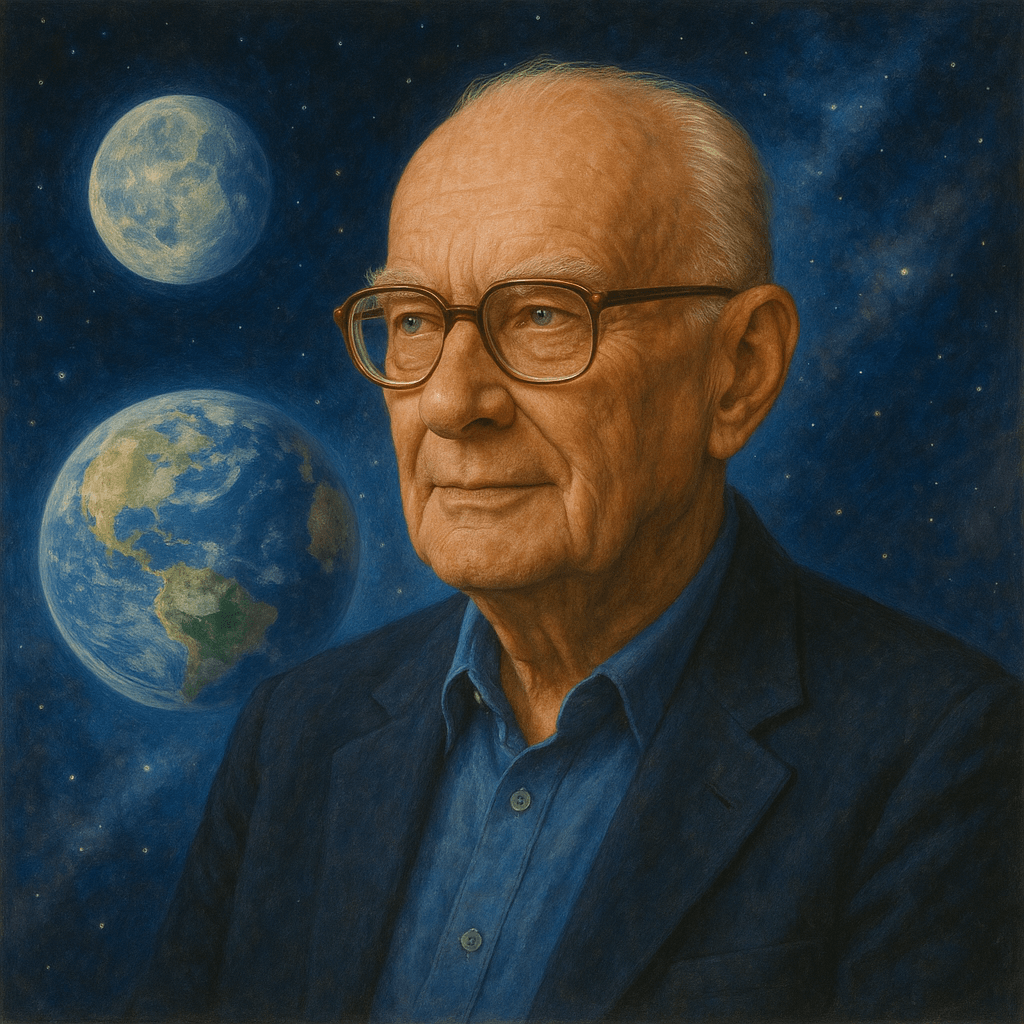
Arthur C. Clarke's legacy extends far beyond his contributions to science fiction literature. He was a true visionary who helped humanity imagine its future among the stars while never losing sight of the profound questions that define our existence. His quotes reveal a mind that was simultaneously scientific and poetic, skeptical and hopeful, grounded in reality yet always reaching for the impossible.
From his famous Three Laws to his profound observations about intelligence, technology, and the cosmos, Clarke challenged us to think bigger, dream bolder, and never stop questioning. His words continue to inspire scientists, writers, philosophers, and dreamers around the world. As we stand on the brink of becoming a truly spacefaring civilization - something Clarke predicted and advocated for throughout his life - his wisdom becomes ever more relevant.
Perhaps Clarke's greatest gift was his ability to make us see ourselves from a cosmic perspective, revealing both our insignificance in the vast universe and the tremendous potential we possess. He reminded us that while we may be alone in the universe, or perhaps surrounded by intelligence too advanced to notice us, our journey of discovery has only just begun. In the end, Arthur C. Clarke taught us that the most important frontiers are not just in space, but in the limitless reaches of human imagination and potential.
As he once said, "The only way of discovering the limits of the possible is to venture a little way past them into the impossible." This philosophy defined his life and work, and continues to light the way for all who dare to dream of tomorrow.
Explore Quote Collections

Books & Knowledge
Explore the best quotes about the power of reading, the magic of libraries, book collecting, literary wisdom, and the timeless bond between reader and author.

Friendship
Explore the best friendship quotes about true friends, loyalty, trust, betrayal, love, and lifelong bonds. Browse curated quote collections by theme.

Life
Explore the deepest questions of existence. A curated collection of quotes on the journey of life, the pursuit of wisdom, the beauty of struggle, and the acceptance of mortality.

Persistence & Progress
Discover the power of steady progress. Explore curated quotes on overcoming challenges, simplifying complex problems, staying focused, and the art of getting things done.
You Might Also Like


Patrick Wright
Software engineer and creator of Quotesperation. I curate wisdom from history's greatest minds to inspire and guide modern life. When I'm not collecting quotes, I'm writing about technology and finding connections between timeless wisdom and today's challenges.