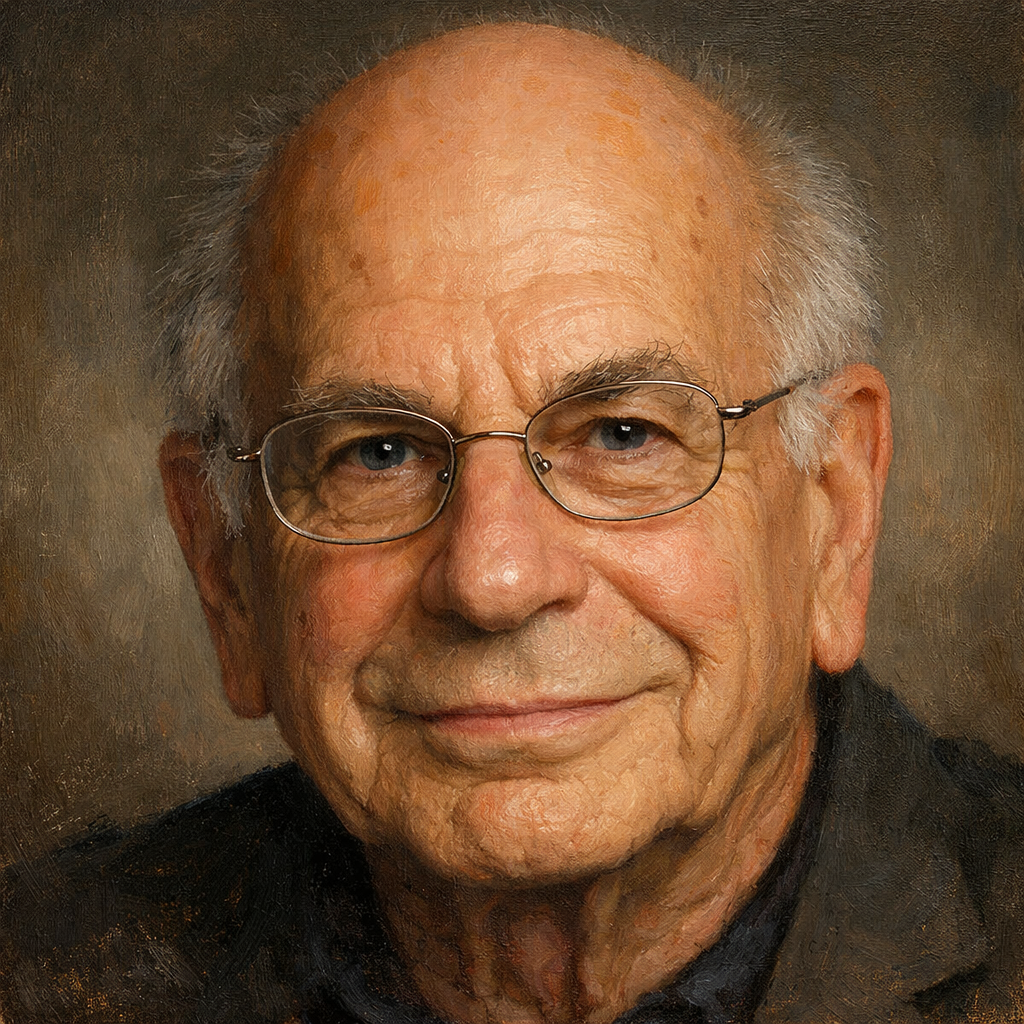
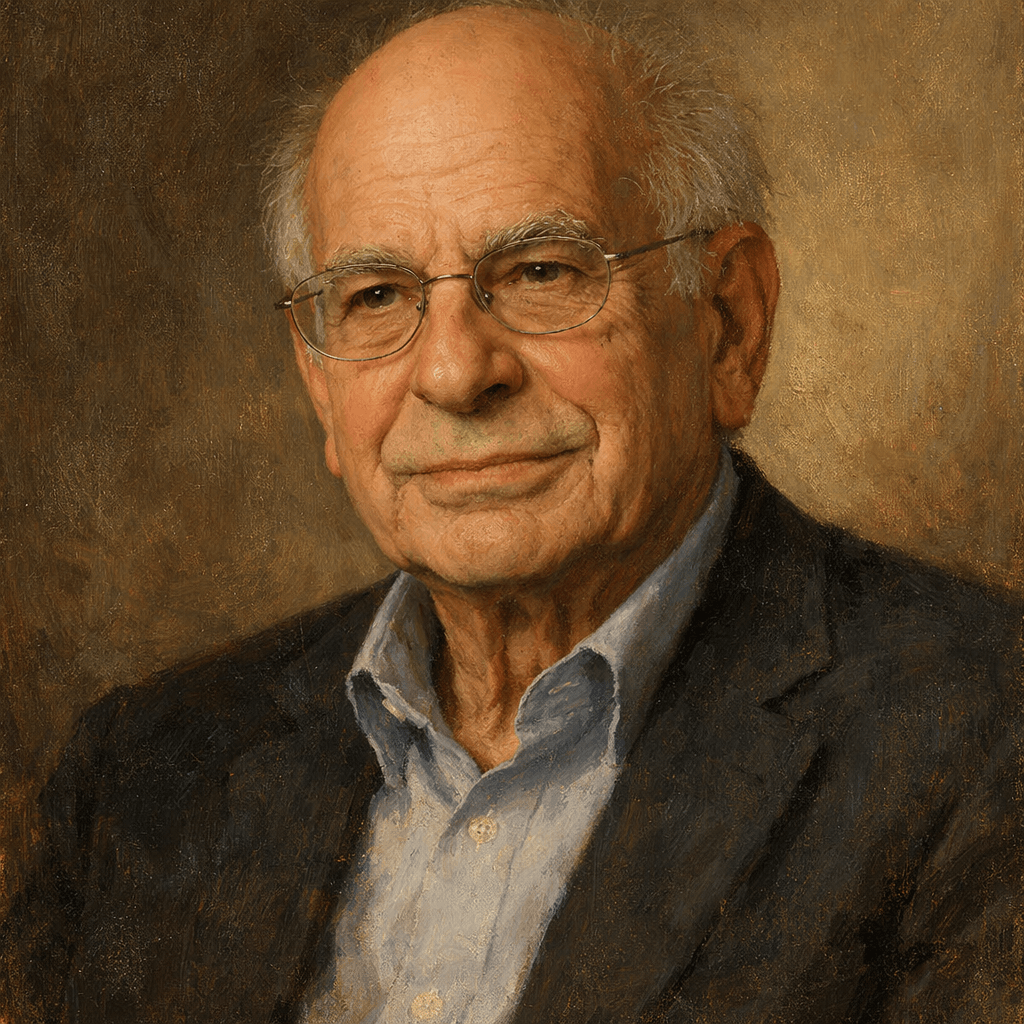
About Daniel Kahneman
Daniel Kahneman (March 5, 1934 – March 27, 2024) was an Israeli-American psychologist renowned for revolutionizing the understanding of human judgment, decision-making, and behavioral economics. A Nobel laureate and author of the seminal book Thinking, Fast and Slow (2011), he co-founded the field of behavioral economics alongside his late collaborator, Amos Tversky. Their groundbreaking work revealed systematic biases in human cognition, challenging the assumption of purely rational decision-making in economics and beyond.
Kahneman and Tversky’s most influential contributions include prospect theory, which explains how people evaluate gains and losses, and their exploration of cognitive heuristics—mental shortcuts that often lead to errors in judgment. These insights reshaped economics, finance, public policy, and even artificial intelligence, emphasizing the role of intuition, emotion, and context in decision-making. Kahneman’s later work, such as the “centrism bias” and the concept of “noise” in human judgment, further expanded the scope of behavioral science.
His legacy lies in transforming how societies understand and apply the science of decision-making. By bridging psychology and economics, Kahneman’s work underpins modern behavioral nudges in healthcare, finance, and governance. His ideas remain vital today, offering tools to improve personal choices, institutional policies, and global problem-solving in an increasingly complex world.
Daniel Kahneman, the Nobel Prize-winning psychologist and author of the groundbreaking Thinking, Fast and Slow, revolutionized our understanding of the human mind. His work bridges the gap between intuition and reason, uncovering the hidden forces that shape our choices, judgments, and happiness. A pioneer in behavioral economics, Kahneman’s insights into cognitive biases, decision-making, and human behavior have not only reshaped academic disciplines but also offered practical wisdom for navigating the complexities of everyday life.
This collection of 150 quotes distills his profound ideas into accessible, thought-provoking reflections on themes that define our lives. From the paradoxes of happiness and the pitfalls of overconfidence to the mysteries of memory and the power of social connections, each quote invites you to question assumptions, embrace uncertainty, and think more clearly. Whether you’re seeking clarity on economic decisions, a deeper understanding of your mind’s inner workings, or inspiration to lead with empathy, Kahneman’s words are a compass for living more mindfully in a world of noise and complexity. Prepare to be challenged, enlightened, and ultimately, transformed.
Table of Contents
- Happiness and Well-being
- Decision Making and Rationality
- Cognitive Biases and Illusions
- Memory and Experience
- Optimism and Overconfidence
- Attention and Mental Effort
- Economic Behavior
- Leadership and Influence
- Social Connections and Relationships
- Uncertainty and Risk
- Conclusion
Happiness and Well-being
Daniel Kahneman’s insights into happiness and well-being challenge conventional assumptions, emphasizing that contentment stems not from material wealth but from intangible factors like relationships, autonomy, and mental resilience. His research underscores the complexity of human satisfaction, revealing how subtle shifts in time, social interaction, and perception shape our emotional lives.
"Money does not buy you happiness, but lack of money certainly buys you misery." - Daniel Kahneman
"It's a wonderful thing to be optimistic. It keeps you healthy and it keeps you resilient." - Daniel Kahneman
"Happiness is determined by factors like your health, your family relationships and friendships, and above all by feeling that you are in control of how you spend your time." - Daniel Kahneman
Kahneman highlights that optimism and perceived control are foundational to well-being, while material deprivation often leads to dissatisfaction.
"You know, the standard state for people is 'mildly pleasant.'" - Daniel Kahneman
"Divorced women, compared to married women, are less satisfied with their lives, which is not surprising." - Daniel Kahneman
"People should be conscious of the large contribution made by anything that gets people together easily in the reduction of loneliness and emotional well-being." - Daniel Kahneman
His observations reveal how social bonds and stable relationships significantly buffer against loneliness and emotional distress.
"Below an income of ... $60,000 a year, people are unhappy, and they get progressively unhappier the poorer they get." - Daniel Kahneman
"The extra daily social time of 1.7 hours in weekends raises average happiness by about 2%." - Daniel Kahneman
"When people talk of the economy being strong, they don't seem to feel that they, too, are better off." - Daniel Kahneman
Kahneman’s data-driven approach shows that while income thresholds matter, small increases in social time yield measurable gains in happiness.
"It is only a slight exaggeration to say that happiness is the experience of spending time with people you love and who love you." - Daniel Kahneman
"People are really happier with friends than they are with their families or their spouse or their child." - Daniel Kahneman
"If you were allowed one wish for your child, seriously consider wishing him or her optimism." - Daniel Kahneman
Here, he reiterates that love, friendship, and optimism are pillars of enduring well-being.
"It's a wonderful thing to be optimistic. It keeps you healthy and it keeps you resilient." - Daniel Kahneman
Decision Making and Rationality
Daniel Kahneman’s work on decision-making and rationality reveals how cognitive biases and heuristics shape human judgment. His quotes dissect the interplay between intuition, logic, and the fallibility of human reasoning, offering insights into why people often deviate from ideal rationality.
"The only test of rationality is not whether a person's beliefs and preferences are reasonable, but whether they are internally consistent." - Daniel Kahneman
"When you pay attention to a threat, you worry—and the decision weights reflect how much you worry. Because of the possibility effect, the worry is not proportional to the probability of the threat." - Daniel Kahneman
"Jumping to conclusions is risky when the situation is unfamiliar, the stakes are high and there is no time to collect more information." - Daniel Kahneman
Kahneman highlights how internal consistency trumps external reasonableness in rationality, while also exposing the disproportionate fear triggered by improbable threats and the dangers of hasty judgments in high-stakes scenarios.
"Spend some effort in figuring out why each decision did or did not pan out." - Daniel Kahneman
"People who face a difficult question often answer an easier one instead, without realizing it." - Daniel Kahneman
"Economists think about what people ought to do. Psychologists watch what they actually do." - Daniel Kahneman
Kahneman underscores the importance of retrospective analysis in decision-making, contrasts the substitution of complex questions with simpler ones, and emphasizes the gap between theoretical ideals and human behavior.
"If individuals are rational, there is no need to protect them against their own choices." - Daniel Kahneman
"The planning fallacy is that you make a plan, which is usually a best-case scenario." - Daniel Kahneman
"A person who has not made peace with his losses is likely to accept gambles that would be unacceptable to him otherwise." - Daniel Kahneman
Kahneman critiques the assumption of rationality, warns against overoptimistic planning, and illustrates how unresolved losses distort risk tolerance.
"To better avoid errors, you should talk to people who disagree with you." - Daniel Kahneman
"If there is time to reflect, slowing down is likely to be a good idea." - Daniel Kahneman
"The effort invested in 'getting it right' should be commensurate with the importance of the decision." - Daniel Kahneman
Kahneman advocates for deliberate debate, strategic delay, and proportionality in effort to enhance decision quality.
"When people believe a conclusion is true, they are also very likely to believe arguments that appear to support it, even when these arguments are unsound." - Daniel Kahneman
"To know whether you can trust a particular intuitive judgment, there are two questions you should ask." - Daniel Kahneman
"Because adherence to standard operating procedures is difficult to second-guess, decision makers who expect to have their decisions scrutinized with hindsight are driven to bureaucratic solutions." - Daniel Kahneman
Kahneman dissects the dangers of confirmation bias, the need for critical evaluation of intuition, and the bureaucratic inertia born from fear of retrospective judgment.
Cognitive Biases and Illusions
Daniel Kahneman’s work on cognitive biases and illusions reveals how our minds construct narratives, often at the expense of reality. He exposed the mechanisms through which we misinterpret information, overestimate our understanding, and create comforting fictions to navigate uncertainty. These quotes distill his insights into the fragile architecture of human judgment.
"A reliable way to make people believe in falsehoods is frequent repetition, because familiarity is not easily distinguished from truth. Authoritarian institutions and marketers have always known this fact." - Daniel Kahneman
"The amount of evidence and its quality do not count for much, because poor evidence can make a very good story." - Daniel Kahneman
"An odd feature of what happened is that your System 1 treated the mere conjunction of two words as representations of reality." - Daniel Kahneman
Kahneman underscores how repetition and narrative coherence override factual rigor, shaping beliefs through familiarity rather than validity.
"Facts that challenge basic assumptions-and thereby threaten people's livelihood and self-esteem-are simply not absorbed. The mind does not digest them." - Daniel Kahneman
"One of the major biases in risky decision making is optimism. Optimism is a source of high-risk thinking." - Daniel Kahneman
"We are prone to overestimate how much we understand about the world and to underestimate the role of chance in events." - Daniel Kahneman
"If people can construct a simple and coherent story, they will feel confident regardless of how well grounded it is in reality." - Daniel Kahneman
Here, Kahneman links optimism, overconfidence, and the human tendency to favor narratives that simplify complexity—even when those stories ignore chance or contradict evidence.
"We can be blind to the obvious, and we are also blind to our blindness." - Daniel Kahneman
"The confidence people have in their beliefs is not a measure of the quality of evidence but of the coherence of the story the mind has managed to construct." - Daniel Kahneman
"The illusion that we understand the past fosters overconfidence in our ability to predict the future." - Daniel Kahneman
"Laziness is built deep into our nature." - Daniel Kahneman
These quotes reveal the paradox of human cognition: we are both creators and victims of our own illusions, unaware of our blind spots while mistaking coherence for truth.
"...flow - a state that some artists experience in their creative moments." - Daniel Kahneman
"We are far too willing to reject the belief that much of what we see in life is random." - Daniel Kahneman
"Not all illusions are visual. There are illusions of thought, which we call cognitive illusions." - Daniel Kahneman
"Overconfidence is a powerful source of illusions, primarily determined by the quality and coherence of the story that you can construct, not by its validity." - Daniel Kahneman
Kahneman contrasts the clarity of artistic flow with the pervasive cognitive illusions that distort our thinking, emphasizing how overconfidence thrives on narrative, not evidence.
Memory and Experience
Daniel Kahneman’s reflections on memory and experience reveal the intricate dance between lived moments and the stories we construct to preserve them. His work underscores how the "remembering self" shapes our identity, often distorting reality through peaks, endings, and narratives we crave. Below are his most profound quotes on this theme, capturing the paradox of how we live, recall, and reconstruct our lives.
"Memories are all we get to keep from our experience of living. The only perspective that we can adopt as we think about our lives is therefore that of the remembering self." - Daniel Kahneman
"We all care intensely for the narrative of our own life and very much want it to be a good story, with a decent hero." - Daniel Kahneman
"The 'Instagram Generation' now experiences the present as an anticipated memory." - Daniel Kahneman
These quotes highlight how our memories—and the narratives we build around them—become the only tangible remnants of our fleeting experiences.
"Often, the most enjoyable part of an activity is the anticipation." - Daniel Kahneman
"We don’t choose between experiences, we choose between memories of experiences." - Daniel Kahneman
"We think of our future as anticipated memories." - Daniel Kahneman
Here, Kahneman illustrates how anticipation and memory intertwine, shaping our decisions not just for the present but for how we imagine our future will be remembered.
"My impression is that the elimination of memories greatly reduces the value of the experience." - Daniel Kahneman
"We don't only tell stories when we set out to tell stories, our memory tells us stories." - Daniel Kahneman
"The remembering self’s neglect of duration, its exaggerated emphasis on peaks and ends, and its susceptibility to hindsight combine to yield distorted reflections of our actual experience." - Daniel Kahneman
This trio of quotes exposes the fragility of memory: it curates, edits, and distorts, often prioritizing emotional peaks over the full arc of time.
"Some memories come with a very compelling sense of truth about them." - Daniel Kahneman
"You build the best possible story from the information available to you, and if it is a good story, you believe it." - Daniel Kahneman
"We have associations to things. We have, you know, we have associations to tables and to - and to dogs and to cats and to Harvard professors, and that's the way the mind works. It’s an association machine." - Daniel Kahneman
These insights reveal how memory is not just a repository of facts but a storytelling engine that binds fragments into coherent—yet often flawed—truths.
"We’re not aware of changing our minds even when we do change our minds." - Daniel Kahneman
This final quote underscores the insidious nature of memory: it reshapes our beliefs without our conscious awareness, blurring the line between experience and the narrative we inherit.
Optimism and Overconfidence
Daniel Kahneman’s work on optimism and overconfidence reveals a paradox: while optimism fuels resilience and ambition, it often distorts judgment and fuels reckless decision-making. His quotes dissect the psychological mechanisms behind these traits, highlighting how they shape everything from personal relationships to global forecasting. Below are his most compelling insights on this theme.
"The main benefit of optimism is resilience in the face of setback." - Daniel Kahneman
"One of the major biases in risky decision making is optimism. Optimism is a source of high-risk thinking." - Daniel Kahneman
"Suppose you like someone very much. Then, by a familiar halo effect, you will also be prone to believe many good things about that person." - Daniel Kahneman
Kahneman frames optimism as both a protective force and a cognitive hazard, illustrating how emotional attachment can amplify its blind spots.
"Most successful pundits are selected for being opinionated, because it's interesting, and the penalties for incorrect predictions are negligible." - Daniel Kahneman
"The amount of success it takes for leaders to become overconfident isn't terribly large." - Daniel Kahneman
"The dominance of conclusions over arguments is most pronounced where emotions are involved." - Daniel Kahneman
"The effects of high optimism on decision making are, at best, a mixed blessing." - Daniel Kahneman
These quotes underscore how overconfidence thrives in domains where feedback is delayed or absent, from political forecasting to corporate leadership.
"We know that people can maintain an unshakable faith in any proposition, however absurd, when they are sustained by a community of like-minded believers." - Daniel Kahneman
"Overconfidence is a powerful source of illusions, primarily determined by the quality and coherence of the story that you can construct, not by its validity." - Daniel Kahneman
"People exaggerate their confidence in their plans - something we call the planning fallacy." - Daniel Kahneman
"Most people are highly optimistic most of the time." - Daniel Kahneman
Kahneman’s final reflections reveal the societal and psychological roots of overconfidence—how narratives, groupthink, and the inherent optimism of human nature perpetuate flawed certainty.
Attention and Mental Effort
Daniel Kahneman’s exploration of attention and mental effort reveals the finite nature of our cognitive resources and the stark contrast between intuitive and deliberate thinking. His quotes illuminate how our minds allocate focus, the toll of self-control, and the rarity of sustained mental labor in a world dominated by automatic processes.
"The often-used phrase ‘pay attention’ is apt: you dispose of a limited budget of attention that you can allocate to activities, and if you try to go beyond your budget, you will fail." - Daniel Kahneman
"Conscious doubt is not in the repertoire of System 1; it requires maintaining incompatible interpretations in mind at the same time, which demands mental effort." - Daniel Kahneman
"The conclusion is straightforward: self-control requires attention and effort." - Daniel Kahneman
These quotes underscore the constrained nature of attention and the inherent difficulty of resisting impulses or doubts without deliberate mental exertion.
"Mental effort, I would argue, is relatively rare. Most of the time we coast." - Daniel Kahneman
"Slow thinking has the feeling of something you do. It's deliberate." - Daniel Kahneman
"During a mental multiplication, the pupil normally dilated to a large size within a few seconds and stayed large as long as the individual kept working on the problem." - Daniel Kahneman
"Fast thinking includes both variants of intuitive thought – the expert and the heuristic." - Daniel Kahneman
Kahneman contrasts the rarity of sustained mental effort with the automaticity of fast thinking, emphasizing how most of our decisions are driven by subconscious heuristics rather than conscious reasoning.
Economic Behavior
Daniel Kahneman’s insights into economic behavior challenge the notion of purely rational decision-making, revealing how cognitive biases, heuristics, and overconfidence shape financial choices. His work underscores the gap between theoretical economics and real-world human behavior, emphasizing the role of perception, emotion, and flawed reasoning in markets and everyday life.
"Nothing in life is as important as you think it is when you are thinking about it." - Daniel Kahneman
"The world makes much less sense than you think. The coherence comes mostly from the way your mind works." - Daniel Kahneman
"We have in our head a remarkably powerful computer, not vast by conventional hardware standards, but able to represent the structure of our world by various types of associative links in a vast network of various types of ideas." - Daniel Kahneman
Kahneman’s early quotes highlight the fallibility of human cognition, which directly impacts economic behavior—our tendency to overestimate importance, misinterpret patterns, and construct narratives often leads to irrational financial decisions.
"There are domains in which expertise is not possible. Stock picking is a good example." - Daniel Kahneman
"If owning stocks is a long-term project for you, following their changes constantly is a very, very bad idea." - Daniel Kahneman
"An investment said to have an 80% chance of success sounds far more attractive than one with a 20% chance of failure." - Daniel Kahneman
These quotes dismantle common assumptions about market expertise and investor behavior. Kahneman argues that overconfidence in predicting outcomes and the framing of risks distort choices, revealing how psychological biases undermine rational economic models.
"Although professionals are able to extract a considerable amount of wealth from amateurs, few stock pickers, if any, have the skill needed to beat the market consistently, year after year." - Daniel Kahneman
"The evidence is unequivocal, there's a great deal more luck than skill in people getting very rich." - Daniel Kahneman
Kahneman’s skepticism of financial expertise underscores the role of randomness in economic success. His critique of market efficiency and the illusion of control exposes the limitations of traditional economic theories.
"First, people are generally rational, and their thinking is normally sound." - Daniel Kahneman
"Most things that couples disagree upon aren't worth more than a day's combat." - Daniel Kahneman
While these quotes appear divergent, they collectively reflect Kahneman’s broader philosophy: humans are fundamentally rational beings, yet our judgments are prone to error—whether in markets, relationships, or life. The final quote serves as a reminder that not all conflicts, even in personal economics, demand disproportionate effort.
Leadership and Influence
Daniel Kahneman’s insights into human behavior and decision-making reveal how biases, perceptions, and cognitive shortcuts shape leadership and influence. His quotes dissect the interplay between authority, social dynamics, and irrationality, offering a lens to understand why certain leaders rise and how influence can be both constructed and manipulated.
"People like leaders who look like they are dominant, optimistic, friendly to their friends, and quick on the trigger when it comes to enemies." - Daniel Kahneman
"If there was one ubiquitous recommendation about marriage it was this: 'Don't go to bed angry.'" - Daniel Kahneman
"Employers who violate rules of fairness are punished by reduced productivity." - Daniel Kahneman
Kahneman’s early observations highlight how social and organizational dynamics favor leaders with specific traits, while also underscoring the role of fairness in sustaining productivity.
"Banks are run by executives, and executives protect themselves." - Daniel Kahneman
"Political columnists and sports pundits are rewarded for being overconfident." - Daniel Kahneman
"An executive might have a very strong intuition that a given product has promise, without considering the probability that a rival is already ahead in developing the same product." - Daniel Kahneman
Here, Kahneman critiques institutional self-preservation and the societal reinforcement of overconfidence, which often clouds rational decision-making in competitive environments.
"We associate leadership with decisiveness. That perception of leadership pushes people to make decisions fairly quickly." - Daniel Kahneman
"Nobody would say, ‘I’m voting for this guy because he’s got the stronger chin,’ but that, in fact, is partly what happens." - Daniel Kahneman
"The brain scientists are the wave of the future in the financial world." - Daniel Kahneman
Kahneman’s final trio of quotes underscores the myth of decisiveness as a leadership virtue, the subconscious weight of physical cues in influence, and the growing intersection of neuroscience and economic decision-making.
Social Connections and Relationships
In Daniel Kahneman’s exploration of human behavior, he often highlights how social connections and relationships shape our perceptions of success, happiness, and fairness. His insights into the dynamics between individuals and groups reveal the complexities of human interaction and the psychological underpinnings of our social bonds.
"When people evaluate their life, they compare themselves to a standard of what a successful life is." - Daniel Kahneman
"Employers who violate rules of fairness are punished by reduced productivity." - Daniel Kahneman
"Friends are sometimes a big help when they share your feelings." - Daniel Kahneman
These quotes underscore how self-evaluation, workplace fairness, and emotional solidarity with friends interweave to shape social dynamics.
"If you can't take the time for a vacation right now, or even a night out with friends, put something on the calendar." - Daniel Kahneman
"People are really happier with friends than they are with their families or their spouse or their child." - Daniel Kahneman
"Stories of how businesses rise and fall strike a chord with readers by offering what the human mind needs." - Daniel Kahneman
"Most things that couples disagree upon aren't worth more than a day's combat." - Daniel Kahneman
Kahneman’s emphasis on prioritizing social time, the emotional resonance of friendships, and the value of storytelling or compromise reflects his belief in the practical and psychological importance of nurturing relationships.
Uncertainty and Risk
In his exploration of human judgment, Daniel Kahneman reveals how uncertainty and risk shape our decisions, often leading to predictable errors in thinking. His insights challenge our assumptions about expertise, rationality, and the narratives we construct to explain the world.
"The idea that the future is unpredictable is undermined every day by the ease with which the past is explained." - Daniel Kahneman
"A compelling narrative fosters an illusion of inevitability." - Daniel Kahneman
"Emotional learning may be quick, but what we consider as 'expertise' usually takes a long time to develop." - Daniel Kahneman
These quotes underscore Kahneman’s critique of hindsight bias and the overconfidence in narratives that simplify complex events.
"The concept of loss aversion is certainly the most significant contribution of psychology to behavioral economics." - Daniel Kahneman
"Courage is willingness to take the risk once you know the odds." - Daniel Kahneman
Kahneman’s focus on loss aversion and the psychology of risk highlights how human emotions distort rational decision-making in uncertain scenarios.
"Survival prospects are poor for an animal that is not suspicious of novelty." - Daniel Kahneman
"An unbiased appreciation of uncertainty is a cornerstone of rationality – but it is not what people and organizations want." - Daniel Kahneman
Here, Kahneman contrasts evolutionary instincts with modern organizational behavior, revealing a tension between biological caution and systemic denial of uncertainty.
"Intuitive diagnosis is reliable when people have a lot of relevant feedback." - Daniel Kahneman
This final quote emphasizes Kahneman’s nuanced view of expertise, where intuition thrives only in environments rich with feedback and predictable patterns.
Additional Quotes
"Most important, of course, we all care intensely for the narrative of our own life and very much want it to be a good story, with a decent hero." - Daniel Kahneman
"Memories are all we get to keep from our experience of living. The only perspective that we can adopt as we think about our lives is therefore that of the remembering self." - Daniel Kahneman
"Nothing in life is as important as you think it is when you are thinking about it." - Daniel Kahneman
"Many parents have discovered, perhaps with some guilt, that they can read a story to a child while thinking of something else." - Daniel Kahneman
"Odd as it may seem, I am my remembering self, and the experiencing self, who does my living, is like a stranger to me." - Daniel Kahneman
"Some experimenters have reported that an angry face “pops out” of a crowd of happy faces, but a single happy face does not stand out in an angry crowd. The brains of humans and other animals contain a mechanism that is designed to give priority to bad news." - Daniel Kahneman
"We have inherited from our ancestors a great facility to learn when to be afraid. Indeed, one experience is often sufficient to establish a long term aversion and fear." - Daniel Kahneman
"Freedom has a cost, which is borne by individuals who make bad choices, and by a society that feels obligated to help them." - Daniel Kahneman
"A reliable way to make people believe in falsehoods is frequent repetition, because familiarity is not easily distinguished from truth. Authoritarian institutions and marketers have always known this fact." - Daniel Kahneman
"The expectation of intelligent gossip is a powerful motive for serious self-criticism, more powerful than New Year resolutions to improve one's decision making at work and at home." - Daniel Kahneman
"The world makes much less sense than you think. The coherence comes mostly from the way your mind works." - Daniel Kahneman
"...the characters are useful because of some quirks of our minds, yours and mine. A sentence is understood more easily if it describes what an agent (system 2) does than if it describes what something is, what properties it has." - Daniel Kahneman
"The only test of rationality is not whether a person's beliefs and preferences are reasonable, but whether they are internally consistent." - Daniel Kahneman
"Ultimately, a richer language is essential to the skill of constructive criticism." - Daniel Kahneman
"The experience of familiarity has a simple but powerful quality of ‘pastness’ that seems to indicate that it is a direct reflection of prior experience’. This quality of pastness is an illusion." - Daniel Kahneman
"The main benefit of optimism is resilience in the face of setback." - Daniel Kahneman
"The pleasure we found in working together made us exceptionally patient; it is much easier to strive for perfection when you are never bored." - Daniel Kahneman
"We all care intensely for the narrative of our own life and very much want it to be a good story, with a decent hero." - Daniel Kahneman
"There's a lot of randomness in the decisions that people make." - Daniel Kahneman
"Nothing in life is as important as you think it is when you are thinking of it." - Daniel Kahneman
"When you pay attention to a threat, you worry—and the decision weights reflect how much you worry. Because of the possibility effect, the worry is not proportional to the probability of the threat. Reducing or mitigating the risk is not adequate; to eliminate the worry the probability must be broughtdown to zero." - Daniel Kahneman
"However, attention can be moved away from an unwanted focus, primarily by focusing intently on another target." - Daniel Kahneman
"The 'Instagram Generation' now experiences the present as an anticipated memory." - Daniel Kahneman
"Many unfortunate human situations unfold . . . where people who face bad options take desperate gambles, accepting a high probability of making things worse in exchange for a small hope of avoiding a large loss. The thought of accepting the large sure loss is too painful, and the hope of complete relief is too enticing, to make the sensible decision that it is time to cut one's losses." - Daniel Kahneman
"Jumping to conclusions is efficient if the conclusions are likely to be correct and the costs of an occasional mistake acceptable. Jumping to conclusions is risky when the situation is unfamiliar, the stakes are high and there is no time to collect more information." - Daniel Kahneman
"The often-used phrase “pay attention” is apt: you dispose of a limited budget of attention that you can allocate to activities, and if you try to you try to go beyond your budget, you will fail." - Daniel Kahneman
"We all have our genre. Some people live a tragedy, others inhabit a never-ending religious drama, some approach life as if it were an action film, and not a few act as if in a comedy. But in the end, they are all just stories." - Daniel Kahneman
"We have in our head a remarkably powerful computer, not vast by conventional hardware standards, but able to represent the structure of our world by various types of associative links in a vast network of various types of ideas." - Daniel Kahneman
"The amount of evidence and its quality do not count for much, because poor evidence can make a very good story. For some of our most important beliefs we have no evidence at all, except that people we love and trust hold these beliefs. Considering how little we know, the confidence we have in our beliefs is preposterous - and it is also essential." - Daniel Kahneman
"...flow - a state that some artists experience in their creative moments and that many other people achieve when enthralled by a film, a book, or a crossword puzzle; interruptions are not welcome in any of these situations." - Daniel Kahneman
"Conscious doubt is not in the repertoire of System 1; it requires maintaining incompatible interpretations in mind at the same time, which demands mental effort. Uncertainty and doubt are the domain of System 2." - Daniel Kahneman
"It is useful to remember, however, that neglecting valid stereotypes inevitably results in suboptimal judgments. Resistance to stereotyping is a laudable moral position, but the simplistic idea that the resistance is costles is wrong. The costs are worth paying to achieve a better society, but denying that the costs exist, while satisfying to the soul and politically correct, is no scientifically defensible." - Daniel Kahneman
"The idea that the future is unpredictable is undermined every day by the ease with which the past is explained." - Daniel Kahneman
"When something cement does not fit into the current context of activated ideas, the system detects an abnormality, as you just experienced. You had no particular idea of what was coming after something, but you knew when the word cement came that it was abnormal in that sentence. Studies of brain responses have shown that violations of normality are detected with astonishing speed and subtlety." - Daniel Kahneman
"A compelling narrative fosters an illusion of inevitability." - Daniel Kahneman
"the brain is a machine for jumping to conclusions" - Daniel Kahneman
"Emotional learning may be quick, but what we consider as “expertise” usually takes a long time to develop." - Daniel Kahneman
"It is easier to change directions in a crisis, but this was not a crisis." - Daniel Kahneman
"An odd feature of what happened is that your System 1 treated the mere conjunction of two words as representations of reality. Your body acted in an attenuated replica of reaction to the real thing, and the emotional response and physical recoil were part of the interpretation of the event. As cognitive scientists have emphasised in recent years, cognition is embodied; you think with your body, not only with your brain." - Daniel Kahneman
"Everyone has some awareness of the limited capacity of attention, and our social behaviour makes allowances for these limitations" - Daniel Kahneman
"An inconsistency is built into the design of our mind." - Daniel Kahneman
"Experienced radiologists who evaluate chest X-rays as “normal” or “abnormal” contradict themselves 20% of the time when they see the same picture on separate occasions" - Daniel Kahneman
"You are more likely to learn something by finding surprises in your own behavior than by hearing surprising facts about people in general." - Daniel Kahneman
"Everything makes sense in hindsight." - Daniel Kahneman
"We know that people can maintain an unshakable faith in any proposition, however absurd, when they are sustained by a community of like-minded believers" - Daniel Kahneman
"Statistical results with a causal interpretation have a stronger effect on our thinking than non-causal information. But even compelling causal statistics will not change long-held beliefs or beliefs rooted in personal experience." - Daniel Kahneman
"The primed ideas have some ability to prime other ideas, although more weakly. Like ripples on a pond, activation spreads through a small part of the vast network of associated ideas." - Daniel Kahneman
"I can best describe our state as a form of lethargy- an unwillingness to think about what had happened. So we carried on." - Daniel Kahneman
"Correcting your predictions may complicate your life" - Daniel Kahneman
"Nothing in life is as important as you think it is, while you are thinking about it" - Daniel Kahneman
"Most importantly, of course, we all care intensely for the narrative of our own life and very much want it to be a good story, with a decent hero." - Daniel Kahneman
"Facts that challenge basic assumptions-and thereby threaten people's livelihood and self-esteem-are simply not absorbed. The mind does not digest them." - Daniel Kahneman
"It's a wonderful thing to be optimistic. It keeps you healthy and it keeps you resilient." - Daniel Kahneman
"One of the major biases in risky decision making is optimism. Optimism is a source of high-risk thinking." - Daniel Kahneman
"I have always emphasized the willingness to discard." - Daniel Kahneman
"Often, the most enjoyable part of an activity is the anticipation." - Daniel Kahneman
"People's mood is really determined primarily by their genetic make-up and personality, and in the second place by their immediate context, and only in the third and fourth place by worries and concerns and other things like that." - Daniel Kahneman
"In essence, the optimistic style involves taking credit for successes but little blame for failures." - Daniel Kahneman
"People like leaders who look like they are dominant, optimistic, friendly to their friends, and quick on the trigger when it comes to enemies. They like boldness and despise the appearance of timidity and protracted doubt." - Daniel Kahneman
"We are prone to overestimate how much we understand about the world and to underestimate the role of chance in events." - Daniel Kahneman
"Optimism is normal, but some fortunate people are more optimistic than the rest of us. If you are genetically endowed with an optimistic bias, you hardly need to be told that you are a lucky person - you already feel fortunate." - Daniel Kahneman
"Negotiations over a shrinking pie are especially difficult because they require an allocation of losses. People tend to be much more easygoing when they bargain over an expanding pie." - Daniel Kahneman
"In strategic decisions, I'd be really concerned about overconfidence." - Daniel Kahneman
"Intuitive diagnosis is reliable when people have a lot of relevant feedback. But people are very often willing to make intuitive diagnoses even when they're very likely to be wrong." - Daniel Kahneman
"Most people are highly optimistic most of the time." - Daniel Kahneman
"Friends are sometimes a big help when they share your feelings. In the context of decisions, the friends who will serve you best are those who understand your feelings but are not overly impressed by them." - Daniel Kahneman
"We think, each of us, that we're much more rational than we are. And we think that we make our decisions because we have good reasons to make them. Even when it's the other way around. We believe in the reasons, because we've already made the decision." - Daniel Kahneman
"One of the problems with expertise is that people have it in some domains and not in others." - Daniel Kahneman
"There is a huge wave of interest in happiness among researchers. There is a lot of happiness coaching. Everybody would like to make people happier." - Daniel Kahneman
"One thing we have lost, that we had in the past, is a sense of progress, that things are getting better. There is a sense of volatility, but not of progress." - Daniel Kahneman
"Spend some effort in figuring out why each decision did or did not pan out. Doing that systematically is key: really try to question the way you make decisions, and improve it." - Daniel Kahneman
"If people can construct a simple and coherent story, they will feel confident regardless of how well grounded it is in reality." - Daniel Kahneman
"The idea that you can ask one question and it makes the point - well, that wasn't how psychology was done at the time." - Daniel Kahneman
"Policy makers, like most people, normally feel that they already know all the psychology and all the sociology they are likely to need for their decisions. I don't think they are right, but that's the way it is." - Daniel Kahneman
"Mind is a machine for jumping to conclusions" - Daniel Kahneman
"If people do not know what is going to make them better off or give them pleasure, then the idea that you can trust people to do what will give them pleasure becomes questionable." - Daniel Kahneman
"You're surprised by something, but you don't really know what surprised you; you recognize someone, but you don't really know what cues cause you to recognize that person." - Daniel Kahneman
"The 'Instagram Generation' now experiences the present as an anticipated memory" - Daniel Kahneman
"I think one of the major results of the psychology of decision making is that people's attitudes and feelings about losses and gains are really not symmetric. So we really feel more pain when we lose $10,000 than we feel pleasure when we get $10,000." - Daniel Kahneman
"All of us roughly know what memory is. I mean, memory is sort of the storage of the past. It's the storage of our personal experiences. It's a very big deal." - Daniel Kahneman
"I would be wary of experts' intuition, except when they deal with something that they have dealt with a lot in the past." - Daniel Kahneman
"Happiness is determined by factors like your health, your family relationships and friendships, and above all by feeling that you are in control of how you spend your time." - Daniel Kahneman
"It's clear that policymakers and economists are going to be interested in the measurement of well-being primarily as it correlates with health; they also want to know whether researchers can validate subjective responses with physiological indices." - Daniel Kahneman
"We don’t choose between experiences, we choose between memories of experiences. Even when we think about the future, we don’t think of our future normally as experiences. We think of our future as anticipated memories." - Daniel Kahneman
"Nobody would say, 'I'm voting for this guy because he's got the stronger chin,' but that, in fact, is partly what happens." - Daniel Kahneman
"Ten minutes of a smartphone in front of your nose is about the equivalent of an hour long walk in bright daylight. Imagine going for an hour long walk in bright daylight and then thinking, "Now I'll get some sleep." It ain't going to happen." - Daniel Kahneman
"Our memory tells us stories, that is, what we get to keep from our experiences is a story." - Daniel Kahneman
"It is the consistency of the information that matters for a good story, not its completeness. Indeed, you will often find that knowing little makes it easier to fit everything you know into a coherent pattern." - Daniel Kahneman
"The extra daily social time of 1.7 hours in weekends raises average happiness by about 2%." - Daniel Kahneman
"We can be blind to the obvious, and we are also blind to our blindness." - Daniel Kahneman
"There are domains in which expertise is not possible. Stock picking is a good example. And in long-term political strategic forecasting, it's been shown that experts are just not better than a dice-throwing monkey." - Daniel Kahneman
"If there was one ubiquitous recommendation about marriage it was this: "Don't go to bed angry."" - Daniel Kahneman
"That's one of the real dangers of leader selection in many organizations: leaders are selected for overconfidence." - Daniel Kahneman
"When people evaluate their life, they compare themselves to a standard of what a successful life is, and it turns out that standard tends to be universal: People in Togo and Denmark have the same idea of what a good life is, and a lot of that has to do with money and material prosperity." - Daniel Kahneman
"A large portion of the weekend effects is explained by differences in the amount of time spent with friends or family between weekends and weekdays." - Daniel Kahneman
"The confidence people have in their beliefs is not a measure of the quality of evidence but of the coherence of the story the mind has managed to construct." - Daniel Kahneman
"If you can't take the time for a vacation right now, or even a night out with friends, put something on the calendar - even if it's a month or a year down the road. Then whenever you need a boost of happiness, remind yourself about it." - Daniel Kahneman
"Nothing in life is quite as important as you think it is while you're thinking about it." - Daniel Kahneman
"Every night for the next week, set aside ten minutes before you go to sleep. Write down three things that went well today and why they went well...Writing about why the positive events in your life happened may seem awkward at first, but please stick with it for one week. It will get easier. The odds are that you will be less depressed, happier, and addicted to this exercise six months from now." - Daniel Kahneman
"We're generally overconfident in our opinions and our impressions and judgments." - Daniel Kahneman
"One study found that people who just thought about watching their favorite movie actually raised their endorphin levels by 27 percent." - Daniel Kahneman
"If people are failing, they look inept. If people are succeeding, they look strong and good and competent. That's the 'halo effect.' Your first impression of a thing sets up your subsequent beliefs. If the company looks inept to you, you may assume everything else they do is inept." - Daniel Kahneman
"Each additional day together is a gift. The end of the day means the end of hostilities, the recognition that the underlying shared values and commitment to the relationship trump the need for one last dig or self-righteous justification." - Daniel Kahneman
"There is research on the effects of 9/11, and you know, compared to the enormity of it, it didn't have a huge effect on people's mood. They were going about their business, mostly." - Daniel Kahneman
"Optimistic people play a disproportionate role in shaping our lives. Their decisions make a difference; they are inventors, entrepreneurs, political and military leaders - not average people. They got to where they are by seeking challenges and taking risks." - Daniel Kahneman
"Most things that couples disagree upon aren't worth more than a day's combat..." - Daniel Kahneman
"Experienced happiness refers to your feelings, to how happy you are as you live your life. In contrast, the satisfaction of the remembering self refers to your feelings when you think about your life." - Daniel Kahneman
"Establish a closing ritual. Know when to stop working. Try to end each work day the same way, too. Straighten up your desk. Back up your computer. Make a list of what you need to do tomorrow." - Daniel Kahneman
"We're blind to our blindness. We have very little idea of how little we know. We're not designed to know how little we know." - Daniel Kahneman
"We're not aware of changing our minds even when we do change our minds. And most people, after they change their minds, reconstruct their past opinion - they believe they always thought that." - Daniel Kahneman
"By their very nature, heuristic shortcuts will produce biases, and that is true for both humans and artificial intelligence, but the heuristics of AI are not necessarily the human ones." - Daniel Kahneman
"A plan is only a scenario, and almost by definition, it is optimistic... As a result, scenario planning can lead to a serious underestimate of the risk of failure." - Daniel Kahneman
"It's nonsense to say money doesn't buy happiness, but people exaggerate the extent to which more money can buy more happiness." - Daniel Kahneman
"People assign much higher probability to the truth of their opinions than is warranted." - Daniel Kahneman
"After a crisis we tell ourselves we understand why it happened and maintain the illusion that the world is understandable. In fact, we should accept the world is incomprehensible much of the time." - Daniel Kahneman
"The easiest way to increase happiness is to control your use of time." - Daniel Kahneman
"If owning stocks is a long-term project for you, following their changes constantly is a very, very bad idea. It's the worst possible thing you can do, because people are so sensitive to short-term losses. If you count your money every day, you'll be miserable." - Daniel Kahneman
"The brain scientists are the wave of the future in the financial world. If you seek to maximize understanding, whether you're in academia or in the investment community, you'd better pay serious attention to them." - Daniel Kahneman
"You know, the standard state for people is 'mildly pleasant.' Negative emotions are quite rare, and extremely positive emotions are rare. But people are mildly pleased most of the time, they're mildly tired a lot of the time, and they wish they were somewhere else a substantial part of the time - but mostly they're mildly pleased." - Daniel Kahneman
"Divorced women, compared to married women, are less satisfied with their lives, which is not surprising. But they're actually more cheerful, when you look at the average mood they're in in the course of the day." - Daniel Kahneman
"People exaggerate their confidence in their plans - something we call the planning fallacy... The existence of the plan tends to induce overconfidence." - Daniel Kahneman
"Economists think about what people ought to do. Psychologists watch what they actually do." - Daniel Kahneman
"Intelligence is not only the ability to reason; it is also the ability to find relevant material in memory and to deploy attention when needed." - Daniel Kahneman
"Suppose you like someone very much. Then, by a familiar halo effect, you will also be prone to believe many good things about that person - you will be biased in their favor. Most of us like ourselves very much, and that suffices to explain self-assessments that are biased in a particular direction." - Daniel Kahneman
"The concept of loss aversion is certainly the most significant contribution of psychology to behavioral economics." - Daniel Kahneman
"We are very influenced by completely automatic things that we have no control over, and we don't know we're doing it." - Daniel Kahneman
"When action is needed, optimism, even of the mildly delusional variety, may be a good thing." - Daniel Kahneman
"So your emotional state really has a lot to do with what you're thinking about and what you're paying attention to." - Daniel Kahneman
"We are often confident even when we are wrong, and an objective observer is more likely to detect our errors than we are." - Daniel Kahneman
"People should be conscious of the large contribution made by anything that gets people together easily in the reduction of loneliness and emotional well-being." - Daniel Kahneman
"If you care about being thought credible and intelligent, do not use complex language where simpler language will do." - Daniel Kahneman
"If individuals are rational, there is no need to protect them against their own choices." - Daniel Kahneman
"However, optimism is highly valued, socially and in the market; people and firms reward the providers of dangerously misleading information more than they reward truth tellers. One of the lessons of the financial crisis that led to the Great Recession is that there are periods in which competition, among experts and among organizations, creates powerful forces that favor a collective blindness to risk and uncertainty." - Daniel Kahneman
"It's very easy for trusted companies to mislead naive customers, and life insurance companies are trusted." - Daniel Kahneman
"The most effortful forms of slow thinking are those that require you to think fast." - Daniel Kahneman
"Alternative descriptions of the same reality evoke different emotions and different associations." - Daniel Kahneman
"The illusion that we understand the past fosters overconfidence in our ability to predict the future." - Daniel Kahneman
"Most successful pundits are selected for being opinionated, because it's interesting, and the penalties for incorrect predictions are negligible. You can make predictions, and a year later people won't remember them." - Daniel Kahneman
"The confidence that individuals have in their beliefs depends mostly on the quality of the story they can tell about what they see, even if they see little." - Daniel Kahneman
"The planning fallacy is that you make a plan, which is usually a best-case scenario. Then you assume that the outcome will follow your plan, even when you should know better." - Daniel Kahneman
"A person who has not made peace with his losses is likely to accept gambles that would be unacceptable to him otherwise." - Daniel Kahneman
"If you're going to be unreligious, it's likely going to be due to reflecting on it and finding some things that are hard to believe." - Daniel Kahneman
"Knowing the importance of luck, you should be particularly suspicious when highly consistent patterns emerge from the comparison of successful and less successful firms. In the presence of randomness, regular patterns can only be mirages." - Daniel Kahneman
"Most of the time, we think fast. And most of the time we're really expert at what we're doing, and most of the time, what we do is right." - Daniel Kahneman
"An investment said to have an 80% chance of success sounds far more attractive than one with a 20% chance of failure. The mind can't easily recognize that they are the same." - Daniel Kahneman
"You should expect little or nothing from Wall Street stock pickers who hope to be more accurate than the market in predicting the future of prices. And you should not expect much from pundits making long-term forecasts." - Daniel Kahneman
"It's very difficult to distinguish between what a person believes and what they say they believe." - Daniel Kahneman
"Finally, the illusions of validity and skill are supported by a powerful professional culture. We know that people can maintain an unshakeable faith in any proposition, however absurd, when they are sustained by a community of like-minded believers. Given the professional culture of the financial community, it is not surprising that large numbers of individuals in that world believe themselves to be among the chosen few who can do what they believe others cannot." - Daniel Kahneman
"True intuitive expertise is learned from prolonged experience with good feedback on mistakes." - Daniel Kahneman
Conclusion
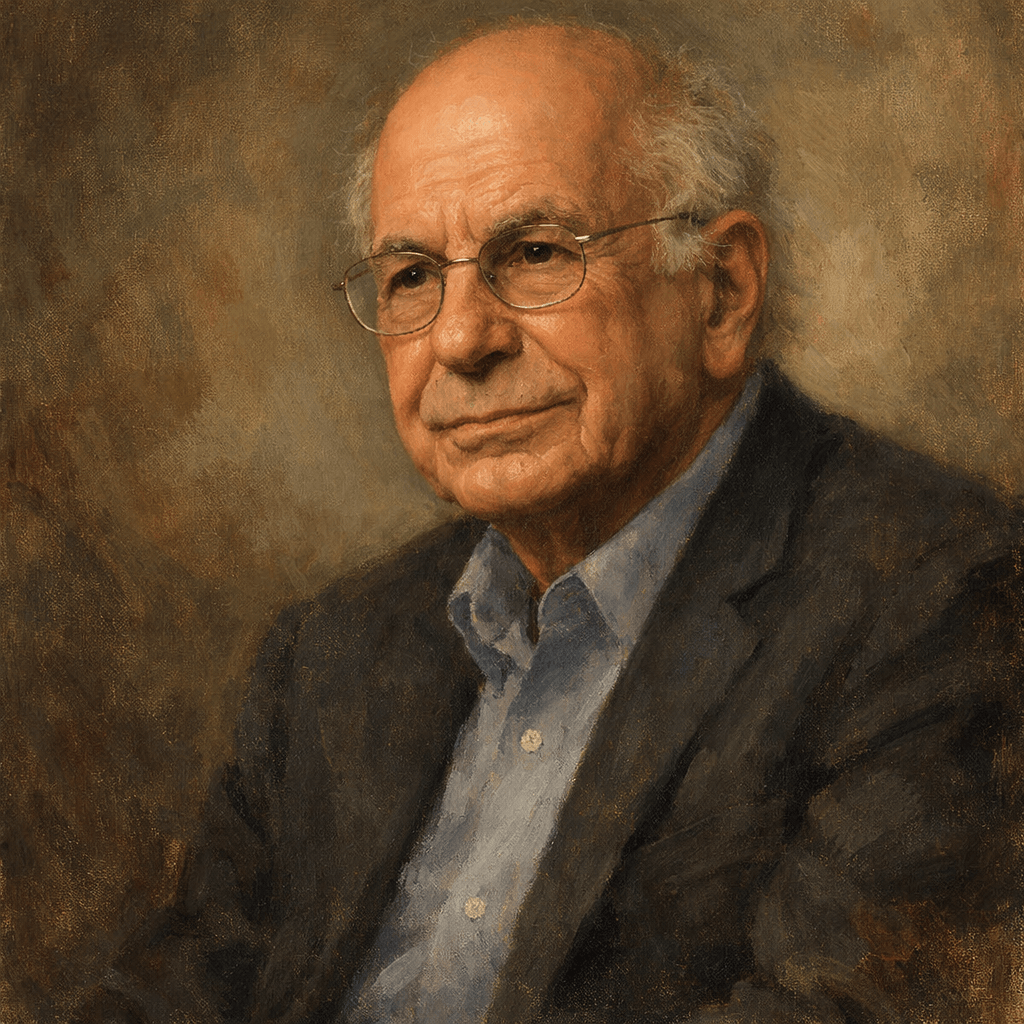
Daniel Kahneman’s legacy is a testament to the power of questioning the very foundations of human thought. A pioneer of behavioral economics and a Nobel laureate, he reshaped our understanding of the mind, exposing the tension between intuition and reason, and challenging the myth of human rationality. His work transcends academia, offering a lens to navigate the complexities of happiness, decision-making, and social dynamics. By dissecting cognitive biases, memory’s illusions, and the pitfalls of overconfidence, Kahneman gifted us not just insights, but tools to live more deliberately in a world governed by uncertainty.
The themes explored in his quotes—ranging from the paradox of happiness to the hidden costs of mental effort—reveal a profound truth: our minds are both our greatest asset and our most enduring mystery. His reflections on optimism, economic behavior, and the fragility of attention urge us to confront the narratives we construct about ourselves and the world. Yet, beneath the analytical rigor lies a quiet optimism: that awareness can liberate us.
As we reflect on Kahneman’s wisdom, let his words inspire a lifetime of curiosity and critical thinking. In a world that often confuses busyness with purpose or confusion with complexity, his legacy challenges us to slow down, question assumptions, and embrace the dualities of our nature. After all, the mind, like any tool, becomes sharper when we choose to use it—not just for survival, but for a life well-lived.
Explore Quote Collections

Books & Knowledge
Explore the best quotes about the power of reading, the magic of libraries, book collecting, literary wisdom, and the timeless bond between reader and author.
Friendship
Explore the best friendship quotes about true friends, loyalty, trust, betrayal, love, and lifelong bonds. Browse curated quote collections by theme.

Life
Explore the deepest questions of existence. A curated collection of quotes on the journey of life, the pursuit of wisdom, the beauty of struggle, and the acceptance of mortality.
Persistence & Progress
Discover the power of steady progress. Explore curated quotes on overcoming challenges, simplifying complex problems, staying focused, and the art of getting things done.
You Might Also Like
Patrick Wright
Software engineer and creator of Quotesperation. I curate wisdom from history's greatest minds to inspire and guide modern life. When I'm not collecting quotes, I'm writing about technology and finding connections between timeless wisdom and today's challenges.