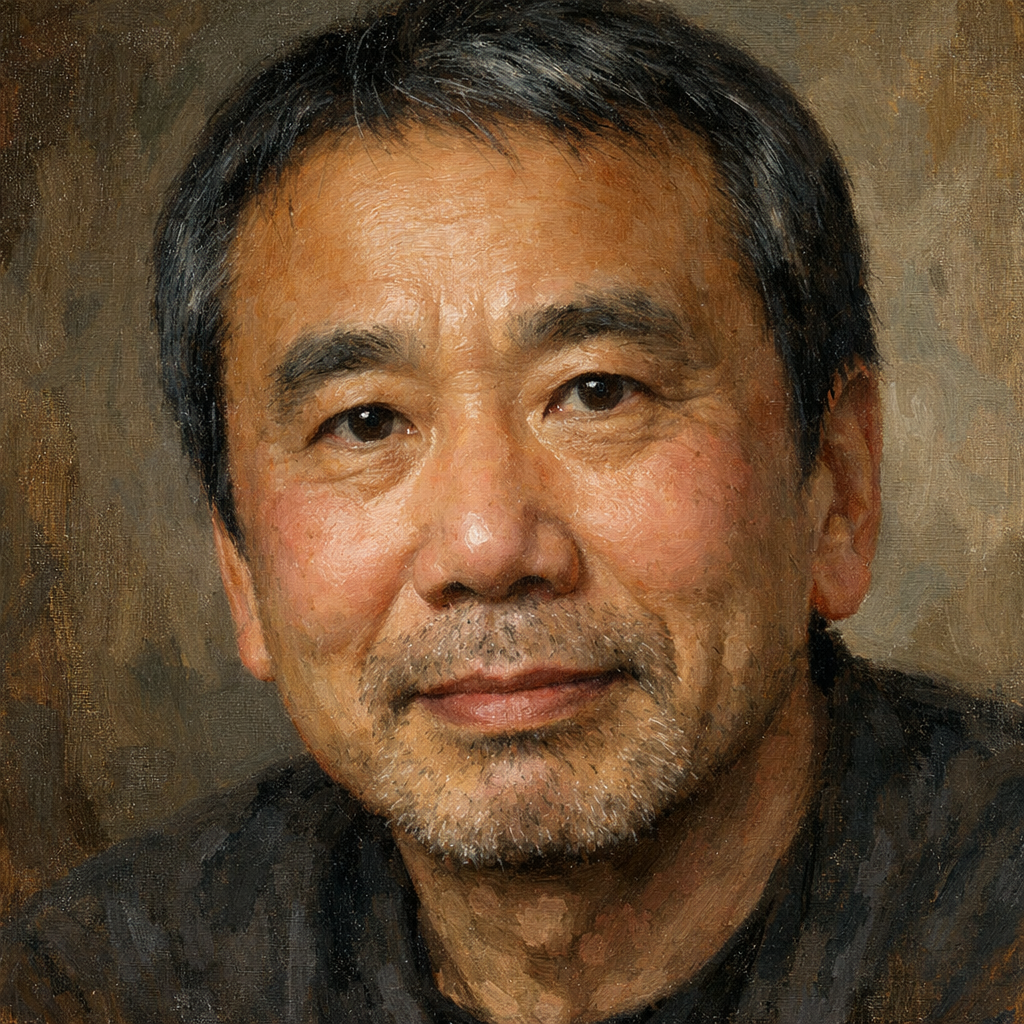
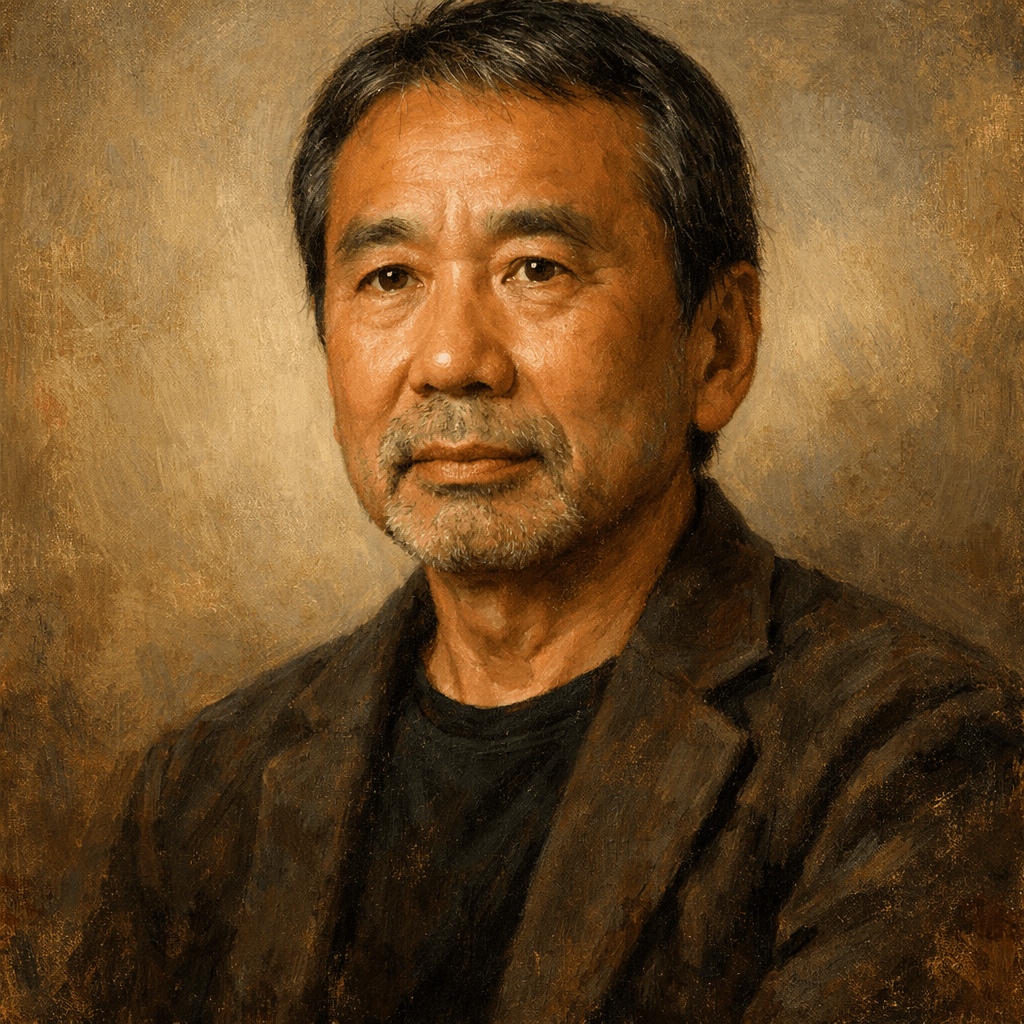
About Haruki Murakami
Haruki Murakami, born on January 12, 1949, in Kyoto, Japan, is a celebrated novelist, translator, and musician whose work has redefined contemporary Japanese literature. Known for blending magical realism, existential philosophy, and surrealism, Murakami’s oeuvre includes iconic novels such as Norwegian Wood, Kafka on the Shore, A Wild Sheep Chase, and the epic trilogy The Wind-Up Bird Chronicle. His writing often explores themes of identity, solitude, memory, and the porous boundary between reality and dreams, resonating with global audiences through its universal introspection and lyrical prose.
Murakami’s contributions have earned him widespread acclaim, including the World Fantasy Award and the Frank O’Connor International Short Story Award. Though frequently cited as a Nobel Prize in Literature contender, his influence extends beyond accolades, shaping modern literary and pop culture landscapes. His translations of Western authors like F. Scott Fitzgerald and Raymond Carver, alongside his fusion of Japanese and global narratives, have bridged cultural gaps, making Japanese literature more accessible worldwide.
Today, Murakami’s words remain profoundly relevant, offering solace and insight in an era marked by existential uncertainty and digital disconnection. His stories, steeped in melancholy yet imbued with hope, invite readers to navigate the complexities of modern life through imagination and self-discovery. As a chronicler of the human condition, Murakami continues to inspire readers and writers alike, affirming the enduring power of storytelling.
Haruki Murakami is a literary alchemist, weaving the mundane and the magical into stories that resonate with the quiet chaos of the human soul. With a career spanning decades, his novels, short stories, and essays have redefined modern fiction, blending surrealism, introspection, and a deep curiosity about life’s big questions. His work transcends borders and languages, offering readers a mirror to their own dreams, doubts, and desires. Murakami’s voice—equal parts philosopher, storyteller, and poet—has captivated millions, making him one of the most celebrated authors of our time.
This collection of 150 quotes is a gateway into the heart of Murakami’s universe. Here, you’ll encounter his musings on life’s duality—celebrating the beauty of love and relationships while confronting the shadow of pain and suffering. You’ll journey through the labyrinth of self-discovery, the boundaries of freedom, and the mysteries of time and the unknown. Whether he’s pondering the art of writing, the weight of wisdom, or the whispers of imagination, Murakami’s words are both a comfort and a challenge, inviting you to question, dream, and embrace the enigmatic dance of existence. Let these quotes inspire you to find light in life’s shadows and courage in its uncertainties.
Table of Contents
- Life and Death
- Love and Relationships
- Dreams and Imagination
- Pain and Suffering
- Self-Discovery and Inner Journey
- Wisdom and Knowledge
- Boundaries and Freedom
- Art and Writing
- Time and Change
- Mystery and the Unknown
- Conclusion
Life and Death
Haruki Murakami’s reflections on life and death are woven with existential poignancy, blending the mundane with the metaphysical. For Murakami, these themes are not binaries but intertwined forces that shape human experience, often revealed through quiet introspection and surreal imagery. His quotes confront mortality, loss, and resilience, offering no easy answers—only the raw, ungraspable truth of existence.
"When you come out of the storm, you won’t be the same person who walked in. That’s what this storm’s all about." - Haruki Murakami
"Death is not the opposite of life, but a part of it." - Haruki Murakami
"Every one of us is losing something precious to us. Lost opportunities, lost possibilities, feelings we can never get back again. That’s part of what it means to be alive." - Haruki Murakami
Murakami’s early quotes here reflect on transformation and impermanence, framing life itself as a process of loss and rebirth.
"In everybody’s life there’s a point of no return. And in a very few cases, a point where you can’t go forward anymore. And when we reach that point, all we can do is quietly accept the fact. That’s how we survive." - Haruki Murakami
"No truth can cure the sorrow we feel from losing a loved one. No truth, no sincerity, no strength, no kindness can cure that sorrow." - Haruki Murakami
"Sometimes fate is like a small sandstorm that keeps changing directions. You change direction but the sandstorm chases you. You turn again, but the storm adjusts. Over and over you play this out, like some ominous dance with death just before dawn." - Haruki Murakami
"The dead will always be dead, but we have to go on living." - Haruki Murakami
These quotes confront the irreversibility of loss and the futility of seeking solace in logic, painting survival as a quiet, unspoken endurance.
"So that's how we live our lives. No matter how deep and fatal the loss, no matter how important the thing that's stolen from us--that's snatched right out of our hands--even if we are left completely changed, with only the outer layer of skin from before, we continue to play out our lives this way, in silence." - Haruki Murakami
"A person's last moments are an important thing. You can't choose how you're born but you can choose how you die." - Haruki Murakami
"That's the kind of death that frightens me. The shadow of death slowly, slowly eats away at the region of life, and before you know it everything's dark and you can't see, and the people around you think of you as more dead than alive." - Haruki Murakami
"Time, of course, topples everyone in its path equally- the way that driver beats his old horse until it dies. But the thrashing we receive is one of frightful gentleness." - Haruki Murakami
Here, Murakami underscores the paradox of agency in death, juxtaposing human fragility with the eerie gentleness of time’s inexorable march.
"Tell me, Doctor, are you afraid of death?""I guess it depends on how you die." - Haruki Murakami
"The moon had been observing the earth close-up longer than anyone. It must have witnessed all of the phenomena occurring - and all of the acts carried out - on this earth. But the moon remained silent; it told no stories." - Haruki Murakami
"The pure present is an ungraspable advance of the past devouring the future." - Haruki Murakami
"Just because there’s an end doesn’t mean existence has meaning. An end point is simply set up as a temporary marker, or perhaps as an indirect metaphor for the fleeting nature of existence." - Haruki Murakami
These final quotes distill Murakami’s philosophy: existence is fleeting, meaning is elusive, and the universe remains a silent, indifferent witness.
Love and Relationships
Haruki Murakami’s exploration of love and relationships is marked by its paradoxes: the yearning for connection amid solitude, the fleeting nature of happiness, and the quiet power of small moments. His quotes dissect the weight of emotion, the choices we make, and the often-solitary journey of the heart.
"If you remember me, then I don't care if everyone else forgets." - Haruki Murakami
"I was always hungry for love. Just once, I wanted to know what it was like to get my fill of it -- to be fed so much love I couldn't take any more. Just once." - Haruki Murakami
"What happens when people open their hearts? They get better." - Haruki Murakami
These quotes highlight the duality of longing and vulnerability, as Murakami often portrays love as both a sustenance and a burden.
"But who can say what's best? That's why you need to grab whatever chance you have of happiness where you find it, and not worry too much about other people." - Haruki Murakami
"My experience tells me that we get no more than two or three such chances in a lifetime, and if we let them go, we regret it for the rest of our lives." - Haruki Murakami
"That's what love's all about, Kafka. You're the one having those wonderful feelings, but you have to go it alone as you wander through the dark." - Haruki Murakami
These reflections underscore the gravity of choices in love, where seizing fleeting moments can define a lifetime.
"I have always loved Naoko, and I still love her. But there is a decisive finality to what exists between Midori and me. It has an irresistible power that is bound to sweep me into the future." - Haruki Murakami
"Somewhere between 'not enough' and 'not at all.' I was always hungry for love. Just once, I wanted to know what it was like to get my fill of it - to be fed so much love I couldn't take any more. Just once." - Haruki Murakami
"When you fall in love, the natural thing to do is give yourself to it. That's what I think. It's just a form of sincerity." - Haruki Murakami
Here, Murakami captures the paradox of love’s sincerity and its solitary nature, where surrender becomes both a gift and a burden.
"I’m in love. And this love is about to carry me off somewhere. The current’s too overpowering; I don’t have any choice. It may very well be a special place, some place I’ve never seen before." - Haruki Murakami
"For a certain kind of person, love begins from something tiny or silly. From something like that or it doesn't begin at all." - Haruki Murakami
"For a certain kind of person, love begins from something tiny or silly. From something like that or it doesn't begin at all." - Haruki Murakami
"For a certain kind of person, love begins from something tiny or silly. From something like that or it doesn't begin at all." - Haruki Murakami
"For a certain kind of person, love begins from something tiny or silly. From something like that or it doesn't begin at all." - Haruki Murakami
"For a certain kind of person, love begins from something tiny or silly. From something like that or it doesn't begin at all." - Haruki Murakami
"For a certain kind of person, love begins from something tiny or silly. From something like that or it doesn't begin at all." - Haruki Murakami
The repetition of this quote underscores Murakami’s belief that love often begins with the subtlest of gestures, a theme he revisits to emphasize its quiet, transformative power.
Dreams and Imagination
Haruki Murakami’s work is a labyrinth of dreams and imagination, where the boundaries between the real and the surreal blur. For Murakami, dreams are not just nocturnal escapes but portals to deeper truths, while imagination becomes a tool to navigate the complexities of existence.
"The answer is dreams. Dreaming on and on. Entering the world of dreams and never coming out. Living in dreams for the rest of time." - Haruki Murakami
"In dreams you don't need to make any distinctions between things. Not at all. Boundaries don't exist. So in dreams there are hardly ever collisions. Even if there are, they don't hurt. Reality is different. Reality bites." - Haruki Murakami
"The better you were able to imagine what you wanted to imagine, the farther you could flee from reality." - Haruki Murakami
"It is the inherent right of all writers to experiment with the possibilities of language in every way they can imagine—without that adventurous spirit, nothing new can ever be born." - Haruki Murakami
Murakami often explores how imagination acts as both an escape and a lens to reinterpret reality, blending the mundane with the metaphysical.
"The good thing about writing book is that you can dream while you are awake." - Haruki Murakami
"The journey I'm taking is inside me. Just like blood travels down veins, what I'm seeing is my inner self and what seems threatening is just the echo of the fear in my heart." - Haruki Murakami
"The journey I'm taking is inside me. Just like blood travels down veins, what I'm seeing is my inner self and what seems threatening is just the echo of the fear in my heart." - Haruki Murakami
"The journey I'm taking is inside me. Just like blood travels down veins, what I'm seeing is my inner self and what seems threatening is just the echo of the fear in my heart." - Haruki Murakami
Here, Murakami frames the inner journey as a metaphor for confronting one’s vulnerabilities, transforming fear into a navigable terrain.
"The journey I'm taking is inside me. Just like blood travels down veins, what I'm seeing is my inner self and what seems threatening is just the echo of the fear in my heart." - Haruki Murakami
"The journey I'm taking is inside me. Just like blood travels down veins, what I'm seeing is my inner self and what seems threatening is just the echo of the fear in my heart." - Haruki Murakami
"The journey I'm taking is inside me. Just like blood travels down veins, what I'm seeing is my inner self and what seems threatening is just the echo of the fear in my heart." - Haruki Murakami
"The journey I'm taking is inside me. Just like blood travels down veins, what I'm seeing is my inner self and what seems threatening is just the echo of the fear in my heart." - Haruki Murakami
The repetition of this quote underscores Murakami’s belief in introspection as a constant, cyclical process of self-discovery.
"The journey I'm taking is inside me. Just like blood travels down veins, what I'm seeing is my inner self and what seems threatening is just the echo of the fear in my heart." - Haruki Murakami
"The journey I'm taking is inside me. Just like blood travels down veins, what I'm seeing is my inner self and what seems threatening is just the echo of the fear in my heart." - Haruki Murakami
"I want to write stories that are different from the ones I've written so far, Junpei thought: I want to write about people who dream and wait for the night to end, who long for the light so they can hold the ones they love." - Haruki Murakami
In this final quote, Murakami channels the yearning for connection and transformation, weaving dreams into a bridge between solitude and shared humanity.
Pain and Suffering
Haruki Murakami often explores the duality of pain and suffering, emphasizing that while physical and emotional pain are inescapable parts of life, the way we internalize and respond to it defines our capacity for resilience. His reflections on endurance, identity, and the human condition reveal a philosophy centered on quiet strength and the necessity of embracing hardship.
"Pain is inevitable. Suffering is optional." - Haruki Murakami
"The strength I'm looking for isn't the type where you win or lose. I'm not after a wall that'll repel power coming from outside. What I want is the kind of strength to be able to absorb that kind of power, to stand up to it. The strength to quietly endure things - unfairness, misfortunes, sadness, mistakes, misunderstandings." - Haruki Murakami
"In most cases learning something essential in life requires physical pain." - Haruki Murakami
These early quotes establish Murakami’s recurring theme: pain as an unavoidable reality, and suffering as a choice shaped by perspective and resilience.
"Pain is inevitable. Suffering is optional. Say you’re running and you think, ‘Man, this hurts, I can’t take it anymore. The ‘hurt’ part is an unavoidable reality, but whether or not you can stand anymore is up to the runner himself." - Haruki Murakami
"I hate requests. They make me feel unhappy. It's like when I take a book out of the library. As soon as I start to read it, all I can think about is when I'll finish it." - Haruki Murakami
"Memories warm you up from the inside. But they also tear you apart." - Haruki Murakami
Murakami uses metaphors like running and reading to dissect how external pressures and internal reflections intertwine, often leading to emotional dissection.
"I can bear any pain as long as it has meaning." - Haruki Murakami
"I'm just kind of tired. Like a monkey in the rain." - Haruki Murakami
"Nobody's going to win all the time. On the highway of life you can't always be in the fast lane." - Haruki Murakami
Here, Murakami underscores the tension between purpose and futility, suggesting that meaning—and even exhaustion—can coexist with the inevitability of life’s detours.
"The strength I'm looking for isn't the type where you win or lose. I'm not after a wall that'll repel power coming from outside. What I want is the kind of strength to be able to absorb that kind of power, to stand up to it. The strength to quietly endure things - unfairness, misfortunes, sadness, mistakes, misunderstandings." - Haruki Murakami
"You live by yourself for a stretch of time and you get to staring at different objects. Sometimes you talk to yourself." - Haruki Murakami
"There's a void inside me, a blank that's slowly expanding, devouring what's left of who I am. I can hear it happening. I'm totally lost, my identity dying." - Haruki Murakami
These quotes reveal Murakami’s existential focus, where isolation and introspection often lead to a confrontation with one’s own fragility and voids.
"The thoughts that occur to me while I’m running are like clouds in the sky. Clouds of all different sizes. They come and they go, while the sky remains the same sky always. The clouds are mere guests in the sky that pass away and vanish, leaving behind the sky." - Haruki Murakami
"Despite your best efforts, people are going to be hurt when it's time for them to be hurt." - Haruki Murakami
"You make do with what you have. As you age you learn even to be happy with what you have." - Haruki Murakami
In the final set, Murakami’s metaphors of clouds and voids culminate in acceptance—a quiet surrender to life’s impermanence and the wisdom to find contentment in the present.
Self-Discovery and Inner Journey
Haruki Murakami's works often explore the labyrinth of the self, where external journeys are mere reflections of internal transformations. His quotes on self-discovery and inner journey reveal the delicate balance between confronting inner demons and embracing the unknown within.
"The journey I'm taking is inside me. Just like blood travels down veins, what I'm seeing is my inner self and what seems threatening is just the echo of the fear in my heart." - Haruki Murakami
"The journey I'm taking is inside me. Just like blood travels down veins, what I'm seeing is my inner self and what seems threatening is just the echo of the fear in my heart." - Haruki Murakami
"The journey I'm taking is inside me. Just like blood travels down veins, what I'm seeing is my inner self and what seems threatening is just the echo of the fear in my heart." - Haruki Murakami
The repetition of this quote underscores Murakami's belief that self-discovery is a continuous, often cyclical process. Each iteration reflects a deeper confrontation with one's own fears and uncertainties.
"The journey I'm taking is inside me. Just like blood travels down veins, what I'm seeing is my inner self and what seems threatening is just the echo of the fear in my heart." - Haruki Murakami
"The journey I'm taking is inside me. Just like blood travels down veins, what I'm seeing is my inner self and what seems threatening is just the echo of the fear in my heart." - Haruki Murakami
"The journey I'm taking is inside me. Just like blood travels down veins, what I'm seeing is my inner self and what seems threatening is just the echo of the fear in my heart." - Haruki Murakami
"The journey I'm taking is inside me. Just like blood travels down veins, what I'm seeing is my inner self and what seems threatening is just the echo of the fear in my heart." - Haruki Murakami
The metaphor of the journey within is central to Murakami's philosophy. By likening it to blood flowing through veins, he suggests that self-discovery is as natural and inevitable as life itself.
"The journey I'm taking is inside me. Just like blood travels down veins, what I'm seeing is my inner self and what seems threatening is just the echo of the fear in my heart." - Haruki Murakami
"The journey I'm taking is inside me. Just like blood travels down veins, what I'm seeing is my inner self and what seems threatening is just the echo of the fear in my heart." - Haruki Murakami
"The journey I'm taking is inside me. Just like blood travels down veins, what I'm seeing is my inner self and what seems threatening is just the echo of the fear in my heart." - Haruki Murakami
"The journey I'm taking is inside me. Just like blood travels down veins, what I'm seeing is my inner self and what seems threatening is just the echo of the fear in my heart." - Haruki Murakami
Murakami’s insistence on the internal journey as the true path to understanding oneself challenges the reader to look beyond the surface, into the depths of their own being.
"The journey I'm taking is inside me. Just like blood travels down veins, what I'm seeing is my inner self and what seems threatening is just the echo of the fear in my heart." - Haruki Murakami
"You have to overcome the fear and anger inside you,” the boy named Crow says. “Let a bright light shine in and melt the coldness in your heart. That’s what being tough is all about." - Haruki Murakami
"There are some things about myself I can’t explain to anyone. There are some things I don’t understand at all. I can’t tell what I think about things or what I’m after. I don’t know what my strengths are or what I’m supposed to do about them." - Haruki Murakami
"There’s nothing worth getting in this world that you can get easily." - Haruki Murakami
The final quotes shift from introspection to action and resolve. Crow’s advice encapsulates the necessity of confronting inner turmoil with courage, while the last line serves as a reminder that true self-discovery is inherently challenging.
Wisdom and Knowledge
Haruki Murakami’s reflections on wisdom and knowledge often challenge conventional assumptions, emphasizing the value of independent thought, the pursuit of deeper truths, and the courage to confront life’s uncertainties. His words blend existential insight with practical advice, reminding readers that understanding the world—and oneself—requires both curiosity and humility.
"If you only read the books that everyone else is reading, you can only think what everyone else is thinking." - Haruki Murakami
"The most important thing we learn at school is the fact that the most important things can't be learned at school." - Haruki Murakami
"That’s how stories happen — with a turning point, an unexpected twist. There’s only one kind of happiness, but misfortune comes in all shapes and sizes. It’s like Tolstoy said. Happiness is an allegory, unhappiness a story." - Haruki Murakami
Murakami’s early quotes underscore the tension between conformity and individuality, suggesting that true wisdom begins with questioning what society deems “essential.”
"Have books ‘happened’ to you? Unless your answer to that question is ‘yes,’ I’m unsure how to talk to you." - Haruki Murakami
"When it comes to anything halfway important, you just don't get it. It's amazing to me that you can put a piece of fiction together." - Haruki Murakami
"If you don't practice, any gifts or talents you do have won't emerge where people can see them." - Haruki Murakami
Here, Murakami highlights the paradox of creativity: it requires both serendipity and relentless effort, with the writer navigating the gap between inspiration and execution.
"I don't know what I want. And, if that's the case, as my ex-wife said, I'd only hurt people." - Haruki Murakami
"Everything has boundaries. The same holds true with thought. You shouldn't fear boundaries, but you should not be afraid of destroying them. That's what is most important if you want to be free: respect for and exasperation with boundaries." - Haruki Murakami
"People die all the time. Life is a lot more fragile than we think. So you should treat others in a way that leaves no regrets. Fairly, and if possible, sincerely." - Haruki Mura-kami
These quotes reveal Murakami’s contemplation of self-awareness and responsibility, urging readers to confront limitations while honoring the impermanence of life.
"What we needed were not words and promises but the steady accumulation of small realities." - Haruki Murakami
"Nobody likes being alone that much. I don't go out of my way to make friends, that's all. It just leads to disappointment." - Haruki Murakami
"In other words, let's face it: Life is basically unfair. But even in a situation that's unfair, I think it's possible to seek out a kind of fairness." - Haruki Murakami
Murakami here grapples with the tension between idealism and pragmatism, advocating for quiet resilience in the face of life’s contradictions.
"That's how it is with art. Mere humans who root through their refrigerators at three o'clock in the morning are incapable of such writing." - Haruki Murakami
"Writers have to keep on writing if they want to mature, like caterpillars endlessly chewing on leaves." - Haruki Murakami
"You can hide memories, but you can’t erase the history that produced them." - Haruki Murakami
These final quotes affirm Murakami’s belief in art as a transformative force, demanding both dedication and acceptance of the past’s enduring influence.
Boundaries and Freedom
Haruki Murakami often explores the tension between structure and liberation, examining how boundaries—both physical and metaphorical—shape human freedom. His quotes on this theme reveal a nuanced philosophy that balances the necessity of limits with the desire to transcend them.
"Everything has boundaries. The same holds true with thought. You shouldn't fear boundaries, but you should not be afraid of destroying them. That's what is most important if you want to be free: respect for and exasperation with boundaries." - Haruki Murakami
Murakami frames freedom as a dynamic interplay between respecting and challenging boundaries.
"The people who build high, strong fences are the ones who survive the best. You deny that reality only at the risk of being driven into the wilderness yourself." - Haruki Murakami
"The people who build high, strong fences are the ones who survive the best. You deny that reality only at the risk of being driven into the wilderness yourself." - Haruki Murakami
"The people who build high, strong fences are the ones who survive the best. You deny that reality only at the risk of being driven into the wilderness yourself." - Haruki Murakami
"The people who build high, strong fences are the ones who survive the best. You deny that reality only at the risk of being driven into the wilderness yourself." - Haruki Murakami
"The people who build high, strong fences are the ones who survive the best. You deny that reality only at the risk of being driven into the wilderness yourself." - Haruki Murakami
"The people who build high, strong fences are the ones who survive the best. You deny that reality only at the risk of being driven into the wilderness yourself." - Haruki Murakami
"The people who build high, strong fences are the ones who survive the best. You deny that reality only at the risk of being driven into the wilderness yourself." - Haruki Murakami
"The people who build high, strong fences are the ones who survive the best. You deny that reality only at the risk of being driven into the wilderness yourself." - Haruki Murakami
"The people who build high, strong fences are the ones who survive the best. You deny that reality only at the risk of being driven into the wilderness yourself." - Haruki Murakami
"The people who build high, strong fences are the ones who survive the best. You deny that reality only at the risk of being driven into the wilderness yourself." - Haruki Murakami
"The people who build high, strong fences are the ones who survive the best. You deny that reality only at the risk of being driven into the wilderness yourself." - Haruki Murakami
"The people who build high, strong fences are the ones who survive the best. You deny that reality only at the risk of being driven into the wilderness yourself." - Haruki Murakami
"The people who build high, strong fences are the ones who survive the best. You deny that reality only at the risk of being driven into the wilderness yourself." - Haruki Murakami
"The people who build high, strong fences are the ones who survive the best. You deny that reality only at the risk of being driven into the wilderness yourself." - Haruki Murakami
"Closing your eyes isn't going to change anything. Nothing's going to disappear just because you can't see what's going on." - Haruki Murakami
The repetition of the fence-building quote underscores Murakami’s belief in the paradoxical role of boundaries as both protective and confining.
The final quote shifts focus to denial, emphasizing that avoiding reality offers no reprieve from its consequences.
Art and Writing
Haruki Murakami’s reflections on art and writing reveal a philosophy that intertwines creativity with existential inquiry, blending the mundane with the metaphysical. His words often explore the tension between tradition and experimentation, the role of communication in civilization, and the transformative power of storytelling. Murakami’s quotes, infused with wit and melancholy, invite readers to see art as both a mirror and a portal to the unknown.
"Exerting yourself to the fullest within your individual limits: that's the essence of running, and a metaphor for life." - Haruki Murakami
"Civilization is communication. When that which should be expressed and transmitted is lost, civilization comes to an end." - Haruki Murakami
"I'm a very ordinary human being; I just happen to like reading books." - Haruki Murakami
Murakami’s juxtaposition of the ordinary and the profound—whether through running, reading, or civilization itself—highlights how art and life are interwoven through effort and expression.
"I'm a writer. I don't support any war. That's my principle." - Haruki Murakami
"I love pop culture -- the Rolling Stones, the Doors, David Lynch, things like that. That's why I said I don't like elitism." - Haruki Murakami
"I love pop culture -- the Rolling Stones, the Doors, David Lynch, things like that. That's why I said I don't like elitism." - Haruki Murakami
His steadfast anti-war stance and embrace of pop culture underscore his belief in art’s accessibility, challenging elitism to democratize creativity.
"It is the inherent right of all writers to experiment with the possibilities of language in every way they can imagine—without that adventurous spirit, nothing new can ever be born." - Haruki Murakami
"Like Tolstoy said. Happiness is an allegory, unhappiness a story." - Haruki Murakami
"It's not right for one friend to do all the giving and the other to do all the taking: that's not read friendship." - Haruki Murakami
Murakami champions linguistic experimentation as the lifeblood of innovation, while his musings on happiness and friendship reveal art’s role in navigating human paradoxes.
"Time moves in it special way in the middle of the night." - Haruki Murakami
"Ships passing in broad daylight." - Haruki Murakami
"You know what I should do?" Hoshino asked excited. "Of course," the cat said. "What'd I told you? Cats know everything. Not like dogs." - Haruki Murakami
His surreal imagery and dialogue with feline wisdom reflect his fascination with time and the subconscious, where stories thrive in liminal spaces.
"The role of a story was, in the broadest terms, to transpose a single problem into another form. ... It was like a piece of paper bearing the indecipherable text of a magic spell." - Haruki Murakami
"The thoughts that occur to me while I’m running are like clouds in the sky. Clouds of all different sizes. They come and they go, while the sky remains the same sky always. The clouds are mere guests in the sky that pass away and vanish, leaving behind the sky." - Haruki Murakami
"Things change everyday. With each new dawn, it is not the same world as before. And you’re not the same person you were either." - Haruki Murakami
Murakami’s metaphors for storytelling and impermanence remind us that art is both a fleeting moment and an enduring truth, shaped by the ever-shifting self and world.
Time and Change
Haruki Murakami’s reflections on time and change reveal a world where the past, present, and future are in constant flux, shaped by memory, loss, and the quiet resilience of human existence. His words capture the tension between the unstoppable march of time and the fragile, enduring nature of identity.
"Things change everyday. With each new dawn, it is not the same world as before. And you’re not the same person you were either." - Haruki Murakami
"But still, no matter how much time passes, no matter what takes place in the interim, there are some things we can never assign to oblivion, memories we can never rub away." - Haruki Murakami
"Time moves in it special way in the middle of the night." - Haruki Murakami
"Time, of course, topples everyone in its path equally- the way that driver beats his old horse until it dies." - Haruki Murakami
Time, in Murakami’s world, is both a relentless force and a quiet observer, reshaping lives while leaving echoes of the past intact.
"The pure present is an ungraspable advance of the past devouring the future." - Haruki Murakami
"Just because there’s an end doesn’t mean existence has meaning. An end point is simply set up as a temporary marker, or perhaps as an indirect metaphor for the fleeting nature of existence." - Haruki Murakami
"So that's how we live our lives. No matter how deep and fatal the loss, no matter how important the thing that's stolen from us--that's snatched right out of our hands--even if we are left completely changed, with only the outer layer of skin from before, we continue to play out our lives this way, in silence." - Haruki Murakami
"There are things in this world it is better not to know about. Of course, those are the very things that people most want to know about. It's strange." - Haruki Murakami
Murakami’s quotes often blur the line between time’s indifference and humanity’s desperate need for meaning, suggesting that existence itself is a fleeting, paradoxical journey.
"For a ten-year-old boy and a ten-year-old girl to become good friends was not easy under any circumstances. Indeed, it might be one of the most difficult accomplishments in the world." - Haruki Murakami
"In other words, let's face it: Life is basically unfair. But even in a situation that's unfair, I think it's possible to seek out a kind of fairness." - Haruki Murakami
"People are drawn deeper into tragedy not by their defects but by their virtues." - Haruki Murakami
The interplay of time and change reveals how human connections—and their fragility—are both shaped by and resistant to the passage of time.
"It's not me but the world that's deranged." - Haruki Murakami
"I don't go out of my way to make friends, that's all." - Haruki Murakami
"The moon had been observing the earth close-up longer than anyone. It must have witnessed all of the phenomena occurring - and all of the acts carried out - on this earth. But the moon remained silent; it told no stories." - Haruki Murakami
"A gentleman is someone who does not what he wants to do, but what he should do." - Haruki Murakami
Murakami’s musings on time and change ultimately point to a world where silence, stillness, and moral restraint become acts of quiet defiance against chaos.
Mystery and the Unknown
Haruki Murakami’s work thrives in the liminal space between the known and the unknowable, where curiosity and fear intertwine. His quotes on mystery and the unknown often reveal humanity’s struggle to reconcile with truths that defy logic, while probing the paradoxes of desire, memory, and survival.
"There are things in this world it is better not to know about. Of course, those are the very things that people most want to know about. It's strange." - Haruki Murakami
"People are drawn deeper into tragedy not by their defects but by their virtues." - Haruki Murakami
"In the name of God, they stole her time and her freedom, putting shackles on her heart. They preached about God's kindness, but preached twice as much about his wrath and intolerance." - Haruki Murakami
"But still, no matter how much time passes, no matter what takes place in the interim, there are some things we can never assign to oblivion, memories we can never rub away." - Haruki Murakami
Murakami’s quotes often juxtapose human yearning with the inescapable weight of the unknown, suggesting that some truths are too vast or painful to confront directly.
"No truth can cure the sorrow we feel from losing a loved one. No truth, no sincerity, no strength, no kindness can cure that sorrow." - Haruki Murakami
"You can hide memories, but you can’t erase the history that produced them." - Haruki Murakami
"When you come out of the storm you won't be the same person who walked in. That's what this storm's all about." - Haruki Murakami
"Ships passing in broad daylight." - Haruki Murakami
These lines evoke the idea that the unknown shapes identity and reality, often leaving indelible marks on the psyche. Murakami’s imagery of storms and ships underscores the inevitability of transformation in the face of mystery.
"It's not right for one friend to do all the giving and the other to do all the taking: that's not real friendship." - Haruki Murakami
"The people who build high, strong fences are the ones who survive the best. You deny that reality only at the risk of being driven into the wilderness yourself." - Haruki Murakami
"The people who build high, strong fences are the ones who survive the best. You deny that reality only at the risk of being driven into the wilderness yourself." - Haruki Murakami
"The people who build high, strong fences are the ones who survive the best. You deny that reality only at the risk of being driven into the wilderness yourself." - Haruki Murakami
The repetition of the fence-building quote highlights Murakami’s critique of isolation as a survival mechanism, a metaphor for the barriers people erect to guard against the chaos of the unknown.
"The people who build high, strong fences are the ones who survive the best. You deny that reality only at the risk of being driven into the wilderness yourself." - Haruki Murakami
"The people who build high, strong fences are the ones who survive the best. You deny that reality only at the risk of being driven into the wilderness yourself." - Haruki Murakami
"The people who build high, strong fences are the ones who survive the best. You deny that reality only at the risk of being driven into the wilderness yourself." - Haruki Murakami
This recurring line underscores the tension between self-preservation and the existential solitude of confronting life’s mysteries alone. Murakami’s work suggests that while fences may offer protection, they also distance us from the very truths we seek.
Additional Quotes
"Everything has boundaries. The same holds true with thought. You shouldn't fear boundaries, but you should not be afraid of destroying them. That's what is most important if you want to be free: respect for and exasperation with boundaries." - Haruki Murakami
"You are a beautiful person, Doctor. Clearheaded. Strong. But you seem always to be dragging your heart along the ground. From now on, little by little, you must prepare yourself to face death. If you devote all of your future energy to living, you will not be able to die well. You must begin to shift gears, a little at a time. Living and dying are, in a sense, of equal value."--Nimit in "Thailand" - Haruki Murakami
"I think you still love me, but we can’t escape the fact that I’m not enough for you. I knew this was going to happen. So I’m not blaming you for falling in love with another woman. I’m not angry, either. I should be, but I’m not. I just feel pain. A lot of pain. I thought I could imagine how much this would hurt, but I was wrong." - Haruki Murakami
"If you remember me, then I don't care if everyone else forgets." - Haruki Murakami
"If you can love someone with your whole heart, even one person, then there's salvation in life. Even if you can't get together with that person." - Haruki Murakami
"When I see a dictionary on my desk I feel like I'm looking at some strange dog leaving a twisty piece of poop on our lawn out back." - Haruki Murakami
"I’m not totally mad at you. I’m just sad. You’re all locked up in that little world of yours, and when I try knocking on the door, you just sort of look up for a second and go right back inside." - Haruki Murakami
"Nobody likes being alone that much. I don't go out of my way to make friends, that's all. It just leads to disappointment." - Haruki Murakami
"My father always told me: 'Give somebody a hand and he'll take an arm." - Haruki Murakami
"We survived. You and I. And those who survive have a duty. Our duty is to do our best to keep on living. Even if our lives are not perfect." - Haruki Murakami
"Sometimes when I look at you, I feel I'm gazing at a distant star. It's dazzling, but the light is from tens of thousands of years ago.Maybe the star doesn't even exist any more. Yet sometimes that light seems more real to me than anything." - Haruki Murakami
"It's like Tolstoy said. Happiness is an allegory, unhappiness a story." - Haruki Murakami
"No matter how much suffering you went through, you never wanted to let go of those memories." - Haruki Murakami
"I have a million things to talk to you about. All I want in this world is you. I want to see you and talk. I want the two of us to begin everything from the beginning." - Haruki Murakami
"Humans by necessity must have a midway point between their desires and their pride. Just as all objects must have a center of gravity." - Haruki Murakami
"Wasn't it better if they kept this desire to see each other hidden within them, and never actually got together? That way, there would always be hope in their hearts. That hope would be a small, yet vital flame that warmed them to their core-- a tiny flame to cup one's hands around and protect from the wind, a flame that the violent winds of reality might easily extinguish." - Haruki Murakami
"I was always hungry for love. Just once, I wanted to know what it was like to get my fill of it -- to be fed so much love I couldn't take any more. Just once." - Haruki Murakami
"Guns are like cars: you can trust a good used one better than one that's brand new." - Haruki Murakami
"No, I don't want your money. The world moves less by money than by what you owe people and what they owe you. I don't like to owe anybody anything, so I keep to myself as much on the lending side as I can." - Haruki Murakami
"That’s how stories happen — with a turning point, an unexpected twist. There’s only one kind of happiness, but misfortune comes in all shapes and sizes. It’s like Tolstoy said. Happiness is an allegory, unhappiness a story." - Haruki Murakami
"Is it possible, in the final analysis, for one human being to achieve perfect understanding of another?We can invest enormous time and energy in serious efforts to know another person, but in the end, how close can we come to that person's essence? We convince ourselves that we know the other person well, but do we really know anything important about anyone?" - Haruki Murakami
"Despite your best efforts, people are going to be hurt when it's time for them to be hurt." - Haruki Murakami
"She’s got to be a ghost. First of all, she’s just too beautiful. Her features are gorgeous, but it’s not only that. She’s so perfect I know she can’t be real. She’s like a person who stepped right out of a dream. The purity of her beauty gives me a feeling close to sadness –a very natural feeling, though one that only something extraordinary could produce." - Haruki Murakami
"here she is, all mine, trying her best to give me all she can. How could I ever hurt her? But I didn’t understand then. That I could hurt somebody so badly she would never recover. That a person can, just by living, damage another human being beyond repair." - Haruki Murakami
"Death is not the opposite of life, but a part of it." - Haruki Murakami
"Mountains, according to the angle of view, the season, the time of day, the beholder's frame of mind, or any one thing, can effectively change their appearance. Thus, it is essential to recognize that we can never know more than one side, one small aspect of a mountain." - Haruki Murakami
"With my eyes closed, I would touch a familiar book and draw its fragrance deep inside me. This was enough to make me happy." - Haruki Murakami
"Every one of us is losing something precious to us. Lost opportunities, lost possibilities, feelings we can never get back again. That’s part of what it means to be alive." - Haruki Murakami
"In everybody’s life there’s a point of no return. And in a very few cases, a point where you can’t go forward anymore. And when we reach that point, all we can do is quietly accept the fact. That’s how we survive." - Haruki Murakami
"You knew when you saw those eyes he was going to die soon. There was no sign of life in his flesh, just the barest trace of what had once been a life. His body was like a dilapidated old house from which all the fixtures and fittings had been removed, awaiting its final demolition. Around the dry lips clumps of whiskers sprouted like weeds. So, I thought, even after so much of a man's life force has been lost, his beard continues to grow." - Haruki Murakami
"Being with her I feel a pain, like a frozen knife stuck in my chest. An awful pain, but the funny thing is I'm thankful for it. It's like that frozen pain and my very existence are one.The pain is an anchor, mooring me here." - Haruki Murakami
"Now for a good twelve-hour sleep, I told myself. Twelve solid hours. Let birds sing, let people go to work. Somewhere out there, a volcano might blow, Israeli commandos might decimate a Palestinian village. I couldn't stop it. I was going to sleep." - Haruki Murakami
"Most everything you think you know about me is nothing more than memories." - Haruki Murakami
"I'm tired of living unable to love anyone. I don't have a single friend - not one. And, worst of all, I can't even love myself. Why is that? Why can't I love myself? It's because I can't love anyone else. A person learns how to love himself through the simple acts of loving and being loved by someone else. Do you understand what I am saying? A person who is incapable of loving another cannot properly love himself." - Haruki Murakami
"The Earth, time, concepts, love, life, faith justice, evil - they're all fluid and in transition. They don't stay in one form or in one place forever. The whole universe is like some big FedEx box." - Haruki Murakami
"I was dying to have a cat. But they wouldn't let me. My mother hated them. Not once in my life have I managed to get something I really wanted. Not once. Can you believe it? You can't understand what it's like to live like that. When you get used to that kind of life--of never having anything you want--then you stop knowing what it is you want." - Haruki Murakami
"In his or her own way, everyone I saw before me looked happy. Whether they were really happy or just looked it, I couldn't tell. But they did look happy on this pleasant early afternoon in late September, and because of that I felt a kind of loneliness new to me, as if I were the only one here who was not truly part of the scene." - Haruki Murakami
"There had to be something wrong with my life. I should have been born a Yugoslavian shepherd who looked up at the Big Dipper every night." - Haruki Murakami
"Sometimes I get real lonely sleeping with you." - Haruki Murakami
"For a long time, she held a special place in my heart. I kept this special place just for her, like a "Reserved" sign on a quiet corner table in a restaurant. Despite the fact that I was sure I'd never see her again." - Haruki Murakami
"We truly believed in something back then, and we knew we were the kind of people capable of believing in something - with all our hearts. And that kind of hope will never simply vanish." - Haruki Murakami
"He was a far more voracious reader than me, but he made it a rule to never touch a book by any author who had not been dead at least 30 years. "That's the only kind of book I can trust," he said."It's not that I don't believe in contemporary literature," he added, "but I don't want to waste valuable time reading a book that has not had the baptism of time. Life is too short." - Haruki Murakami
"I myself, as I’m writing, don’t know who did it. The readers and I are on the same ground. When I start to write a story, I don’t know the conclusion at all and I don’t know what’s going to happen next. If there is a murder case as the first thing, I don’t know who the killer is. I write the book because I would like to find out. If I know who the killer is, there’s no purpose to writing the story." - Haruki Murakami
"Even chance meetings are the result of karma… Things in life are fated by our previous lives. That even in the smallest events there’s no such thing as coincidence." - Haruki Murakami
"Everybody thinks I'm this delicate little girl." - Haruki Murakami
"I love you," I said to her. "From the bottom of my heart. I don't ever want to let you go again. But there's nothing I can do. I can't make a move.""Because of her?"I nodded." - Haruki Murakami
"Life is not like water. Things in life don't necessarily flow over the shortest possible route." - Haruki Murakami
"The sense of tragedy - according to Aristotle - comes, ironically enough, not from the protagonist's weak points but from his good qualities. Do you know what I'm getting at? People are drawn deeper into tragedy not by their defects but by their virtues....But we accept irony through a device called metaphor. And through that we grow and become deeper human beings." - Haruki Murakami
"This is what it means to live on. When granted hope, a person uses it as fuel, as a guidepost to life. It is impossible to live without hope." - Haruki Murakami
"As we go through life we gradually discover who we are, but the more we discover, the more we lose ourselves." - Haruki Murakami
"I've been lonely for so long. And I've been hurt so deeply. If only I could have met you again a long time ago, then I wouldn't have had to take all these detours to get here.'Tengo shook his head. 'I don't think so. This way is just fine. This is exactly the right time. For both of us. ... We needed that much time.... to understand how lonely we really were." - Haruki Murakami
"I dream. Sometimes I think that's the only right thing to do." - Haruki Murakami
"Some things in life are too complicated to explain in any language." - Haruki Murakami
"The answer is dreams. Dreaming on and on. Entering the world of dreams and never coming out. Living in dreams for the rest of time." - Haruki Murakami
"In dreams you don't need to make any distinctions between things. Not at all. Boundaries don't exist. So in dreams there are hardly ever collisions. Even if there are, they don't hurt. Reality is different. Reality bites. Reality, reality." - Haruki Murakami
"Dreams come from the past, not from the future. Dreams shouldn't control you--you should control them." - Haruki Murakami
"The others in the dorm thought I wanted to be a writer, because I was always alone with a book, but I had no such ambition. ”― Haruki Murakami, Norwegian Wood" - Haruki Murakami
"A person learns how to love himself through the simple acts of loving and being loved by someone else." - Haruki Murakami
"Artists are those who can evade the verbose." - Haruki Murakami
"The whole terrible fight occured in the area of imagination. That is the precise location of our battlefield. It is there, that we experience our victories and defeats." - Haruki Murakami
"Don't get impatient. Even if things are so tangled up, you can't do anything, don't get desperate or blow a fuse and start yanking on one particular thread before it's ready to come undone. You have to realise it's going to be a long process and that you'll work on things slowly, one at a time." - Haruki Murakami
"People want to be bowled over by something special. Nine times out of ten you might strike out, but that tenth time, that peak experience, is what people want. That's what can move the world. That's art." - Haruki Murakami
"Holding this soft, small living creature in my lap this way, though, and seeing how it slept with complete trust in me, I felt a warm rush in my chest. I put my hand on the cat's chest and felt his heart beating. The pulse was faint and fast, but his heart, like mine, was ticking off the time allotted to his small body with all the restless earnestness of my own." - Haruki Murakami
"In dreams begins responsiblities." - Haruki Murakami
"Life doesn't require ideals. It requires standards of action." - Haruki Murakami
"There are symbolic dreams-- dreams that symbolize some reality. Then there are symbolic realities -- realities that symbolize a dream. Symbols are what you might call the honorary town councillors of the worm universe. In the worm universe, there is nothing unusual about a dairy cow seeking a pair of pliers. A cow is bound to get her pliers sometime. It has nothing to do with me." - Haruki Murakami
"Closing your eyes isn't going to change anything. Nothing's going to disappear just because you can't see what's going on. In fact, things will even be worse the next time you open your eyes." - Haruki Murakami
"People die all the time. Life is a lot more fragile than we think. So you should treat others in a way that leaves no regrets. Fairly, and if possible, sincerely. It's too easy not to make the effort, then weep and wring your hands after the person dies." - Haruki Murakami
"There's a void inside me, a blank that's slowly expanding, devouring what's left of who I am. I can hear it happening. I'm totally lost, my identity dying." - Haruki Murakami
"But still, even for a short time, I'd like to be a normal Nakata. Up until now there was never anything in particular I wanted to do. I always did what people told me as best I could. Maybe that just became a habit. But now I want to go back to being normal. I want to be a Nakata with his own ideas, his own meaning." - Haruki Murakami
"If only I could wipe out this me who's here, right her and right now." - Haruki Murakami
"That's how it is with art. Mere humans who root through their refrigerators at three o'clock in the morning are incapable of such writing." - Haruki Murakami
"Wherever there's hope there's a trial." - Haruki Murakami
"Don't tell me anymore. You should have your dream, as the old woman told you to. I understand how you feel, but if you put those feelings into words they will turn into lies. (from Thailand)" - Haruki Murakami
"It was Aomame’s firm belief that the human body was a temple, to be kept as strong and beautiful and clean as possible." - Haruki Murakami
"Maybe it's just hiding somewhere. Or gone on a trip to come home. But falling in love is always a pretty crazy thing. It might appear out of the blue and just grab you. Who knows — maybe even tomorrow." - Haruki Murakami
"I just gave them a little scare. A touch of psychological terror. As Joseph Conrad once wrote, true terror is the kind that men feel towards their imagination. (from Super-frog Saves Tokyo)" - Haruki Murakami
"It's all a question of imagination. Our responsibility begins with the power to imagine." - Haruki Murakami
"I closed my eyes and tried to sleep. But it was not until much later that I was able to get any real sleep. In a place far away from anyone or anywhere, I drifted off for a moment." - Haruki Murakami
"Well, I'm from once upon a time before the bullet train!" - Haruki Murakami
"People fall in love without reason, without even wanting to. You can't predict it. That's love." - Haruki Murakami
"That’s it”, Crow replies pointedly. “A theory that still doesn’t have any good counter-evidence is one worth pursuing. And right now? Pursuing it’s the only choice you have. Even if it means sacrificing yourself, you have to pursue it to the bitter end." - Haruki Murakami
"Time expands, then contracts, all in tune with the stirrings of the heart." - Haruki Murakami
"Have your dream...What you need now more than anything is discipline. Cast off mere words. Words turn into stone. (from Thailand)" - Haruki Murakami
"I seriously believed I could escape myself–as long as I made the effort. But I always hit a dead end. No matter where I go, I still end up me. What’s missing never changes. The scenery may change, but I’m still the same old incomplete person. The same missing elements torture me with a hunger that I can never satisfy. I guess that lack itself is as close as I’ll come to defining myself." - Haruki Murakami
"Snow floated down every once in a while, but it was frail snow, like a memory fading into the distance." - Haruki Murakami
"We each have our own paths to follow, in our places. Like Ao said, "There's no going back." Sorrow surged then, silently, like water inside him. A formless, transparent sorrow. A sorrow he could touch, yet something that was also far away, out of reach. Pain struck him, as if gouging out his chest, and he could barely breathe." - Haruki Murakami
"But such bliss couldn't last forever. At some point paradise would be lost. They would each mature at different rates, take different paths in life. As time passed, an unavoidable sense of unease would develop among them, a subtle fault line, no doubt turning into something less than "subtle." - Haruki Murakami
"Don't blame me. That's evolution. Evolution's always hard. Hard and bleak. No such thing as happy evolution." - Haruki Murakami
"People soon get tired of things that aren't boring, but not of what is boring." - Haruki Murakami
"The others in the dorm thought I wanted to be a writer, because I was always alone with a book, but I had no such ambition. There was nothing I wanted to be." - Haruki Murakami
"Love can rebuild the world, they say, so everything's possible when it comes to love." - Haruki Murakami
"If only I could fallsound asleep and wake up in my old reality!" - Haruki Murakami
"How can I be strong when I do not know my own mind? I am lost.""That's not true. You are not lost. It's just that your own thoughts are being kept from you, or hidden away. But the mind is strong. It survives, even without thought. Even with everything taken away, it holds a seed-- your self. You must believe in your own powers." - Haruki Murakami
"I have these realistic dreams and snap wide awake in the middle of the night. And for a while I can't work out what's real and what isn't... That kind of feeling. Do you have any idea what I'm saying?" - Haruki Murakami
"That does it for me, then. I’m not going to believe in any damned revolution. Love is all I’m going to believe in.''Peace,' I said.'Peace,' said Midori." - Haruki Murakami
"The darkness behind my closed eyelids was like the cloud-covered sky, but the gray was somewhat deeper. Every few minutes, someone would come and paint over the gray with a different-textured gray - one with a touch of gold or green or red. I was impressed with the variety of grays that existed. Human beings were so strange. All you had to do was sit still for ten minutes, and you could see this amazing variety of grays." - Haruki Murakami
"Losing you is most difficult for me, but the nature of my love for you is what matters. If it distorts into half-truth, then perhaps it is better not to love you. I must keep my mind but lose you." - Haruki Murakami
"Like you're riding a train at night across some vast plain, and youcatch a glimpse of a tiny light in a window of a farmhouse. In aninstant it's sucked back into the darkness behind and vanishes. Butif you close your eyes, that point of light stays with you, justbarely for a few moments." - Haruki Murakami
"Things change everyday. With each new dawn, it is not the same world as before. And you’re not the same person you were either." - Haruki Murakami
"It's just that you're about to do something out of the ordinary. And after you do something like that, the everyday look of things might seem to change a little. Things may look different to you than they did before. But don't let appearances fool you. There's always only one reality." - Haruki Murakami
"Look at the rain long enough, with no thoughts in your head, and you gradually feel your body falling loose, shaking free of the world of reality. Rain has the power to hypnotize." - Haruki Murakami
"Like dry ground welcoming the rain, he let the solitude, silence, and loneliness soak in." - Haruki Murakami
"Have books ‘happened’ to you? Unless your answer to that question is ‘yes,’ I’m unsure how to talk to you" - Haruki Murakami
"I'll be happy if running and I can grow old together." - Haruki Murakami
"it occurred to me what a simple thing reality is, how easy it is to make it work. It's just reality. Just housework. Just a home. Like running a simple machine. Once you learn to run it, it's just a matter of repetition. You push this button and pull that lever. You adjust a gauge, put on the lid, set the timer. The same thing, over and over." - Haruki Murakami
"I'm not afraid to die. What I'm afraid of is having reality get the better of me, of having reality leave me behind." - Haruki Murakami
"My biggest fault is that the faults I was born with grow bigger each year." - Haruki Murakami
"Those were strange days, now that I look back at them. In the midst of life, everything revolved around death." - Haruki Murakami
"I’ve never once thought about how I was going to die,” she said. “I can’t think about it. I don’t even know how I’m going to live." - Haruki Murakami
"I don’t know what it means to live." - Haruki Murakami
"Life is long, and sometimes cruel. Sometimes victims are needed. Someone has to take on that role. And human bodies are fragile, easily damaged. Cut them, and they bleed." - Haruki Murakami
"No matter how much he loved someone, he still couldn't share his life with them. He needed solitary time every day to concentrate, and he couldn't stand it when someone's presence threw off his concentration. If he lived with someone he knew he would end up detesting them. Whether it was his parents, a wife, or children. He feared that above all. He wasn't afraid of loving someone. What he feared was growing to hate someone." - Haruki Murakami
"...most people in the world don't really use their brains to think. And people who don't think are the ones who don't listen to others." - Haruki Murakami
"Kino enjoyed listening to whatever music he liked and reading books he'd been wanting to read. Like dry ground welcoming the rain, he let the solitude, silence, and loneliness soak in." - Haruki Murakami
"I love pop culture -- the Rolling Stones, the Doors, David Lynch, things like that. That's why I said I don't like elitism." - Haruki Murakami
"As soon as I sat down across from her, she ordered me to put the entire contents of my pants pockets on the table. I did as I was told, saying nothing. My reality seemed to have left me and was now wandering around nearby. I hope it can find me, I thought." - Haruki Murakami
"The world follows its own course. Each possesses his own thoughts, each treads his own path. So it is with your mother, and so it is with your starling. As it is with everyone. The world follows its own course." - Haruki Murakami
"There's no such thing as perfect writing, just like there's no such thing as perfect despair." - Haruki Murakami
"With jealousy, a parasite takes root in your heart. It becomes a cancer that eats away at your soul." - Haruki Murakami
"She tried to think about what lay ahead, but soon gave up. 'Words turn into stone,' Nimit had told her. She settled deep into her seat and closed her eyes. All at once the image came to her of the sky she had seen while swimming on her back. And Erroll Garner's 'I'll Remember April.' Let me sleep, she thought. Just let me sleep. And wait for the dream to come." - Haruki Murakami
"the mind is strong. It survives, even without thought. Even with everything taken away, it holds a seed--your self. You must believe in your own powers." - Haruki Murakami
"If you're young and talented, it's like you have wings." - Haruki Murakami
"Hundreds of butterflies flitted in and out of sight like short-lived punctuation marks in a stream of consciousness without beginning or end." - Haruki Murakami
"It just happens to be the way that I'm made. I have to write things down to feel I fully comprehend them." - Haruki Murakami
"The thoughts that occur to me while I’m running are like clouds in the sky. Clouds of all different sizes. They come and they go, while the sky remains the same sky always. The clouds are mere guests in the sky that pass away and vanish, leaving behind the sky." - Haruki Murakami
"Writing novels is much the same. You gather up bones and make your gate, but no matter how wonderful the gate might be, that alone doesn't make it a living breathing novel. A story is not something of this world. A real story requires a kind of magical baptism to link the world on this side with the world on the other side." - Haruki Murakami
"Still, though, I can’t be sure if the zoo as I recall it was really like that. How can I put it? I sometimes feel that it’s too vivid, if you know what I mean. And when I start having thoughts like this, the more I think about it, the less I can tell how much of the vividness is real and how much of it my imagination has invented." - Haruki Murakami
"It seems to me that reality itself has a screw loose somewhere. That's why I try to keep at least myself in line as much as possible." - Haruki Murakami
"I’m free, I think. I shut my eyes and think hard and deep about how free I am, but I can’t really understand what it means. All I know is I’m totally alone. All alone in an unfamiliar place, like some solitary explorer who’s lost his compass and his map. Is this what it means to be free?" - Haruki Murakami
"If she did experience sex--or something close to it--in high school, I'm sure it would have been less out of sexual desire or love than literary curiosity." - Haruki Murakami
"I couldn't begin to grasp what he might be thinking or feeling in the murky depths of his consciousness." - Haruki Murakami
"Where was i now? I had no idea. No idea at all. Where was this place? All that flashed into my eyes were the countless shapes of people walking by to nowhere. Again and again I called out for Midori from the dead centre of this place that was no place." - Haruki Murakami
"It's not that I don't believe in contemporary literature, but I don't want to waste valuable time reading any book that has not had the baptism of time. Life is too short. (...) If you only read the books that everyone else is reading, you can only think what everyone else is thinking. That's the world of hicks and slobs. Real people would be ashamed of themselves doing that." - Haruki Murakami
"Hey, Mr. Nakata. Gramps. Fire! Flood! Earthquake! Revolution! Godzilla's on the loose! Get up!" - Haruki Murakami
"I want to write about people who dream and wait for the night to end, who long for the light so they can hold the ones they love." - Haruki Murakami
"Generally, people who are good at writing letters have no need to write letters. They've got plenty of life to lead inside their own context." - Haruki Murakami
"It's all a question of imagination. Our responsibility begins with the power to imagine. It's just as Yeats said: "In dreams begin responsibility. Turn this on its head and you could say that where there's no power to imagine, no responsibility can arise." ... Just like Adolf Eichmann caught up in the twisted dreams of a man named Hitler. - Oshima" - Haruki Murakami
"There are three ways you can get along with a girl: one, shut up and listen to what she has to say; two, tell her you like what she's wearing; and three, treat her to really good food...If you do all that and still don't get the results you want, better give up." - Haruki Murakami
"There are plenty of things in history that are best left in the shadows. Accurate knowledge does not improve people’s lives. The objective does not necessarily surpass the subjective, you know. Reality does not necessarily extinguish fantasy." - Haruki Murakami
"I was the chain that bit into my ankle, and I was the ruthless guard that never slept." - Haruki Murakami
"The scene seemed somehow divorced from reality, although reality, he knew, could at times be terribly unreal." - Haruki Murakami
"This is one more piece of advice I have for you: don't get impatient. Even if things are so tangled up you can't do anything, don't get desperate or blow a fuse and start yanking on one particular thread before it's ready to come undone. You have to realize it's going to be along process and that you'll work on things slowly, one at a time." - Haruki Murakami
"The power to concentrate was the most important thing. Living without this power would be like opening one’s eyes without seeing anything." - Haruki Murakami
"Loving another person is a wonderful thing, and if that love is sincere, no one ends up tossed into a labyrinth. You have to have more faith in yourself." - Haruki Murakami
"Like most novelists, I like to do exactly the opposite of what I'm told. It's in my nature as a novelist. Novelists can't trust anything they haven't seen with their own eyes or touched with their own hands. (Jerusalem Prize acceptance speech, JERUSALEM POST, Feb. 15, 2009)" - Haruki Murakami
"You like to write. It's the single most important quality for someone who wants to be a writer. But not in itself enough." - Haruki Murakami
"Sheep hurt my father, and through my father, sheep have also hurt me." - Haruki Murakami
"Dreaming is the day job of novelists, but sharing our dreams is a still more important task for us. We cannot be novelists without this sense of sharing something." - Haruki Murakami
Conclusion
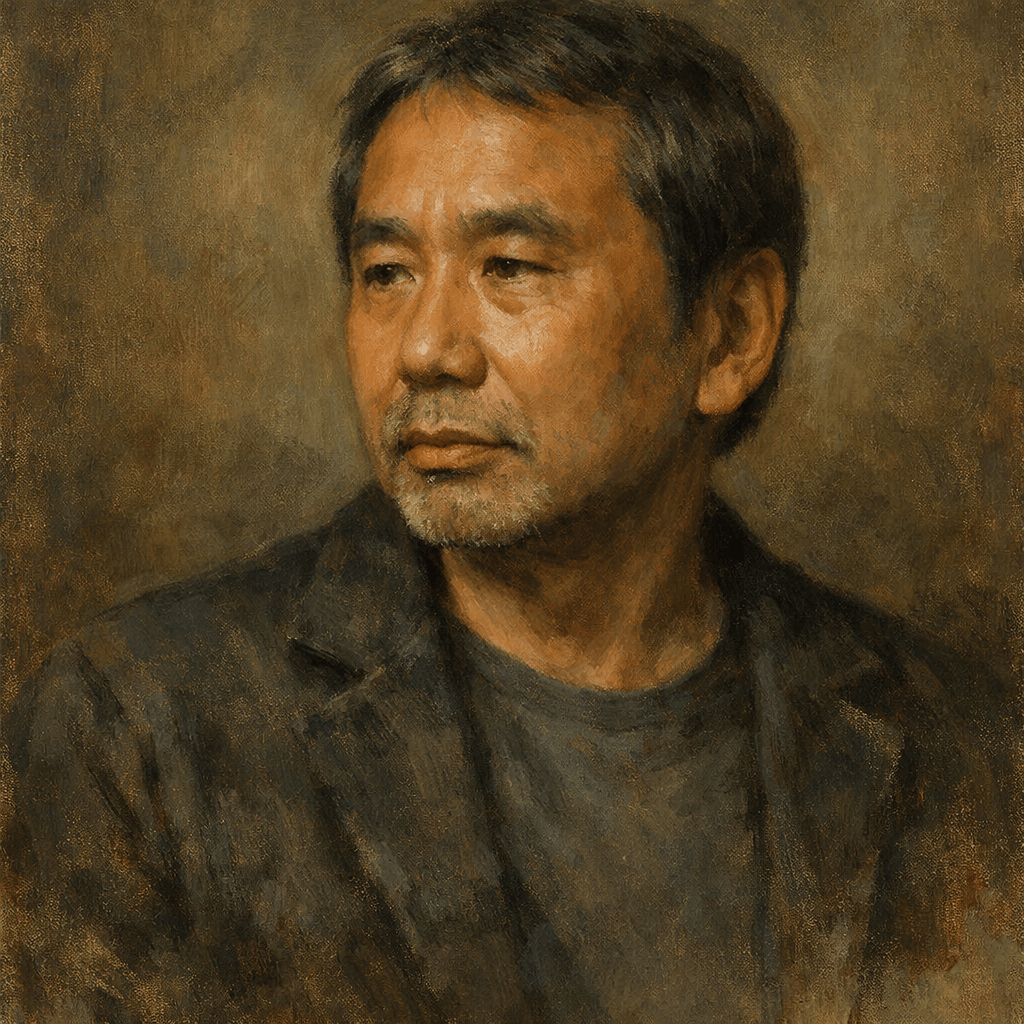
Haruki Murakami’s enduring legacy lies in his ability to distill the complexities of the human experience into words that feel both intimately personal and universally resonant. Across decades of storytelling, his quotes have become touchstones for readers navigating life’s profound mysteries. By weaving together the mundane and the surreal, the melancholic and the hopeful, Murakami has crafted a literary universe that challenges us to confront existence’s ambiguities while finding beauty in them. His impact transcends language and borders, offering a mirror to the soul and a compass for the uncharted territories of the mind.
The themes explored in his quotes—life and death, love’s fragile constancy, the interplay of dreams and reality, the transformative power of pain, and the relentless pursuit of self—reflect a writer deeply attuned to the paradoxes of being. Murakami reminds us that boundaries are illusions, that art is a portal to truth, and that time’s passage is both a thief and a gift. As we turn the final page, his words leave us with an invitation: to lean into the unknown, to trust the quiet voice within, and to find courage in the spaces between what is said and what remains unspeakable. In the spirit of Murakami, let these quotes not just be read, but lived—guiding us toward the mysteries we’re meant to discover.
Explore Quote Collections

Books & Knowledge
Explore the best quotes about the power of reading, the magic of libraries, book collecting, literary wisdom, and the timeless bond between reader and author.
Friendship
Explore the best friendship quotes about true friends, loyalty, trust, betrayal, love, and lifelong bonds. Browse curated quote collections by theme.
Life
Explore the deepest questions of existence. A curated collection of quotes on the journey of life, the pursuit of wisdom, the beauty of struggle, and the acceptance of mortality.
Persistence & Progress
Discover the power of steady progress. Explore curated quotes on overcoming challenges, simplifying complex problems, staying focused, and the art of getting things done.
You Might Also Like

Patrick Wright
Software engineer and creator of Quotesperation. I curate wisdom from history's greatest minds to inspire and guide modern life. When I'm not collecting quotes, I'm writing about technology and finding connections between timeless wisdom and today's challenges.