Historical Context of Famous Quotes: Understanding the Power Behind Memorable Words
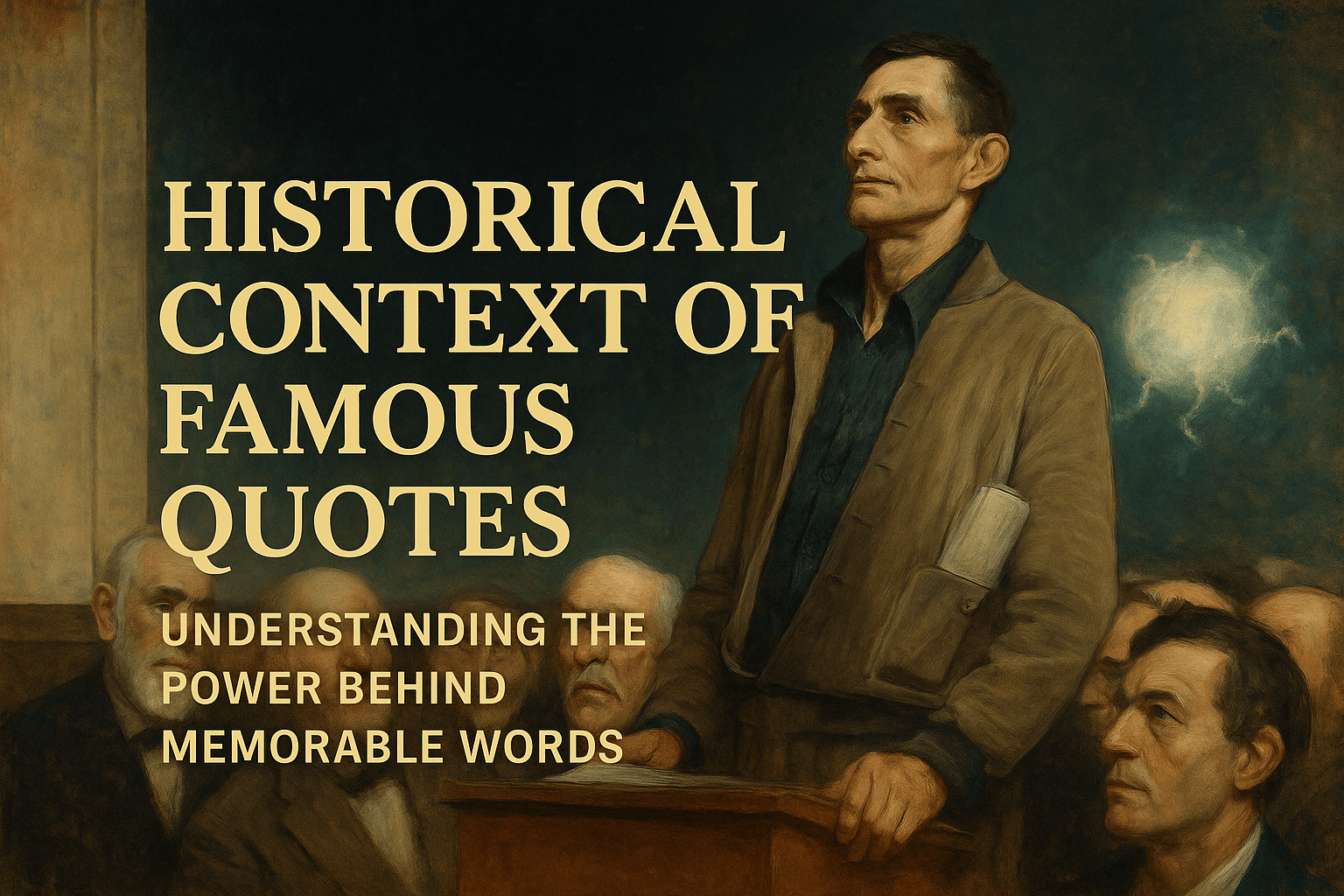
Words have the remarkable ability to transcend time, echoing across centuries to inspire, provoke, and illuminate the human experience. Famous quotes often become divorced from their original context, taking on new meanings as they're shared, reshared, and reimagined through social media, motivational posters, and casual conversation. However, understanding the historical circumstances that birthed these memorable phrases reveals layers of meaning that make them infinitely more powerful and profound.
When we examine famous quotes within their proper historical framework, we discover that many of our most cherished sayings emerged from moments of crisis, triumph, desperation, or revelation. The context doesn't merely provide background information—it transforms our understanding of the speaker's intent, the audience's reception, and the quote's enduring relevance.
The Revolutionary Spirit: Words That Changed Nations
Some of the most enduring quotes in human history emerged from revolutionary moments when the old order was crumbling and new possibilities seemed within reach. These words weren't spoken in ivory towers or comfortable drawing rooms, but in the heat of transformation when every phrase could mean the difference between freedom and oppression.
"Give me liberty, or give me death!" - Patrick Henry's famous declaration wasn't delivered as a philosophical musing about freedom, but as a rallying cry during a heated debate in the Virginia Convention on March 23, 1775. The American colonies stood at a crossroads, with some delegates still hoping for reconciliation with Britain while others pushed for armed resistance. Henry's words came at the climax of a passionate speech where he argued that the colonies had exhausted all peaceful means of resolving their disputes with the Crown. The phrase gained its power not from abstract political theory, but from the desperate urgency of a people who saw war as their only remaining option.
Similarly, "Let them eat cake" (though likely never spoken by Marie Antoinette) represents the profound disconnect between France's aristocracy and its starving masses in the years leading up to the French Revolution. Whether the phrase originated with Marie Antoinette, an earlier princess, or was simply attributed to her by revolutionaries seeking to demonize the monarchy, its historical context reveals the explosive social tensions that would soon tear French society apart. The quote embodies not just individual callousness, but an entire system's inability to comprehend the suffering it had created.
The French Revolution also gave us "L'État, c'est moi" (I am the state), attributed to Louis XIV. While historians debate whether the Sun King actually spoke these exact words, the phrase perfectly encapsulates the absolute monarchy that the revolutionaries sought to destroy. Understanding this context transforms the quote from a simple expression of arrogance into a symbol of the divine right of kings that seemed so natural to one era and so abhorrent to the next.
Words in the Crucible of War
Military conflicts have always been fertile ground for memorable quotes, but their true meaning emerges only when we understand the desperate circumstances that produced them. These weren't casual observations about warfare, but words spoken when nations hung in the balance and individual decisions could alter the course of history.
"I have not yet begun to fight!" attributed to John Paul Jones during his naval battle with HMS Serapis in 1779, represents more than American bravado. Jones commanded the aging and outgunned Bonhomme Richard against a superior British vessel. When the British captain called for surrender after Jones's ship had been severely damaged, the American captain's defiant response came at a moment when defeat seemed certain. The historical context reveals that this wasn't empty boasting but a desperate gamble that ultimately succeeded when Jones captured the British ship. The quote embodies the underdog spirit that characterized much of the American Revolutionary War.
World War II produced some of the most memorable quotes in modern history, each gaining significance from the existential threat facing democratic civilization. "We shall never surrender" from Winston Churchill's speech to Parliament on June 4, 1940, came at Britain's darkest hour. France was falling, British forces had barely escaped from Dunkirk, and Nazi invasion seemed imminent. Churchill's words weren't delivered as inspiring rhetoric to a confident nation, but as a desperate promise to a people who faced the very real possibility of defeat and occupation. The historical context transforms the quote from mere defiance into a leader's commitment to fight alone if necessary against overwhelming odds.
"The only thing we have to fear is fear itself" from Franklin D. Roosevelt's first inaugural address gains profound meaning when we understand the economic catastrophe facing America in March 1933. Banks were failing daily, unemployment had reached 25 percent, and the very foundations of the capitalist system seemed to be crumbling. Roosevelt's words weren't platitudes about positive thinking, but a calculated attempt to prevent panic from completing the economic collapse that fear and uncertainty had already begun.
Civil Rights and Social Justice: Voices from the Struggle
The fight for civil rights and social justice has produced some of history's most powerful quotes, but their impact can only be fully appreciated when we understand the courage required to speak truth to power in societies built on oppression and inequality.
"I have a dream" represents perhaps the most famous phrase from Martin Luther King Jr.'s speech at the March on Washington on August 28, 1963. While the words themselves speak to universal hopes for equality and justice, the historical context reveals their revolutionary nature. King spoke to 250,000 people gathered at the Lincoln Memorial, but his words were also directed at a nation where segregation was still legal, where Black Americans were routinely denied basic rights, and where nonviolent protesters faced brutal violence from authorities. The "dream" wasn't a passive wish but an active challenge to a system that had denied equality for nearly a century after the Civil War.
Understanding this context also illuminates King's strategic brilliance. Speaking at the Lincoln Memorial, he explicitly connected the civil rights movement to America's founding principles and to Lincoln's legacy. The historical setting transformed his words from a protest into a redemptive vision that called America to fulfill its own promises.
"The arc of the moral universe is long, but it bends toward justice" is another King quote that gains power from historical context. While often cited as evidence of inevitable progress, King spoke these words during periods of severe backlash against civil rights advances. He wasn't expressing confidence in automatic improvement but faith that sustained struggle would eventually prevail over injustice. The historical context reveals this as a statement of determined hope rather than passive optimism.
Sojourner Truth's "Ain't I a woman?" delivered at the Women's Convention in Akron, Ohio, in 1851, emerged from the intersection of two liberation movements. As both a woman and a formerly enslaved person, Truth challenged not only male supremacy but also the racism within the women's rights movement itself. Her words gained power from her personal experience of being denied the protections and courtesies that white women claimed as their due, while simultaneously being expected to perform the same hard labor as men.
Scientific and Philosophical Revelations
Even quotes from the world of science and philosophy gain deeper meaning when we understand the intellectual and social contexts that produced them. These weren't abstract musings but responses to specific challenges and discoveries that reshaped human understanding.
"And yet it moves" (Eppur si muove), supposedly muttered by Galileo after being forced to recant his support for heliocentrism, may be apocryphal, but it captures the tension between scientific truth and religious authority that defined the Scientific Revolution. Whether Galileo actually spoke these words or not, they represent the courage required to challenge established beliefs even when faced with persecution. The historical context of the Catholic Church's resistance to scientific discoveries that seemed to contradict scripture gives the phrase its power as a symbol of intellectual integrity.
"God does not play dice with the universe" from Albert Einstein reflects not casual theism but his deep discomfort with quantum mechanics' implications for causality and determinism. Understanding the specific scientific debates of the early 20th century—particularly Einstein's conflicts with Niels Bohr and other physicists over quantum theory—reveals this as a statement about the fundamental nature of reality rather than a simple expression of religious faith.
Charles Darwin's observation that "It is not the strongest of the species that survives, nor the most intelligent that survives. It is the one that is most adaptable to change" (often paraphrased) gains significance from the fierce resistance his theories encountered from religious and scientific establishments. These words weren't academic speculation but a revolutionary challenge to humanity's understanding of its place in the natural world.
The Power of Context in Modern Times
Contemporary events continue to produce quotes that will likely endure, but understanding their immediate context remains crucial for grasping their full significance. Social media and global communication have accelerated the spread of memorable phrases while sometimes stripping away the circumstances that gave them meaning.
"Mr. Gorbachev, tear down this wall!" from Ronald Reagan's 1987 speech in Berlin demonstrates how historical context can completely transform our understanding of a quote's significance. At the time, many dismissed Reagan's words as empty rhetoric—the Berlin Wall seemed permanent, and few imagined that the Soviet Union itself would collapse within four years. The historical context reveals that Reagan spoke these words not as confident prophecy but as a challenge to what seemed like an immutable reality. When the wall actually fell in 1989, the quote was retroactively transformed from political theater into prophetic vision.
The digital age has created new challenges for understanding historical context. "Yes we can" became Barack Obama's signature phrase during his 2008 presidential campaign, but its power came from specific historical circumstances—a nation exhausted by war, economic crisis, and political polarization. The phrase offered hope for change during a moment when many Americans had lost faith in their institutions and leaders.
Misattribution and the Evolution of Meaning
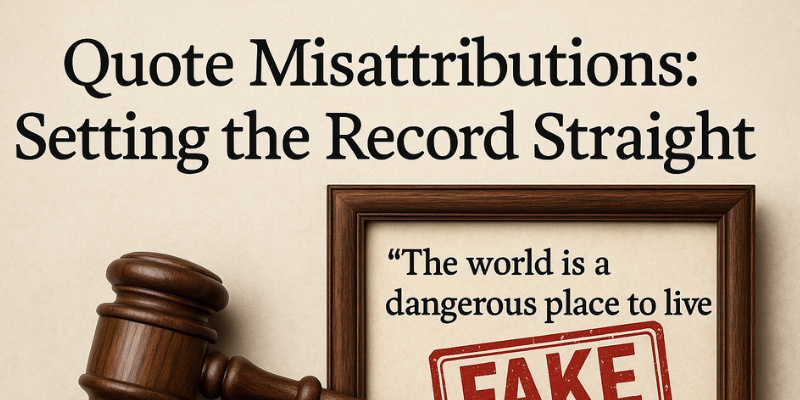
One of the most fascinating aspects of famous quotes is how their meanings can evolve or become distorted as they're separated from their historical contexts. Many quotes attributed to famous figures were never actually spoken by them, but these misattributions often reveal more about our own times than about the supposed speakers.
"The definition of insanity is doing the same thing over and over and expecting different results" is commonly attributed to Einstein, but no evidence suggests he ever said anything similar. The quote's persistence and false attribution reflect our contemporary desire to find scientific authority for common-sense observations about human behavior.
Similarly, "Be yourself; everyone else is already taken" is widely attributed to Oscar Wilde, but scholars have found no evidence he wrote or spoke these words. The attribution succeeds because the sentiment sounds like something Wilde might have said, reflecting our image of him as a witty advocate for individualism and authenticity.
These misattributions remind us that famous quotes often function as modern myths, carrying meanings that transcend their supposed origins. However, understanding authentic historical context remains crucial for appreciating the genuine insights and courage of historical figures.
Lessons for Understanding Our Own Time
Examining famous quotes within their historical contexts offers valuable lessons for navigating our contemporary world. It reminds us that memorable words often emerge from moments of crisis, uncertainty, and transformation—times much like our own.
Understanding historical context also reveals how quotes can be manipulated or misused when separated from their original circumstances. Political leaders and commentators regularly invoke historical figures to support contemporary positions that those figures might not have recognized or endorsed.
Moreover, studying the historical context of famous quotes illuminates the continuing relevance of past struggles and insights. The challenges faced by previous generations—inequality, injustice, war, scientific ignorance, and political oppression—remain with us in new forms. The words that inspired previous generations to confront these challenges can still guide us today, but only if we understand what made them powerful in the first place.
Conclusion: The Enduring Power of Context
Famous quotes derive their lasting power not from their words alone but from the historical moments that gave those words meaning. Understanding the circumstances that produced memorable phrases—the crises that demanded courage, the injustices that sparked resistance, the discoveries that challenged orthodoxy—transforms them from mere collections of words into windows into the human experience.
As we face our own historical moment with its unique challenges and opportunities, we can draw inspiration from the past not by simply repeating famous phrases but by understanding the contexts that made them meaningful. The courage to speak truth to power, the vision to imagine a better world, and the determination to persevere through difficulty remain as relevant today as they were when these words were first spoken.
Historical context doesn't diminish the power of famous quotes—it amplifies it. By understanding the specific circumstances that produced these memorable words, we can better appreciate both their original significance and their continuing relevance. In doing so, we honor not just the words themselves but the courage, wisdom, and humanity of those who spoke them into existence during their own defining moments in history.
The next time you encounter a famous quote, take a moment to explore its historical context. You might discover that behind those familiar words lies a story of courage, insight, or determination that makes them far more powerful than you ever imagined. In our interconnected but often superficial age, this deeper understanding becomes not just intellectually rewarding but essential for comprehending the forces that have shaped our world and continue to influence our future.
Explore Quote Collections

Books & Knowledge
Explore the best quotes about the power of reading, the magic of libraries, book collecting, literary wisdom, and the timeless bond between reader and author.
Friendship
Explore the best friendship quotes about true friends, loyalty, trust, betrayal, love, and lifelong bonds. Browse curated quote collections by theme.

Life
Explore the deepest questions of existence. A curated collection of quotes on the journey of life, the pursuit of wisdom, the beauty of struggle, and the acceptance of mortality.

Persistence & Progress
Discover the power of steady progress. Explore curated quotes on overcoming challenges, simplifying complex problems, staying focused, and the art of getting things done.
You Might Also Like


Patrick Wright
Software engineer and creator of Quotesperation. I curate wisdom from history's greatest minds to inspire and guide modern life. When I'm not collecting quotes, I'm writing about technology and finding connections between timeless wisdom and today's challenges.