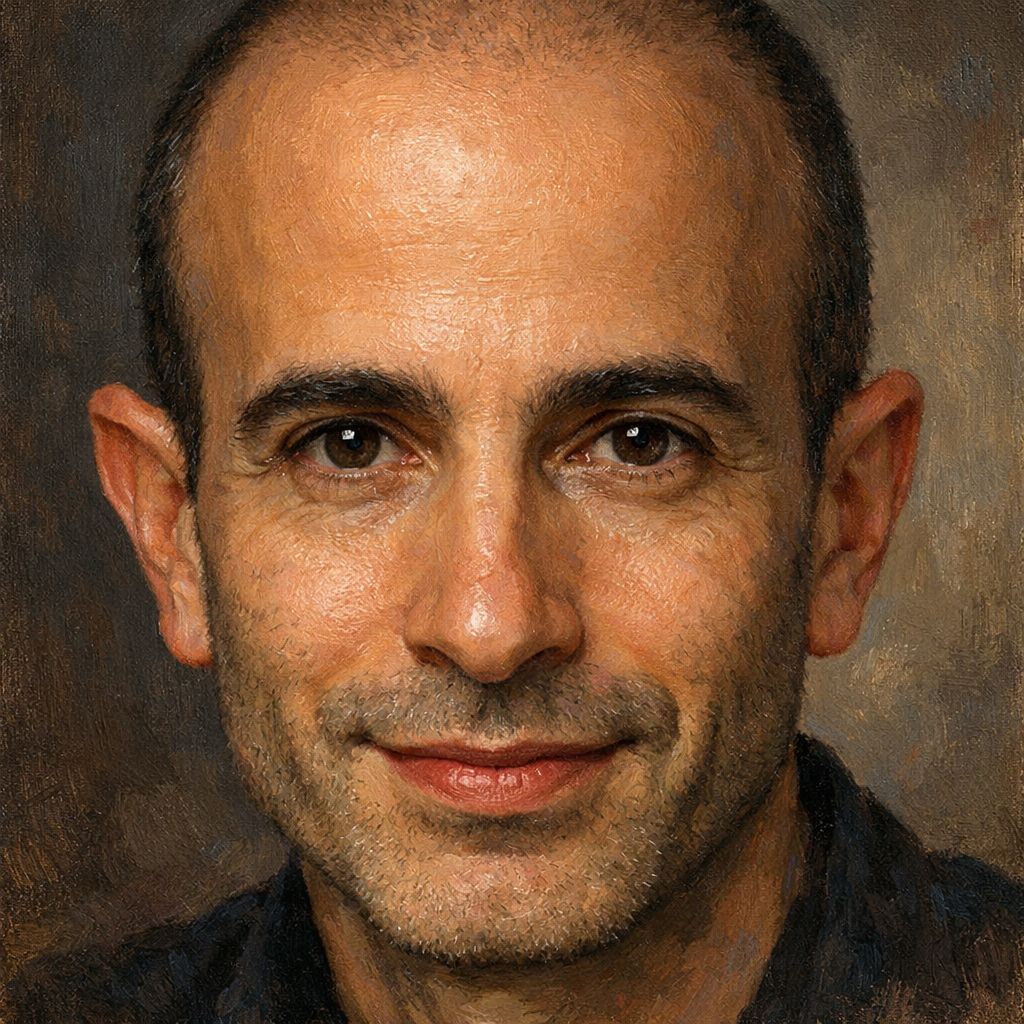
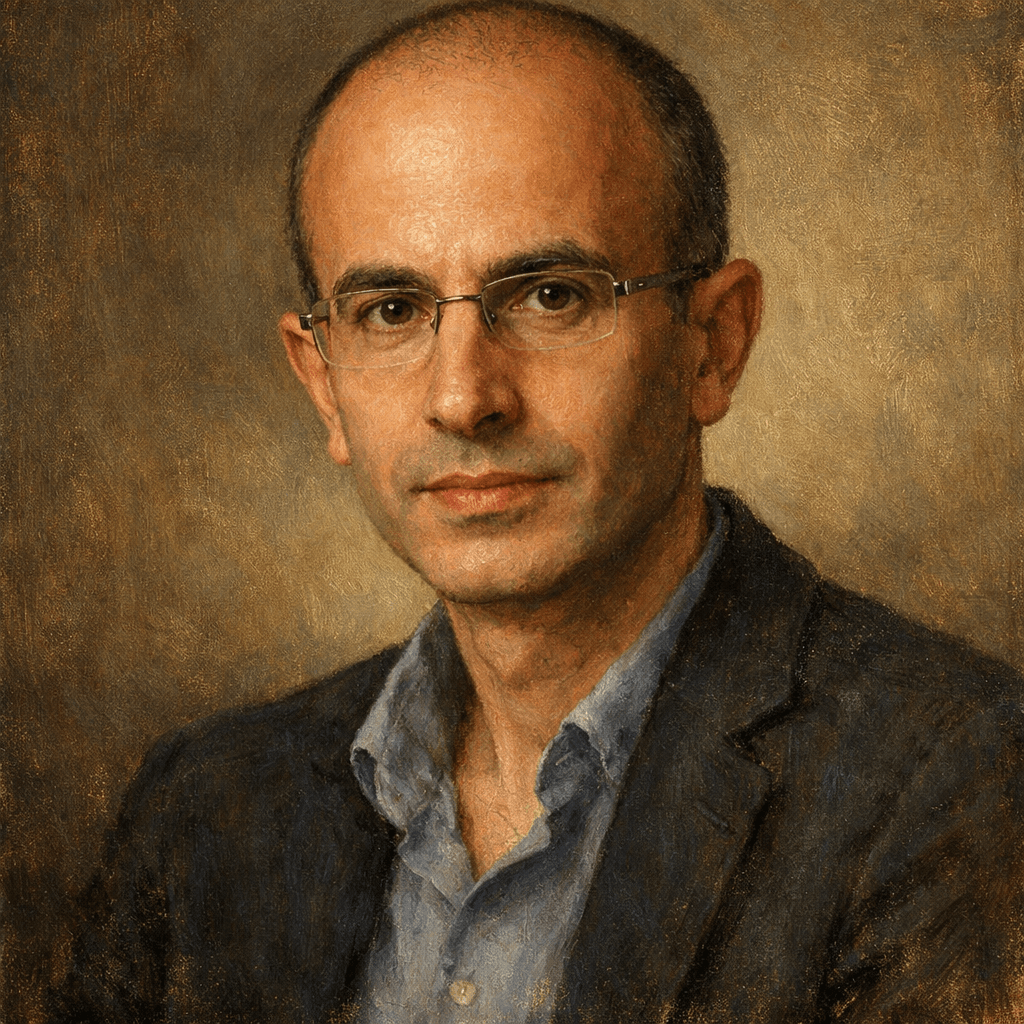
About Yuval Noah Harari
Yuval Noah Harari (born November 23, 1976) is an Israeli historian, philosopher, and author renowned for his interdisciplinary approach to human history and future challenges. A professor at the Hebrew University of Jerusalem, he has gained global acclaim for distilling complex historical, scientific, and societal trends into accessible narratives that challenge conventional thinking.
Harari’s most influential works include Sapiens: A Brief History of Humankind (2014), Homo Deus: A Brief History of Tomorrow (2016), and 21 Lessons for the 21st Century (2018). These books explore humanity’s evolution, the impact of technological and biological advancements, and existential questions about the future of society, consciousness, and meaning. His ability to synthesize insights from history, biology, economics, and philosophy has reshaped public discourse on humanity’s past and trajectory.
Harari’s work holds significant cultural and intellectual influence, offering frameworks to understand contemporary issues like artificial intelligence, climate change, and political polarization. His critical examination of myths, ideologies, and systems of power encourages readers to question assumptions about progress and identity. In an era defined by rapid technological and social change, his ideas serve as a compass for navigating uncertainty, urging humanity to confront ethical dilemmas and foster collective wisdom to shape a sustainable future.
Yuval Noah Harari is one of the most provocative and visionary thinkers of our time, blending history, science, philosophy, and futurology to unravel the mysteries of human existence. From Sapiens to Homo Deus, his work challenges us to reconsider what it means to be human, how societies are built, and where technology might lead us next. With a razor-sharp intellect and a storyteller’s flair, Harari dissects the forces that shape our world—power, belief, cooperation, and imagination—offering insights that are as illuminating as they are unsettling.
This collection of 150 quotes distills his wisdom into moments of clarity, spanning themes like the power of fiction to unite humanity, the paradoxes of happiness and suffering, the evolution of society, and the ethical dilemmas of our technological future. Whether he’s dissecting the myths that bind civilizations, questioning the myths we tell ourselves about happiness, or envisioning a world transformed by artificial intelligence, Harari’s words cut through complexity to reveal profound truths. Dive in, and let his ideas spark curiosity, challenge assumptions, and inspire you to think beyond the boundaries of the ordinary.
Table of Contents
- Imagination and Fiction
- Happiness and Suffering
- Human Society and Cooperation
- Power and Control
- Religion and Belief
- History and Evolution
- Technology and Future
- Economics and Capitalism
- Knowledge and Education
- Nature and Environment
- Conclusion
Imagination and Fiction
Yuval Noah Harari underscores how human imagination and shared fiction form the bedrock of modern society, enabling cooperation through invented constructs like nations, money, and corporations. His insights reveal the paradox of fictional realities that wield tangible power over our lives, blurring the line between myth and truth.
"Corporations, money and nations exist only in our imagination. We invented them to serve us; why do we find ourselves sacrificing our lives in their services?" - Yuval Noah Harari
"Consumerism and nationalism work extra hours to make us imagine that millions of strangers belong to the same community as ourselves, that we have a common past, common interests and a common future. This isn't a lie. It's imagination. Like money, limited liability companies and human rights, nations and consumer tribes are inter-subjective realities. They exist only in our collective imagination, yet their power is immense." - Yuval Noah Harari
"Ever since the Cognitive Revolution, Sapiens have thus been living in a dual reality. On the one hand, the objective reality of rivers, trees and lions; and on the other hand, the imagined reality of gods, nations and corporations. As time went by, the imagined reality became ever more powerful, so that today the very survival of rivers, trees and lions depends on the grace of imagined entities such as the United States and Google." - Yuval Noah Harari
Harari’s first three quotes reveal how human society thrives on shared fictions, which, though intangible, dominate even the natural world.
"If you ask for the true meaning of life and get a story in reply, know that this is the wrong answer. The exact details don’t really matter. Any story is wrong, simply for being a story. The universe just does not work like a story." - Yuval Noah Harari
"The cause of war is fictional, but the suffering is 100 per cent real. This is exactly why we should strive to distinguish fiction from reality." - Yuval Noah Harari
"Can a nation really suffer? Has a nation eyes, hands, senses, affections and passions? If you prick it, can it bleed? Obviously not. If it is defeated in war, loses a province, or even forfeits its independence, still it cannot experience pain, sadness or any other kind of misery, for it has no body, no mind, and no feelings whatsoever. In truth, it is just a metaphor." - Yuval Noah Harari
These quotes highlight Harari’s warning: while nations and stories may be metaphors, their real-world consequences—like war and loss—are devastatingly concrete.
"Fiction isn't bad. It is vital. Without commonly accepted stories about things like money, states or corporations, no complex human society can function. We can't play football unless everyone believes in the same made-up rules, and we can't enjoy the benefits of markets and courts without similar make-believe stories. But the stories are just tools. They should not become our goals or yardsticks. When we forget that they are mere fiction, we lose touch with reality." - Yuval Noah Harari
"There are no gods, no nations, no money and no human rights, except in our collective imagination." - Yuval Noah Harari
"Large numbers of strangers can cooperate successfully by believing in common myth." - Yuval Noah Harari
Harari argues here that fiction is not inherently destructive—it’s a necessary tool for human collaboration, but only when kept in its proper place.
"People easily understand that 'primitives' cement their social order by believing in ghosts and spirits, and gathering each full moon to dance together around the campfire. What we fail to appreciate is that our modern institutions function on exactly the same basis. Take for example the world of business corporations, Modern business-people and lawyers are, in fact, powerful sorcerers. The principal difference between them and tribal shamans is that modern lawyers tell far stranger tales." - Yuval Noah Harari
"We believe in a particular order not because it is objectively true, but because believing in it enables us to cooperate effectively and forge a better society. Imagined orders are not evil conspiracies or useless mirages. Rather, they are the only way large numbers of humans can cooperate effectively." - Yuval Noah Harari
"Humans have this remarkable ability to know and not to know at the same time. Or more correctly, they can know something when they really think about it, but most of the time they don't think about it, so they don't know it. If you really focus, you realise that money is fiction. But usually, you don't focus. If you are asked about it, you know that football is a human invention. But in the heat of the match, nobody asks you about it." - Yuval Noah Harari
Here, Harari draws a parallel between ancient rituals and modern systems, emphasizing how our collective belief in myths binds society together.
"Consumerism tells us that in order to be happy we must consume as many products and services as possible. If we feel that something is missing or not quite right, then we probably need to buy a product (a car, new clothes, organic food) or a service (housekeeping, relationship therapy, yoga classes). Every television commercial is another little legend about how consuming some product or service will make life better." - Yuval Noah Harari
"When a thousand people believe some made-up story for a month - that's fake news. When a billion people believe it for a thousand years - that's religion, and we are admonished to call it fake news in order not to hurt the feelings of the faithful." - Yuval Noah Harari
"Liberalism will collapse on the day the system knows me better than I know myself." - Yuval Noah Harari
These quotes critique consumerism and ideological rigidity, exposing how myths evolve into dogmas that shape our identities and freedoms.
"Homo sapiens does its best to forget the fact, but it is an animal. And it is doubly important to remember our origins at a time when we seek to turn ourselves into gods. No investigation of our divine future can ignore our own animal past, or our relations with other animals – because the relationship between humans and animals is the best model we have for future relations between superhumans and humans." - Yuval Noah Harari
"When the car replaced the horse-drawn carriage, we didn’t upgrade the horses – we retired them. Perhaps it is time to do the same with Homo sapiens." - Yuval Noah Harari
"Seventy thousand years ago, Homo sapiens was still an insignificant animal minding its own business in a corner of Africa. In the following millennia it transformed itself into the master of the entire planet and the terror of the ecosystem. Today it stands on the verge of becoming a god, poised to acquire not only eternal youth, but also the divine abilities of creation and destruction." - Yuval Noah Harari
Harari’s final trio of quotes reflects on humanity’s meteoric rise and the ethical chaos of our imagined future, urging humility in the face of our own godlike ambitions.
Happiness and Suffering
Yuval Noah Harari explores the paradoxes of human existence, dissecting how happiness and suffering are intertwined with our perceptions, cravings, and the narratives we construct. Drawing from Buddhist philosophy, evolutionary science, and modern data, he challenges conventional wisdom to reveal the raw truths about craving, identity, and the futility of seeking lasting satisfaction through external means.
"He encapsulated his teachings in a single law: suffering arises from craving; the only way to be fully liberated from suffering is to be fully liberated from craving; and the only way to be liberated from craving is to train the mind to experience reality as it is." - Yuval Noah Harari
"The key to happiness is to know the truth about yourself - to understand you really are. Most people wrongly identify themselves with their feeling, thoughts, likes and dislikes. When they feel anger, they think, ‘I am angry. This is my anger.’ They consequently spend their life avoiding some kinds of feelings and pursuing others. They never realise that they are not their feelings, and that the relentless pursuit of particular feelings just traps them in misery." - Yuval Noah Harari
"If you experience sadness without craving that the sadness go away, you continue to feel sadness, but you do not suffer from it. There can actually be richness in the sadness. If you experience joy without craving that the joy linger and intensify, you continue to feel joy without losing your peace of mind." - Yuval Noah Harari
Harari’s quotes here dismantle the illusion that happiness is a state to be pursued, instead framing it as a byproduct of accepting impermanence and disentangling the self from transient emotions.
"The first principle of monotheist religions is 'God exists. What does He want from me?' The first principle of Buddhism is 'Suffering exists. How do I escape it?" - Yuval Noah Harari
"Science says that nobody is ever made happy by getting a promotion, winning the lottery or even finding true love. People are made happy by one thing and one thing only - pleasant sensations in their bodies." - Yuval Noah Harari
"In 2012 about 56 million people died throughout the world; 620,000 of them died due to human violence (war killed 120,000 people, and crime killed another 500,000). In contrast, 800,000 committed suicide, and 1.5 million died of diabetes. Sugar is now more dangerous than gunpowder." - Yuval Noah Harari
These quotes juxtapose spiritual and scientific perspectives, revealing how both systems grapple with existential questions while highlighting humanity’s paradoxical relationship with comfort and self-destruction.
"Do you think that if you just eat enough ice cream, the accumulated pleasure could ever equal the rapture of true love?" - Yuval Noah Harari
"According to the Buddha, then, life has no meaning, and people don’t need to create any meaning. They just need to realise that there is no meaning, and thus be liberated from the suffering caused by our attachments and our identification with empty phenomena." - Yuval Noah Harari
"As far as we can tell, from a purely scientific viewpoint, human life has absolutely no meaning. Humans are the outcome of blind evolutionary processes that operate without goal or purpose. Our actions are not part of some divine cosmic plan, and if planet Earth were to blow up tomorrow morning, the universe would probably keep going about business as usual." - Yuval Noah Harari
Harari’s existential lens strips away both spiritual and materialist illusions, urging readers to confront the void of meaning while finding freedom in that very emptiness.
"The idea that we need a supernatural being to make us act morally assumes that there is something unnatural about morality. But why? Morality of some kind is natural. All social mammals from chimpanzees to rats have ethical codes that limit things such as theft and murder." - Yuval Noah Harari
"To survive and flourish in such a world, you will need a lot of mental flexibility and great reserves of emotional balance. You will have to repeatedly let go of some of what you know best, and feel at home with the unknown." - Yuval Noah Harari
"Our narrating self would much prefer to continue suffering in the future, just so it won't have to admit that our past suffering was devoid of all meaning. Eventually, if we want to come clean about past mistakes, our narrating self must invent some twist in the plot that will infuse these mistakes with meaning." - Yuval Noah Harari
Here, Harari critiques the narratives we create to justify suffering, while emphasizing the adaptability required to navigate an uncertain world.
"The generally accepted definition of happiness is 'subjective well-being. Happiness, according to this view, is something I feel inside myself, a sense of either immediate pleasure or long-term contentment with the way my life is going. If it's something felt inside, how can it be measured from outside?" - Yuval Noah Harari
"The Buddha taught that the three basic realities of the universe are that everything is constantly changing, nothing has any enduring essence, and nothing is completely satisfying. You can explore the furthest reaches of the galaxy, of your body, or of your mind – but you will never encounter something that does not change, that has an eternal essence, and that completely satisfies you." - Yuval Noah Harari
"Buddhism does not deny the existence of gods—they are described as powerful beings who can bring rains and victories—but they have no influence on the law that suffering arises from craving. If the mind of a person is free of all craving, no god can make him miserable. Conversely, once craving arises in a person's mind, all the gods in the universe cannot save him from suffering." - Yuval Noah Harari
These quotes confront the futility of seeking satisfaction in a world governed by impermanence, aligning Buddhist principles with scientific skepticism.
"Much of the vaunted material wealth that shields us from disease and famine was accumulated at the expense of laboratory monkeys, dairy cows and conveyor-belt chickens. Over the last two centuries tens of billions of them have been subjected to a regime of industrial exploitation whose cruelty has no precedent in the annals of planet earth. If we accept a mere tenth of what animal-rights activists are claiming, then modern industrial agriculture might well be the greatest crime in history." - Yuval Noah Harari
"Unfortunately, the Sapiens regime on Earth has so far produced little that we can be proud of. We have mastered our surroundings, increased food production, built cities, established empires and created far-flung trade networks. But did we decrease the amount of suffering in the world?" - Yuval Noah Harari
Harari’s final quotes here shift focus to humanity’s collective role in global suffering, challenging the notion that progress inherently reduces pain.
Human Society and Cooperation
Yuval Noah Harari’s work delves into the paradox of human cooperation, exploring how imagined realities—nations, corporations, religions—bind strangers into cohesive societies. His quotes reveal the fragile yet powerful scaffolding of human civilization, built on shared myths and collective imagination.
"Corporations, money and nations exist only in our imagination. We invented them to serve us; why do we find ourselves sacrificing our lives in their services?" - Yuval Noah Harari
"Consumerism and nationalism work extra hours to make us imagine that millions of strangers belong to the same community as ourselves, that we have a common past, common interests and a common future. This isn't a lie. It's imagination. Like money, limited liability companies and human rights, nations and consumer tribes are inter-subjective realities. They exist only in our collective imagination, yet their power is immense." - Yuval Noah Harari
"Ever since the Cognitive Revolution, Sapiens have thus been living in a dual reality. On the one hand, the objective reality of rivers, trees and lions; and on the other hand, the imagined reality of gods, nations and corporations. As time went by, the imagined reality became ever more powerful, so that today the very survival of rivers, trees and lions depends on the grace of imagined entities such as the United States and Google." - Yuval Noah Harari
Harari’s early quotes underscore how human societies are anchored in shared fictions, which he describes as both a tool and a trap.
"We have more choice than ever before, but no matter what we choose, we have lost the ability to really pay attention to it." - Yuval Noah Harari
"So if you want to know the truth about the universe, about the meaning of life, and about your own identity, the best place to start is by observing suffering and exploring what it is.The answer isn’t a story." - Yuval Noah Harari
"Large numbers of strangers can cooperate successfully by believing in common myth." - Yuval Noah Harari
Here, Harari critiques modernity’s illusion of freedom while emphasizing the role of myths in fostering cooperation. His focus on suffering and myth highlights the tension between individual experience and collective narratives.
"Trade cannot exist without trust, and it is very difficult to trust strangers." - Yuval Noah Harari
"Sapiens don’t behave according to a cold mathematical logic, but rather according to a warm social logic. We are ruled by emotions." - Yu Ival Noah Harari
"There is today a division of labor between the elite and the masses. In medieval Europe aristocrats spent their money carelessly on extravagant luxuries whereas peasants lived frugally minding every penny. Today the tables have turned. The rich take great care managing their assets and investments, while the less well-heeled go into debt buying cars and televisions they don't really need." - Yuval Noah Harari
These quotes dissect the mechanics of trust, emotion, and economic disparity, illustrating how human societies balance cooperation with inequality.
"Studying history aims to loosen the grip of the past. It enables us to turn our head this way and that, and begin to notice possibilities that our ancestors could not imagine, or didn’t want us to imagine." - Yuval Noah Harari
"Human diversity may be great when it comes to cuisine and poetry, but few would see witch-burning, infanticide or slavery as fascinating human idiosyncrasies that should be protected against the encroachments of global capitalism and coca-colonialism." - Yuval Noah Harari
"The collapse of the family and the local community and their replacement by the state and the market." - Yuval Noah Harari
Harari challenges romanticized views of cultural diversity, arguing that history and institutions like the state and market reshape societal structures.
"The currency of evolution is neither hunger nor pain, but rather copies of DNA helixes." - Yuval Noah Harari
"Humans nowadays completely dominate the planet not because the individual human is far smarter and more nimble-fingered than the individual chimp or wolf, but because Homo sapiens is the only species on earth capable of cooperating flexibly in large numbers." - Yuval Noah Harari
These final quotes pivot to evolutionary and biological perspectives, framing human dominance as a product of cooperative capacity rather than individual brilliance.
"Less than a hundred. (And even these are mostly Polish wolves that stole over the border in recent years.) In contrast, Germany is home to 5 million domesticated dogs. Altogether about 200,000 wild wolves still roam the earth, but there are more than 400 million domesticated dogs. The world contains 40,000 lions compared to 600 million house cats; 900,000 African buffalo versus 1.5 billion domesticated cows; 50 million penguins and 20 billion chickens." - Yuval Noah Harari
This vivid comparison underscores humanity’s role in reshaping ecosystems through domestication and large-scale cooperation, a recurring theme in Harari’s analysis.
Power and Control
Yuval Noah Harari explores how power and control shape human societies, from ancient empires to the algorithms of the digital age. His insights dissect the mechanisms of authority, the manipulation of desires, and the fragility of systems that govern our lives.
"The only thing we can try to do is to influence the direction scientists are taking. Since we might soon be able to engineer our desires too, perhaps the real questions facing us is not 'What do we want to become?', but 'What do we want to want?' Those who are not spooked by this question probably haven't given it enough thought." - Yuval Noah Harari
"Though it has no intrinsic value – you cannot eat or drink a dollar bill – trust in the dollar and in the wisdom of the Federal Reserve is so firm that it is shared even by Islamic fundamentalists, Mexican drug lords and North Korean tyrants." - Yuval Noah Harari
"This is the fly in the ointment of free-market capitalism. It cannot ensure that profits are gained in a fair way, or distributed in a fair manner. On the contrary, the craving to increase profits and production blinds people to anything that might stand in the way." - Yuval Noah Harari
Harari highlights how economic systems and human desires are intertwined, often obscuring ethical considerations under the guise of progress.
"In truth, our concepts 'natural' and 'unnatural' are taken not from biology, but from Christian theology. The theological meaning of 'natural' is 'in accordance with the intentions of the God who created nature ... To use our body differently than God intends is 'unnatural.' But evolution has no purpose." - Yuval Noah Harari
"So the best advice I could give a fifteen-year-old stuck in an outdated school somewhere in Mexico, India or Alabama is: don’t rely on the adults too much. Most of them mean well, but they just don’t understand the world." - Yuval Noah Harari
"Every day millions of people decide to grant their smartphone a bit more control over their lives or try a new and more effective antidepressant drug. In pursuit of health, happiness and power, humans will gradually change first one of their features and then another, and another, until they will no longer be human." - Yuval Noah Harari
These quotes reveal Harari’s skepticism of rigid definitions and his warning about the unchecked surrender of autonomy to technology and tradition.
"The Industrial Revolution turned the timetable and the assembly line into a template for almost all human activities." - Yuval Noah Harari
"The algorithms will take care of everything. If, however, you want to retain some control of your personal life, you have to run faster than the algorithms, faster than Amazon and the government, and get to know yourself before they do. To run fast, don't take much luggage with you. Leave all your illusions behind. They are very heavy." - Yuval Noah Harari
"Total annihilation has a way of sharpening people's minds." - Yuval Noah Harari
He critiques industrialization and digitalization as forces that standardize human life, while urging individuals to reclaim agency in an age of algorithmic dominance.
"PayPal co-founder Peter Thiel has recently confessed that he aims to live for ever. 'I think there are probably three main modes of approaching death,' he explained. 'You can accept it, you can deny it or you can fight it. I think our society is dominated by people who are into denial or acceptance, and I prefer to fight it." - Yuval Noah Harari
"The first universal order to appear was economic: the monetary order. The second universal order was political: the imperial order. The third universal order was religious: the order of universal religions such as Buddhism, Christianity and Islam." - Yuval Noah Harari
"If I believe in God at all, it is my choice to believe. If my inner self tells me to believe in God- then I believe. I believe because I fell God's presence, and my heart tells me He is there. But if I no longer feel God's presence, and if my heart suddenly tells me that there is no God-I will cease believing. Either way, the real source of authority is my own feelings. So even while saying that I believe in God, the truth is that I have a much stronger belief in my own inner voice." - Yuval Noah Harari
Harari contrasts human ambition with historical systems of control, questioning where true authority lies when faced with mortality and ideology.
"In ancient times having power meant having access to data. Today having power means knowing what to ignore." - Yuval Noah Harari
"The hand of the market is blind as well as invisible, and left to its own devices it may fail to do anything at all about the threat of global warming or the dangerous potential of artificial intelligence." - Yuval Noah Harari
"Unfortunately, in the present political climate any critical thinking about liberalism and democracy might be hijacked by autocrats and various illiberal movements, whose sole interest is to discredit liberal democracy rather than to engage in an open discussion about the future of humanity. While they are more than happy to debate the problems of liberal democracy, they have almost no tolerance of any criticism directed at them." - Yuval Noah Harari
He underscores the paradoxes of modern power: the ability to manipulate information, the market’s blindness to existential threats, and the erosion of democratic discourse.
"The third threat to liberalism is that some people will remain both indispensable and undecipherable, but they will constitute a small and privileged elite of upgraded humans." - Yuval Noah Harari
"A huge gulf is opening between liberal humanism and the latest findings of the life sciences, a gulf we cannot ignore much longer." - Yuval Noah Harari
"An algorithm is a methodical set of steps that can be used to make calculations, resolve problems and reach decisions. An algorithm isn’t a particular calculation, but the method followed when making the calculation." - Yuval Noah Harari
Harari warns of emerging hierarchies, scientific detachment from humanism, and the dehumanizing logic of systems that prioritize efficiency over ethics.
Religion and Belief
Yuval Noah Harari explores the evolution of human belief systems, dissecting how religion, ideology, and cultural narratives shape societies. His work often critiques the intersection of faith, power, and progress, revealing how belief systems—whether ancient or modern—offer frameworks to navigate existential uncertainty while perpetuating both unity and division.
"Discord in our thoughts, ideas and compel us to think, re-evaluate and criticize." - Yuval Noah Harari
"Perhaps the deeper meaning of this commandment is that we should never use the name of God for political interests, economic ambitions, or our personal hatreds. People hate somebody and say 'God hates him.' People covet a piece of land and say 'God wants it.' The world would be a better place if we followed the third commandment more devotedly. You want to wage war on your neighbors and steal their land? Leave God out of it and find yourself some other excuse." - Yuval Noah Harari
"It takes a lot of courage to fight biases and oppressive regimes, but it takes even grater courage to admit ignorance and venture into the unknown." - Yuval Noah Harari
Harari’s early reflections highlight how belief systems can both challenge and reinforce power structures, urging a critical examination of sacred narratives.
"As we come to make the most important decisions in the history of life, I personally would trust more in those who admit ignorance than in those who claim infallibility. If you want your religion, ideology or world view to lead the world, my first question to you is: ‘What was the biggest mistake your religion, ideology or world view committed? What did it get wrong?’ If you cannot come up with something serious, I for one would not trust you." - Yuval Noah Harari
"Religious and idealogical dogmas are still highly attractive in our scientific age precisely because they offer us a safe haven from the frustrating complexity of reality." - Yuval Noah Harari
"Predicting that humankind will try to gain immortality, bliss and divinity is much like predicting that people building a house will want a lawn in their front yard. It sounds very likely. But once you say it out loud, you can begin to think about alternatives." - Yuval Noah Harari
These quotes underscore Harari’s skepticism toward dogmatism, whether in religion or modern ideologies, and his belief in the value of humility in the face of uncertainty.
"Why do young men drive recklessly, get involved in violent arguments and hack confidential Internet sites? Because they are following ancient genetic decrees that might be useless and even counterproductive today, but that made good evolutionary sense 70,000 years ago. A young hunter who risked his life chasing a mammoth outshone all his competitors and won the hand of the local beauty; and we are now stuck with his macho genes." - Yuval Noah Harari
"Modernity, in contrast, is based on the firm belief that economic growth is not only possible, but absolutely essential... Modernity has turned 'more stuff' into a panacea applicable to almost all public and private problems... Economic growth has thus become the crucial juncture where almost all modern religions, ideologies and movements meet." - Yuval Noah Harari
"Whether or not Project Gilgamesh succeeds, from a historical perspective it is fascinating to see that most late-modern religions and ideologies have already taken death and the afterlife out of the equation. Until the eighteenth century, religions considered death and its aftermath central to the meaning of life. Beginning in the eighteenth century, religions and ideologies such as liberalism, socialism and feminism lost all interest in the afterlife." - Yuval Noah Harari
Harari draws parallels between ancient evolutionary imperatives and modern ideological frameworks, illustrating how belief systems adapt—and often fail—to meet contemporary challenges.
"Why is English so widespread today, and not Danish?" - Yuval Noah Harari
"Even when people die in a hurricane, a car accident or a war, we tend to view it as a technical failure that could and should have been prevented. If the government had only adopted a better policy; if the municipality had done its job properly; and if the military commander had taken a wiser decision, death would have been avoided. Death has become an almost automatic reason for lawsuits and investigations. ‘How could they have died? Somebody somewhere must have screwed up.’" - Yuval Noah Harari
"...if a Catholic priest dressed in his sacred garments solemnly said the right words at the right moment, mundane bread and wine turned into God’s flesh and blood. The priest exclaimed ‘Hoc est corpus meum!’ (Latin for ‘This is my body!’) and hocus pocus – the bread turned into Christ’s flesh. Seeing that the priest had properly and assiduously observed all the procedures, millions of devout French Catholics behaved as if God really existed in the consecrated bread and wine." - Yuval Noah Harari
These quotes reveal Harari’s fascination with the arbitrary yet powerful role of shared myths and rituals in shaping human behavior.
"This network of artificial instincts is called 'culture.'" - Yuval Noah Harari
"When you inflict suffering on yourself in the name of some story, it give you a choice: 'Either the story is true, or I am a gullible fool.' When you inflict suffering on others, you are also given a choice: 'Either the story is true, or I am a cruel villain.' And just as we don't want to admit we are fools, we also don't want to admit we are villains, so we prefer to believe that the story is true." - Yuval Noah Harari
"Ancient Greece the philosopher Epicurus explained that worshipping gods is a waste of time, that there is no existence after death, and that happiness is the sole purpose of life." - Yuval Noah Harari
Harari dissects the psychological and societal mechanisms that sustain belief systems, even in the face of suffering or contradiction.
"Whereas the Agricultural Revolution gave rise to theist religions, the Scientific Revolution gave birth to humanist religions, in which humans replaced gods." - Yuval Noah Harari
"Religion is a system of human norms and values that is founded on belief in a superhuman order. The theory of relativity is not a religion, because (at least so far) there are no human norms and values that are founded on it. Football is not a religion because nobody argues that its rules reflect superhuman edicts. Islam, Buddhism and Communism are all religions, because all are systems of human norms and values that are founded on belief in a superhuman order." - Yuval Noah Harari
"The most important segments of many religious dogmas are not their ethical principles, but rather factual statements such as ‘God exists’, ‘the soul is punished for its sins in the afterlife’, ‘the Bible was written by a deity rather than by humans’, ‘the Pope is never wrong’." - Yuval Noah Harari
These observations crystallize Harari’s argument that modern ideologies, like ancient religions, function as belief systems with their own “superhuman” foundations.
History and Evolution
Yuval Noah Harari’s exploration of history and evolution challenges conventional narratives of progress, emphasizing humanity’s precarious journey from ancient foragers to planetary dominators. He interrogates how cultural, technological, and ideological shifts have reshaped our species, often at great cost, while questioning whether these changes truly improved human well-being or simply redefined our relationship with the natural world.
"Going further back, have the seventy or so turbulent millennia since the Cognitive Revolution made the world a better place to live? Was the late Neil Armstrong... happier than the nameless hunter-gatherer...? If not, what was the point of developing agriculture, cities, writing, coinage, empires, science and industry?" - Yuval Noah Harari
"So here is that line from the American Declaration of Independence translated into biological terms: We hold these truths to be self-evident, that all men evolved differently, that they are born with certain mutable characteristics, and that among these are life and the pursuit of pleasure." - Yuval Noah Harari
"The Agricultural Revolution was history's biggest fraud. Who was responsible? Neither kings, nor priests, nor merchants. The culprits were a handful of plant species... These plants domesticated Homo Sapiens, rather than vice versa." - Yuval Noah Harari
"Many call this process 'the destruction of nature.' But it's not really destruction, it's change. Nature cannot be destroyed." - Yuval Noah Harari
Harari’s opening quotes dismantle the myth of agricultural progress, framing it as a betrayal of human freedom and a redefinition of humanity’s role in nature.
"Questions you cannot answer are usually far better for you than answers you cannot question." - Yuval Noah Harari
"Healing is the initial justification for every upgrade." - Yuval Noah Harari
"It is doubtful whether Homo sapiens will still be around a thousand years from now..." - Yuval Noah Harari
"The great success of the Arab imperial project was that the imperial culture it created was wholeheartedly adopted by numerous non-Arab people..." - Yuval Noah Harari
Here, Harari underscores the tension between progress and uncertainty, while highlighting how empires and ideologies outlive their origins through cultural adoption.
"One potential remedy for human stupidity is a dose of humility..." - Yuval Noah Harari
"Throughout the nineteenth and early twentieth centuries, fewer than 5,000 British officials... were sufficient to conquer and rule up to 300 million Indians." - Yu2val Noah Harari
"The Agricultural Revolution was history's biggest fraud..." - Yuval Noah Harari
"Whereas the Agricultural Revolution gave rise to theist religions, the Scientific Revolution gave birth to humanist religions..." - Yuval Noah Harari
This cluster critiques human arrogance and the mechanics of imperial control, linking historical events to the evolution of belief systems that legitimize power.
"So why study history?... We study history not to know the future but to widen our horizons..." - Yuval Noah Harari
"THE AGRICULTURAL REVOLUTION IS ONE of the most controversial events in history..." - Yuval Noah Harari
"Seventy thousand years ago, Homo sapiens was still an insignificant animal... Today it stands on the verge of becoming a god..." - Yuval Noah Harari
Harari’s focus on the Agricultural Revolution as both a turning point and a cautionary tale reflects his broader argument that history is a tool for expanding human possibility, not predicting it.
"Homo sapiens does its best to forget the fact, but it is an animal. And it is doubly important to remember our origins at a time when we seek to turn ourselves into gods." - Yuval Noah Harari
"When Kushim’s neighbours called out to him, they might really have shouted ‘Kushim!’ It is telling that the first recorded name in history belongs to an accountant..." - Yuval Noah Harari
These final quotes juxtapose humanity’s humble beginnings with its aspirations for divinity, while the last line humorously critiques bureaucracy’s role in shaping historical memory.
Technology and Future
Yuval Noah Harari frequently examines how technology and the future are shaped by human narratives, institutions, and the tension between progress and responsibility. His quotes on this theme reveal his concerns about artificial intelligence, bioengineering, and the role of fiction in shaping public understanding of emerging realities.
"Does that mean scientists should start writing science fiction? That is actually not such a bad idea. Art plays a key role in shaping people's view of the world, and in the twenty-first century science fiction is arguably the most important genre of all, for it shapes how most people understand things like AI, bioengineering and climate change. We certainly need good science, but from a political perspective, a good science-fiction movie is worth far more than an article in Science or Nature." - Yuval Noah Harari
"Is there anything more dangerous than dissatisfied and irresponsible gods who don't know what they want?" - Yuval Noah Harari
"You cannot experience something if you don’t have the necessary sensitivity, and you ...
"This is the paradox of historical knowledge. Knowledge that does not change behaviour is useless. But knowledge that changes behaviour loses its relevance. The more data we have and the better we understand history, the faster history alters its course, and the faster our knowledge becomes outdated." - Yuval Noah Harari
Harari underscores the dual role of science fiction in both educating and misdirecting public perception of technological advancements, while his warning about "irresponsible gods" reflects anxieties about uncontrolled power in the age of AI.
"If Marx came back to life today, he would probably urge his few remaining disciples to devote less time to reading Das Kapital and more time to studying the Internet and the human genome." - Yuval Noah Harari
"Putin's Russia lacks a universal ideology. During the Cold War the USSR relied on the global appeal of communism as much as on the global reach of the Red Army. Putinism, in contrast, has little to offer Cubans, Vietnamese or French intellectuals. Authoritarian nationalism may indeed be spreading in the world, but by its very nature it is not conductive to the establishment of cohesive international blocs." - Yuval Noah Harari
"Money is the apogee of human tolerance. Money is more open-minded than language, state laws, cultural codes, religious beliefs and social habits. Money is the only trust system created by humans that can bridge almost any cultural gap, and that does not discriminate on the basis of religion, gender, race, age or sexual orientation." - Yuval Noah Harari
These quotes highlight how Harari critiques modern ideologies and economic systems, emphasizing their limitations and contradictions in shaping the future.
"Patriarchy has been the normal in almost all agricultural and industrial societies. ...If patriarchy in Afro-Asia resulted from some chance occurrence, why were the Aztecs and Incas patriarchal? It is far more likely that even though the precise definition of man and woman varies between cultures, there is some universal biological reason why almost all cultures valued manhood over womanhood. We do not know what this reason is; there are plenty of theories, none of the convincing." - Yuval Noah Harari
"Up until the nineteenth century, the vast majority of military revolutions were the product of organisational rather than technological changes." - Yuval Noah Harari
"Humanism split into three main branches. The orthodox branch holds that each human being is a unique individual possessing a distinctive inner voice and a never-to-be-repeated string of experiences. Every human being is a singular ray of light, which illuminates the world from a different perspective, and which adds colour, depth and meaning to the universe." - Yuval Noah Harari
Harari’s analysis of patriarchy and military history underscores his broader argument that cultural and organizational forces often outpace technological ones in shaping societal evolution.
"During the nineteenth and twentieth centuries, as humanism gained increasing social credibility and political power, it sprouted two very different offshoots: socialist humanism, which encompassed a plethora of socialist and communist movements, and evolutionary humanism, whose most famous advocates were the Nazis. Both offshoots agreed with liberalism that human experience is the ultimate source of meaning and authority." - Yuval Noah Harari
"In Singapore, as befits that no-nonsense city state, they followed this line of thinking even further, and pegged ministerial salaries to the national GDP. When the Singaporean economy grows, ministers get a raise, as if that is what their job is all about." - Yuval Noah Harari
By contrasting ideologies and governance models, Harari illustrates how humanist philosophies have both unified and fractured societies, with real-world implications for leadership and ethics.
"People erroneously jump to the conclusions that if I want to press it, I choose to want to. This is of course false. I don't choose my desires. I only feel them, and act accordingly." - Yuval Noah Harari
"Nothing is beautiful, holy or sexy - but human feelings make things to be this way" - Yuval Noah Harari
"It takes a tribe to raise a human." - Yuval Noah Harari
These quotes reflect Harari’s focus on the interplay between biology, culture, and individual agency in defining human behavior and social structures.
"Fiction isn't bad. It is vital." - Yuval Noah Harari
"Today science fiction is the most important artistic genre. It shapes the understanding of the public on things like artificial intelligence and biotechnology, which are likely to change our lives and society more than anything else in the coming decades." - Yuval Noah Harari
"In the past, censorship worked by blocking the flow of information. In the 21st century, censorship works by flooding people with irrelevant information. People just don't know what to pay attention to, and they often spend their time investigating and debating side issues." - Yuval Noah Harari
Harari’s recurring emphasis on the power of fiction—especially science fiction—reveals his belief in its ability to both inform and manipulate public discourse in the technological era.
Economics and Capitalism
Yuval Noah Harari critically examines the paradoxes of capitalism and the human cost of economic progress, exposing how systems like money and consumerism both unite and divide societies. His insights reveal the contradictions of modern capitalism, from its promises of utopia to its exploitation of nature and marginalized groups.
"For thousands of years, philosophers, thinkers and prophets have besmirched money and called it the root of all evil. Be that as it may, money is also the apogee of human tolerance. Money is more open-minded than language, state laws, cultural codes, religious beliefs and social habits. Money is the only trust system created by humans that can bridge almost any cultural gap, and that does not discriminate on the basis of religion, gender, race, age or sexual orientation." - Yuval Noah Harari
"Consistency is the playground of dull minds" - Yuval Noah Harari
"Even plants and animals were mechanised. Around the time that Homo sapiens was elevated to divine status by humanist religions, farm animals stopped being viewed as living creatures that could feel pain and distress, and instead came to be treated as machines." - Yuval Noah Harari
Harari juxtaposes the unifying power of money with the dehumanization of non-human life under capitalism.
"There is today a division of labor between the elite and the masses. In medieval Europe aristocrats spent their money carelessly on extravagant luxuries whereas peasants lived frugally minding every penny. Today the tables have turned. The rich take great care managing their assets and investments, while the less well-heeled go into debt buying cars and televisions they don't really need." - Yuval Noah Harari
"One of history's few iron laws is that luxuries tend to become necessities and to spawn new obligations. Once people get used to a certain luxury, they take it for granted. Then they begin to count on it. Finally they reach a point where they can't live without it." - Yuval Harari
"Money is the apogee of human tolerance. Money is more open-minded than language, state laws, cultural codes, religious beliefs and social habits. Money is the only trust system created by humans that can bridge almost any cultural gap, and that does not discriminate on the basis of religion, gender, race, age or sexual orientation." - Yuval Noah Harari
These quotes highlight capitalism’s shifting dynamics, from historical class divides to the cyclical transformation of luxuries into essential, debt-driven obligations.
"Paradise, the capitalists promise, is right around the corner. True, mistakes have been made such as the Atlantic slave trade and the exploitation of the European working class, but we have learned our lesson and if we just wait a little longer and allow the pie to grow a little bigger, everybody will receive a fatter slice." - Yuval Noah Harari
"Tolerance is not a Sapiens trademark. In modern times, a small difference in skin colour, dialect or religion has been enough to prompt one group of Sapiens to set about exterminating another group." - Yuval Noah Harari
"One of history's iron law is that luxuries tend to become necessities and to spawn new obligations. Once people get used to a certain luxury, they take it for granted. Then they begin to count on it. Finally they reach a point where they can't live without it." - Yuval Noah Harari
Harari underscores capitalism’s moral contradictions, from its utopian promises to its capacity for exclusion and exploitation.
"Obesity is a double victory for consumerism. Instead of eating little, which will lead to economic contraction, people eat too much and then buy diet products - contributing to economic growth twice over." - Yuval Noah Harari
"Some of the cultural, legal and political disparities between men and women reflect the obvious biological differences between the sexes. Childbearing has always been women’s job, because men don’t have wombs. Yet around this hard universal kernel, every society accumulated layer upon layer of cultural ideas and norms that have little to do with biology. Societies associate a host of attributes with masculinity and femininity that, for the most part, lack a firm biological basis." - Yuval Noah Harari
"Much of the vaunted material wealth that shields us from disease and famine was accumulated at the expense of laboratory monkeys, dairy cows and conveyor-belt chickens. Over the last two centuries tens of billions of them have been subjected to a regime of industrial exploitation whose cruelty has no precedent in the annals of planet earth. If we accept a mere tenth of what animal-rights activists are claiming, then modern industrial agriculture might well be the greatest crime in history." - Yuval Noah Harari
"In Singapore, as befits that no-nonsense city state, they followed this line of thinking even further, and pegged ministerial salaries to the national GDP. When the Singaporean economy grows, ministers get a raise, as if that is what their job is all about." - Yuval Noah Harari
These final quotes reveal capitalism’s absurdities, from profit-driven health crises to the exploitation of nature and the entrenchment of gendered hierarchies in economic systems.
Knowledge and Education
Yuval Noah Harari’s reflections on knowledge and education challenge us to confront ignorance, question dogma, and embrace the complexity of human progress. His quotes underscore the tension between certainty and uncertainty, the role of myths in shaping societies, and the evolving purpose of education in an unpredictable future.
"As we come to make the most important decisions in the history of life, I personally would trust more in those who admit ignorance than in those who claim infallibility. If you want your religion, ideology or world view to lead the world, my first question to you is: ‘What was the biggest mistake your religion, ideology or world view committed? What did it get wrong?’ If you cannot come up with something serious, I for one would not trust you." - Yuval Noah Harari
"Questions you cannot answer are usually far better for you than answers you cannot question." - Yuval Noah Harari
"Whereas many people just accept the ready-made answers provided by the powers that be, spiritual seekers are not so easily satisfied. They are determined to follow the big question wherever it leads, and not just to places you know well or wish to visit." - Yuval Noah Harari
"Humankind ascended to the top so quickly that the ecosystem was not given time to adjust. Moreover, humans themselves failed to adjust." - Yuval Noah Harari
Harari’s early quotes emphasize the importance of humility and curiosity in the face of uncertainty, while also highlighting humanity’s struggle to adapt to its own rapid rise.
"[H}umankind ascended to the top so quickly that the ecosystem was not given time to adjust. Moreover, humans themselves failed to adjust." - Yuval Noah Harari
"Since long intestines and large brains are both massive energy consumers, it’s hard to have both." - Yuval Noah Harari
"A wise old man was asked what he learned about the meaning of life. 'Well,' he answered, 'I have learned that I am here on earth in order to help other people. What I still haven't figured out is why the other people are here." - Yuval Noah Harari
These quotes blend biological evolution with philosophical musings, illustrating how education must grapple with both scientific truths and existential questions.
"The feminine genes that made it to the next generation belonged to women who were submissive caretakers. Women who spent to much time fighting for power did not leave any of those powerful genes for future generations." - Yuval Noah Harari
"It's such an essential feature of any culture that it even has a name: 'cognitive dissonance'. Cognitive dissonance is often considered a failure of the human psyche. In fact it is a vital asset. Had people been unable to hold contradictory beliefs and values, it would probably have been impossible to establish and maintain any human culture." - Yuval Noah Harari
"fantasy gives meaning to the suffering." - Yuval Noah Harari
Harari’s exploration of gender roles and cultural paradoxes reveals how education must address the interplay between biology, myth, and human resilience.
"Most sociopolitical hierarchies lack a logical or biological basis - they are nothing but the perpetuation of chance events supported by myths." - Yuval Noah Harari
"Even if you start with a rejection of all religious dogmas and with a firm commitment to scientific truth, sooner or later the complexity of reality becomes so vexing that one is driven to fashion a doctrine that shouldn’t be questioned. While such doctrines provide people with intellectual comfort and moral certainty, it is debatable whether they provide justice." - Yuval Noah Harari
"So why study history? Unlike physics or economics, history is not a means for making accurate predictions. We study history not to know the future but to widen our horizons, to understand that our present situation is neither natural nor inevitable, and that we consequently have many more possibilities before us than we can imagine." - Yuval Noah Harari
Here, Harari critiques the myths underpinning power structures and underscores the transformative power of historical awareness in shaping a more just future.
"Homo sapiens does its best to forget the fact, but it is an animal. And it is doubly important to remember our origins at a time when we seek to turn ourselves into gods." - Yuval Noah Harari
"It is likely that most of what you currently learn at school will be irrelevant by the time you are 40.... My best advice is to focus on personal resilience and emotional intelligence." - Yuval Noah Harari
"most importantly, this prediction is less of a prophecy and more a way of discussing our present choices. If the discussion makes us choose differently, so that the prediction is proven wrong, all the better. What’s the point of making predictions if they cannot change anything?" - Yuval Noah Harari
These final quotes confront the fragility of human knowledge and the need for education to prioritize adaptability and critical thinking in an ever-changing world.
Nature and Environment
Yuval Noah Harari’s reflections on nature and the environment challenge humanity’s unchecked dominance over ecosystems. His work critiques the anthropocentric worldview, exposing how industrial progress, animal exploitation, and ecological imbalance reflect deeper ethical and existential crises.
"He encapsulated his teachings in a single law: suffering arises from craving; the only way to be fully liberated from suffering is to be fully liberated from craving; and the only way to be liberated from craving is to train the mind to experience reality as it is." - Yuval Noah Harari
"In 2012 about 56 million people died throughout the world; 620,000 of them died due to human violence (war killed 120,000 people, and crime killed another 500,000). In contrast, 800,000 committed suicide, and 1.5 million died of diabetes. Sugar is now more dangerous than gunpowder." - Yuval Noah Harari
"Less than a hundred. (And even these are mostly Polish wolves that stole over the border in recent years.) In contrast, Germany is home to 5 million domesticated dogs. Altogether about 200,000 wild wolves still roam the earth, but there are more than 400 million domesticated dogs. The world contains 40,000 lions compared to 600 million house cats; 900,000 African buffalo versus 1.5 billion domesticated cows; 50 million penguins and 20 billion chickens." - Yuval Noah Harari
Harari juxtaposes human-driven crises like diabetes with historical violence, while starkly contrasting wild and domesticated animal populations to highlight humanity’s disruptive scale of domestication.
"Humankind ascended to the top so quickly that the ecosystem was not given time to adjust. Moreover, humans themselves failed to adjust." - Yuval Noah Harari
"Much of the vaunted material wealth that shields us from disease and famine was accumulated at the expense of laboratory monkeys, dairy cows and conveyor-belt chickens. Over the last two centuries tens of billions of them have been subjected to a regime of industrial exploitation whose cruelty has no precedent in the annals of planet earth. If we accept a mere tenth of what animal-rights activists are claiming, then modern industrial agriculture might well be the greatest crime in history." - Yuval Noah Harari
"fact, however, the lesson is just the opposite. The story demonstrates that by humanising animals we usually underestimate animal cognition and ignore the unique abilities of other creatures." - Yuval Noah Harari
"Homo sapiens does its best to forget the fact, but it is an animal. And it is doubly important to remember our origins at a time when we seek to turn ourselves into gods. No investigation of our divine future can ignore our own animal past, or our relations with other animals – because the relationship between humans and animals is the best model we have for future relations between superhumans and humans." - Yuval Noah Harari
These quotes dissect humanity’s rapid ecological dominance, industrial cruelty, and the paradox of anthropomorphizing animals while neglecting their intrinsic value. Harari underscores the ethical reckoning needed for coexistence.
"Unfortunately, the Sapiens regime on Earth has so far produced little that we can be proud of. We have mastered our surroundings, increased food production, built cities, established empires and created far-flung trade networks. But did we decrease the amount of suffering in the world?" - Yuval Noah Harari
"Seventy thousand years ago, Homo sapiens was still an insignificant animal minding its own business in a corner of Africa. In the following millennia it transformed itself into the master of the entire planet and the terror of the ecosystem. Today it stands on the verge of becoming a god, poised to acquire not only eternal youth, but also the divine abilities of creation and destruction." - Yuval Noah Harari
"Homo sapiens does its best to forget the fact, but it is an animal. And it is doubly important to remember our origins at a time when we seek to turn ourselves into gods." - Yuval Noah Harari
"Homo sapiens does its best to forget the fact, but it is an animal. And it is doubly important to remember our origins at a time when we seek to turn ourselves into gods." - Yuval Noah Harari
Harari’s repeated emphasis on humanity’s animal origins serves as a stark reminder that our technological aspirations must grapple with the ecological and ethical legacies of our evolutionary past.
Additional Quotes
"The only thing we can try to do is to influence the direction scientists are taking. Since we might soon be able to engineer our desires too, perhaps the real questions facing us is not 'What do we want to become?', but "What do we want to want?' Those who are not spooked by this question probably haven't given it enough thought." - Yuval Noah Harari
"He encapsulated his teachings in a single law: suffering arises from craving; the only way to be fully liberated from suffering is to be fully liberated from craving; and the only way to be liberated from craving is to train the mind to experience reality as it is." - Yuval Noah Harari
"The key to happiness is to know the truth about yourself - to understand you really are. Most people wrongly identify themselves with their feeling, thoughts, likes and dislikes. When they feel anger, they think, ‘I am angry. This is my anger.’ They consequently spend their life avoiding some kinds of feelings and pursuing others. They never realise that they are not their feelings, and that the relentless pursuit of particular feelings just traps them in misery." - Yuval Noah Harari
"Though it has no intrinsic value – you cannot eat or drink a dollar bill – trust in the dollar and in the wisdom of the Federal Reserve is so firm that it is shared even by Islamic fundamentalists, Mexican drug lords and North Korean tyrants." - Yuval Noah Harari
"Consumerism and nationalism work extra hours to make us imagine that millions of strangers belong to the same community as ourselves, that we have a common past, common interests and a common future. This isn't a lie. It's imagination. Like money, limited liability companies and human rights, nations and consumer tribes are inter-subjective realities. They exist only in our collective imagination, yet their power is immense." - Yuval Noah Harari
"Going further back, have the seventy or so turbulent millennia since the Cognitive Revolution made the world a better place to live? Was the late Neil Armstrong, whose footprint remains intact on the windless moon, happier than the nameless hunter-gatherer who 30,000 years ago left her handprint on a wall in Chauvet Cave? If not, what was the point of developing agriculture, cities, writing, coinage, empires, science and industry?" - Yuval Noah Harari
"For thousands of years, philosophers, thinkers and prophets have besmirched money and called it the root of all evil. Be that as it may, money is also the apogee of human tolerance. Money is more open-minded than language, state laws, cultural codes, religious beliefs and social habits. Money is the only trust system created by humans that can bridge almost any cultural gap, and that does not discriminate on the basis of religion, gender, race, age or sexual orientation." - Yuval Noah Harari
"Ever since the Cognitive Revolution, Sapiens have thus been living in a dual reality. On the one hand, the objective reality of rivers, trees and lions; and on the other hand, the imagined reality of gods, nations and corporations. As time went by, the imagined reality became ever more powerful, so that today the very survival of rivers, trees and lions depends on the grace of imagined entities such as the United States and Google." - Yuval Noah Harari
"So here is that line from the American Declaration of Independence translated into biological terms:We hold these truths to be self-evident, that all men evolved differently, that they are born with certain mutable characteristics, and that among these are life and the pursuit of pleasure." - Yuval Noah Harari
"Does that mean scientists should start writing science fiction? That is actually not such a bad idea. Art plays a key role in shaping people's view of the world, and in the twenty-first century science fiction is arguably the most important genre of all, for it shapes how most people understand things like AI, bioengineering en climate change. We certainly need good science, but from a political perspective, a good science-fiction movie is worth far more than an article in Science or Nature." - Yuval Noah Harari
"Discord in our thoughts, ideas and compel us to think, re-evaluate and criticize." - Yuval Noah Harari
"If you ask for the true meaning of life and get a story in reply, know that this is the wrong answer. The exact details don’t really matter. Any story is wrong, simply for being a story. The universe just does not work like a story." - Yuval Noah Harari
"The cause of war is fictional, but the suffering is 100 per cent real. This is exactly why we should strive to distinguish fiction from reality." - Yuval Noah Harari
"Can a nation really suffer? Has a nation eyes, hands, senses, affections and passions? If you prick it, can it bleed? Obviously not. If it is defeated in war, loses a province, or even forfeits its independence, still it cannot experience pain, sadness or any other kind of misery, for it has no body, no mind, and no feelings whatsoever. In truth, it is just a metaphor." - Yuval Noah Harari
"If you experience sadness without craving that the sadness go away, you continue to feel sadness, but you do not suffer from it. There can actually be richness in the sadness. If you experience joy without craving that the joy linger and intensify, you continue to feel joy without losing your peace of mind." - Yuval Noah Harari
"Is there anything more dangerous than dissatisfied and irresponsible gods who don't know what they want?" - Yuval Noah Harari
"Fiction isn't bad. It is vital. Without commonly accepted stories about things like money, states or corporations, no complex human society can function. We can't play football unless everyone believes in the same made-up rules, and we can't enjoy the benefits of markets and courts without similar make-believe stories. But the stories are just tools. They should not become our goals or yardsticks. When we forget that they are mere fiction, we lose touch with reality." - Yuval Noah Harari
"You cannot experience something if you don’t have the necessary sensitivity, and you cannot develop your sensitivity except by undergoing a long string of experiences." - Yuval Noah Harari
"This is the fly in the ointment of free-market capitalism. It cannot ensure that profits are gained in a fair way, or distributed in a fair manner. On the contrary, the craving to increase profits and production blinds people to anything that might stand in the way." - Yuval Noah Harari
"In truth, our concepts 'natural' and 'unnatural' are taken not from biology, but from Christian theology. The theological meaning of 'natural' is 'in accordance with the intentions of the God who created nature … To use our body differently than God intends is 'unnatural.' But evolution has no purpose." - Yuval Noah Harari
"So the best advice I could give a fifteen-year-old stuck in an outdated school somewhere in Mexico, India or Alabama is: don’t rely on the adults too much. Most of them mean well, but they just don’t understand the world." - Yuval Noah Harari
"Perhaps the deeper meaning of this commandment is that we should never use the name of God for political interests, economic ambitions, or our personal hatreds. People hate somebody and say "God hates him." People covet a piece of land and say "God wants it." The world would be a better place if we followed the third commandment more devotedly. You want to wage war on your neighbors and steal their land? Leave God out of it and find yourself some other excuse." - Yuval Noah Harari
"Consistency is the playground of dull minds" - Yuval Noah Harari
"The first principle of monotheist religions is 'God exists. What does He want from me?' The first principle of buddhism is 'Suffering exists. How do I escape it?" - Yuval Noah Harari
"It takes a lot of courage to fight biases and oppressive regimes, but it takes even grater courage to admit ignorance and venture into the unknown." - Yuval Noah Harari
"science says that nobody is ever made happy by getting a promotion, winning the lottery or even finding true love. People are made happy by one thing and one thing only - pleasant sensations in their bodies" - Yuval Noah Harari
"In 2012 about 56 million people died throughout the world; 620,000 of them died due to human violence (war killed 120,000 people, and crime killed another 500,000). In contrast, 800,000 committed suicide, and 1.5 million died of diabetes. Sugar is now more dangerous than gunpowder." - Yuval Noah Harari
"People erroneously jump to the conclusions that if I want to press it, I choose to want to. This is of course false. I don't choose my desires. I only feel them, and act accordingly." - Yuval Noah Harari
"In the past, censorship worked by blocking the flow of information. In the 21st century, censorship works by flooding people with irrelevant information. People just don't know what to pay attention to, and they often spend their time investigating and debating side issues." - Yuval Noah Harari
"As we come to make the most important decisions in the history of life, I personally would trust more in those who admit ignorance than in those who claim infallibility. If you want your religion, ideology or world view to lead the world, my first question to you is: ‘What was the biggest mistake your religion, ideology or world view committed? What did it get wrong?’ If you cannot come up with something serious, I for one would not trust you." - Yuval Noah Harari
"Religious and idealogical dogmas are still highly attractive in our scientific age precisely because they offer us a safe haven from the frustrating complexity of reality." - Yuval Noah Harari
"There are no gods, no nations, no money and no human rights, except in our collective imagination." - Yuval Noah Harari
"We have more choice than ever before, but no matter what we choose, we have lost the ability to really pay attention to it." - Yuval Noah Harari
"Nothing is beautiful, holy or sexy - but human feelings make things to be this way" - Yuval Noah Harari
"It takes a tribe to raise a human." - Yuval Noah Harari
"The Agricultural Revolution was history's biggest fraud. Who was responsible? Neither kings, nor priests, nor merchants. The culprits were a handful or plant species, including wheat, rice and potatoes. These plants domesticated Homo Sapiens, rather than vice versa." - Yuval Noah Harari
"So if you want to know the truth about the universe, about the meaning of life, and about your own identity, the best place to start is by observing suffering and exploring what it is.The answer isn’t a story." - Yuval Noah Harari
"Many call this process 'the destruction of nature.' But it's not really destruction, it's change. Nature cannot be destroyed." - Yuval Noah Harari
"Less than a hundred. (And even these are mostly Polish wolves that stole over the border in recent years.) In contrast, Germany is home to 5 million domesticated dogs. Altogether about 200,000 wild wolves still roam the earth, but there are more than 400 million domesticated dogs.1 The world contains 40,000 lions compared to 600 million house cats; 900,000 African buffalo versus 1.5 billion domesticated cows; 50 million penguins and 20 billion chickens." - Yuval Noah Harari
"Even plants and animals were mechanised. Around the time that Homo sapiens was elevated to divine status by humanist religions, farm animals stopped being viewed as living creatures that could feel pain and distress, and instead came to be treated as machines." - Yuval Noah Harari
"Large numbers of strangers can cooperate successfully by believing in common myth." - Yuval Noah Harari
"Trade cannot exist without trust, and it is very difficult to trust strangers." - Yuval Noah Harari
"Questions you cannot answer are usually far better for you than answers you cannot question." - Yuval Noah Harari
"Whereas many people just accept the ready-made answers provided by the powers that be, spiritual seekers are not so easily satisfied. They are determined to follow the big question wherever it leads, and not just to places you know well or wish to visit." - Yuval Noah Harari
"Do you think that if you just eat enough ice cream, the accumulated pleasure could ever equal the rapture of true love?" - Yuval Noah Harari
"Humankind ascended to the top so quickly that the ecosystem was not given time to adjust. Moreover, humans themselves failed to adjust." - Yuval Noah Harari
"[H}umankind ascended to the top so quickly that the ecosystem was not given time to adjust. Moreover, humans themselves failed to adjust." - Yuval Noah Harari
"Healing is the initial justification for every upgrade." - Yuval Noah Harari
"According to the Buddha, then, life has no meaning, and people don’t need to create any meaning. They just need to realise that there is no meaning, and thus be liberated from the suffering caused by our attachments and our identification with empty phenomena." - Yuval Noah Harari
"Every day millions of people decide to grant their smartphone a bit more control over their lives or try a new and more effective antidepressant drug. In pursuit of health, happiness and power, humans will gradually change first one of their features and then another, and another, until they will no longer be human." - Yuval Noah Harari
"As far as we can tell, from a purely scientific viewpoint, human life has absolutely no meaning. Humans are the outcome of blind evolutionary processes that operate without goal or purpose. Our actions are not part of some divine cosmic plan, and if planet Earth were to blow up tomorrow morning, the universe would probably keep going about business as usual." - Yuval Noah Harari
"Today science fiction is the most important artistic genre. It shapes the understanding of the public on things like artificial intelligence and biotechnology, which are likely to change our lives and society more than anything else in the coming decades." - Yuval Noah Harari
"It is doubtful whether Homosapiens will still be around a thousand years from now, so 2 million years is reallyout of our league." - Yuval Noah Harari
"Fiction isn't bad. It is vital." - Yuval Noah Harari
"Sapiens don’t behave according to a cold mathematical logic, but rather according to a warm social logic. We are ruled by emotions." - Yuval Noah Harari
"This is the paradox of historical knowledge. Knowledge that does not change behaviour is useless. But knowledge that changes behaviour loses its relevance. The more data we have and the better we understand history, the faster history alters its course, and the faster our knowledge becomes outdated." - Yuval Noah Harari
"There is today a division of labor between the elite and the masses. In medieval Europe aristocrats spent their money carelessly on extravagant luxuries whereas peasants lived frugally minding every penny. Today the tables have turned. The rich take great care managing their assets and investments, while the less well-heeled go into debt buying cars and televisions they don't really need." - Yuval Noah Harari
"Since long intestines and large brains are both massive energy consumers, it’s hard to have both." - Yuval Noah Harari
"The Industrial Revolution turned the timetable and the assembly line into a template for almost all human activities." - Yuval Noah Harari
"One of history's few iron laws is that luxuries tend to become necessities and to spawn new obligations. Once people get used to a certain luxury, they take it for granted. Then they begin to count on it. Finally they reach a point where they can't live without it." - Yuval Noah Harari
"The great success of the Arab imperial project was that the imperial culture it created was wholeheartedly adopted by numerous non-Arab people, who continued to uphold it, develop it and spread it - even after the original empire collapsed and the Arabs as an ethnic group lost their dominion." - Yuval Noah Harari
"The algorithms will take care of everything. If, however, you want to retain some control of your personal life, you have to run faster than the algorithms, faster than Amazon and the government, and get to know yourself before they do. To run fast, don't take much luggage with you. Leave all your illusions behind. They are very heavy." - Yuval Noah Harari
"Total annihilation has a way of sharpening people's minds." - Yuval Noah Harari
"If Marx came back to life today, he would probably urge his few remaining disciples to devote less time to reading Das Kapital and more time to studying the Internet and the human genome." - Yuval Noah Harari
"Predicting that humankind will try to gain immortality, bliss and divinity is much like predicting that people building a house will want a lawn in their front yard. It sounds very likely. But once you say it out loud, you can begin to think about alternatives." - Yuval Noah Harari
"Putin's Russia lacks a universal ideology. During the Cold War the USSR relied on the global appeal of communism as much as on the global reach of the Red Army. Putinism, in contrast, has little to offer Cubans, Vietnamese or French intellectuals. Authoritarian nationalism may indeed be spreading in the world, but by its very nature it is not conductive to the establishment of cohesive international blocs." - Yuval Noah Harari
"People easily understand that 'primitives' cement their social order by believing in ghosts and spirits, and gathering each full moon to dance together around the campfire. What we fail to appreciate is that our modern institutions function on exactly the same basis. Take for example the world of business corporations, Modern business-people and lawyers are, in fact, powerful sorcerers. The principal difference between them and tribal shamans is that modern lawyers tell far stranger tales." - Yuval Noah Harari
"Studying history aims to loosen the grip of the past. It enables us to turn our head this way and that, and begin to notice possibilities that our ancestors could not imagine, or didn’t want us to imagine. By observing the accidental chain of events that led us here, we realise how our very thoughts and dreams took shape — and we can begin to think and dream differently. Studying history will not tell us what to choose, but at least it gives us more options." - Yuval Noah Harari
"The idea that we need a supernatural being to make us act morally assumes that there is something unnatural about morality. but why? morality of some kind is natural. all social mammals from chimpanzees to rats have ethical codes that limit things such as theft and murder." - Yuval Noah Harari
"Human diversity may be great when it comes to cuisine and poetry, but few would see witch-burning, infanticide or slavery as fascinating human idiosyncrasies that should be protected against the encroachments of global capitalism and coca-colonialism." - Yuval Noah Harari
"One potential remedy for human stupidity is a dose of humility. National, religious and cultural tensions are made worse by the grandiose feeling that my nation, my religion and my culture are the most important in the world – hence my interests should come before the interests of anyone else, or of humankind as a whole. How can we make nations, religions and cultures a bit more realistic and modest about their true place in the world?" - Yuval Noah Harari
"Why do young men drive recklessly, get involved in violent arguments and hack confidential Internet sites? Because they are following ancient genetic decrees that might be useless and even counterproductive today, but that made good evolutionary sense 70,000 years ago. A young hunter who risked his life chasing a mammoth outshone all his competitors and won the hand of the local beauty; and we are now stuck with his macho genes." - Yuval Noah Harari
"To survive and flourish in such a world, you will need a lot of mental flexibility and great reserves of emotional balance. You will have to repeatedly let go of some of what you know best, and feel at home with the unknown." - Yuval Noah Harari
"Modernity, in contrast, is based on the firm belief that economic growth is not only possible, but absolutely essential... Modernity has turned 'more stuff' into a panacea applicable to almost all public and private problems, from religious fundamentalism through Third World authoritarianism down to a failed marriage... Economic growth has thus become the crucial juncture where almost all modern religions, ideologies and movements meet." - Yuval Noah Harari
"Money is the apogee of human tolerance. Money is more open-minded than language, state laws, cultural codes, religious beliefs and social habits. Money is the only trust system created by humans that can bridge almost any cultural gap, and that does not discriminate on the basis of religion, gender, race, age or sexual orientation." - Yuval Noah Harari
"Patriarchy has been the normal in almost all agricultural and industrial societies. ...If patriarchy in Afro-Asia resulted from some chance occurrence, why were the Aztecs and Incas patriarchal? It is far more likely that even though the precise definition of man and woman varies between cultures, there is some universal biological reason why almost all cultures valued manhood over womanhood. We do not know what this reason is; there are plenty of theories, none of the convincing." - Yuval Noah Harari
"Whether or not Project Gilgamesh succeeds, from a historical perspective it is fascinating to see that most late-modern religions and ideologies have already taken death and the afterlife out of the equation. Until the eighteenth century, religions considered death and its aftermath central to the meaning of life. Beginning in the eighteenth century, religions and ideologies such as liberalism, socialism and feminism lost all interest in the afterlife." - Yuval Noah Harari
"A wise old man was asked what he learned about the meaning of life. 'Well,' he answered, 'I have learned that I am here on earth in order to help other people. What I still haven't figured out is why the other people are here." - Yuval Noah Harari
"Our narrating self would much prefer to continue suffering in the future, just so it won't have to admit that our past suffering was devoid of all meaning. Eventually, if we want to come clean about past mistakes, our narrating self must invent some twist in the plot that will infuse these mistakes with meaning." - Yuval Noah Harari
"The feminine genes that made it to the next generation belonged to women who were submissive caretakers. Women who spent to much time fighting for power did not leave any of those powerful genes for future generations." - Yuval Noah Harari
"The generally accepted definition of happiness is 'subjective well-being. Happiness, according to this view, is something I feel inside myself, a sense of either immediate pleasure or long-term contentment with the way my life is going. If it's something felt inside, how can it be measured from outside?" - Yuval Noah Harari
"Throughout the nineteenth and early twentieth centuries, fewer than 5,000 British officials, about 40,000–70,000 British soldiers, and perhaps another 100,000 British business people, hangers-on, wives and children were sufficient to conquer and rule up to 300 million Indians." - Yuval Noah Harari
"Why is English so widespread today, and not Danish?" - Yuval Noah Harari
"Even when people die in a hurricane, a car accident or a war, we tend to view it as a technical failure that could and should have been prevented. If the government had only adopted a better policy; if the municipality haddone its job properly; and if the military commander had taken a wiser decision, death would have been avoided. Death has become an almost automatic reason for lawsuits and investigations. ‘How could they have died? Somebody somewhere must have screwed up." - Yuval Noah Harari
"PayPal co-founder Peter Thiel has recently confessed that he aims to live for ever. ‘I think there are probably three main modes of approaching death,’ he explained. ‘You can accept it, you can deny it or you can fight it. I think our society is dominated by people who are into denial or acceptance, and I prefer to fight it." - Yuval Noah Harari
"...if a Catholic priest dressed in his sacred garments solemnly said the right words at the right moment, mundane bread and wine turned into God’s flesh and blood. The priest exclaimed ‘Hoc est corpus meum!’ (Latin for ‘This is my body!’) and hocus pocus – the bread turned into Christ’s flesh. Seeing that the priest had properly and assiduously observed all the procedures, millions of devout French Catholics behaved as if God really existed in the consecrated bread and wine." - Yuval Noah Harari
"This network of artificial instincts is called 'culture'." - Yuval Noah Harari
"The Agricultural Revolution was history's biggest fraud. Who was responsible? Neither kings, nor priests, nor merchants. The culprits were a handful of plant species, including wheat, rice and potatoes. These plants domesticated Homo Sapiens, rather than vice versa." - Yuval Noah Harari
"The collapse of the family and the local community and their replacement by the state and the market." - Yuval Noah Harari
"We believe in a particular order not because it is objectively true, but because believing in it enables us to cooperate effectively and forge a better society. Imagined orders are not evil conspiracies or useless mirages. Rather, they are the only way large numbers of humans can cooperate effectivelyy." - Yuval Noah Harari
"It's such an essential feature of any culture that it even has a name: 'cognitive dissonance'. Cognitive dissonance is often considered a failure of the human psyche. In fact it is a vital asset. Had people been unable to hold contradictory beliefs and values, it would probably have been impossible to establish and maintain any human culture." - Yuval Noah Harari
"When you inflict suffering on yourself in the name of some story, it give you a choice: 'Either the story is true, or I am a gullible fool.' When you inflict suffering on others, you are also given a choice: 'Either the story is true, or I am a cruel villain.' And just as we don't want to admit we are fools, we also don't want to admit we are villains, so we prefer to believe that the story is true." - Yuval Noah Harari
"The Buddha taught that the three basic realities of the universe are that everything is constantly changing, nothing has any enduring essence, and nothing is completely satisfying. You can explore the furthest reaches of the galaxy, of your body, or of your mind – but you will never encounter something that does not change, that has an eternal essence, and that completely satisfies you." - Yuval Noah Harari
"fantasy gives meaning to the suffering." - Yuval Noah Harari
"Money is the most universal and most efficient system of mutual trust ever devised." - Yuval Noah Harari
"Ancient Greece the philosopher Epicurus explained that worshipping gods is a waste of time, that there is no existence after death, and that happiness is the sole purpose of life." - Yuval Noah Harari
"Whereas the Agricultural Revolution gave rise to theist religions, the Scientific Revolution gave birth to humanist religions, in which humans replaced gods." - Yuval Noah Harari
"the truly unique feature of our language is not its ability to transmitinformation about men and lions. Rather, it’s the ability to transmit informationabout things that do not exist at all. As far as we know, only Sapiens can talkabout entire kinds of entities that they have never seen, touched or smelled." - Yuval Noah Harari
"For thousands of years priests, rabbis and muftis explained that humans cannot overcome famine, plague and war by their own efforts. Then along came the bankers, investors and industrialists, and within 200 years managed to do exactly that." - Yuval Noah Harari
"Paradise, the capitalists promise, is right around the corner. True, mistakes have been made such as the Atlantic slave trade and the exploitation of the European working class, but we have learned our lesson and if we just wait a little longer and allow the pie to grow a little bigger, everybody will receive a fatter slice." - Yuval Noah Harari
"Despite their having no real bodies, the American legal system treats corporations as legal person, as if they were flesh-and-blood human beings." - Yuval Noah Harari
"The first universal order to appear was economic: the monetary order. The second universal order was political: the imperial order. The third universal order was religious: the order of universal religions such as Buddhism, Christianity and Islam." - Yuval Noah Harari
"Humans have this remarkable ability to know and not to know at the same time. Or more correctly, they can know something when they really think about it, but most of the time they don't think about it, so they don't know it. If you really focus, you realise that money is fiction. But usually, you don't focus. If you are asked about it, you know that football is a human invention. But in the heat of the match, nobody asks you about it." - Yuval Noah Harari
"Tolerance is not a Sapiens trademark. In modern times, a smalldiʃerence in skin colour, dialect or religion has been enough to prompt one groupof Sapiens to set about exterminating another group." - Yuval Noah Harari
"One of history's iron law is that luxuries tend to become necessities and to spawn new obligations. Once people get used to a certain luxury, they take it for granted. Then they begin to count on it. Finally they reach a point where they can't live without it." - Yuval Noah Harari
"Most sociopolitical hierarchies lack a logical or biological basis - they are nothing but the perpetuation of chance events supported by myths." - Yuval Noah Harari
"The currency of evolution is neither hunger nor pain, but rather copies of DNA helixes" - Yuval Noah Harari
"Rather, when famine, plague or war break out of our control, we feel that somebody must have screwed up, we set up a commission of inquiry, and promise ourselves that next time we’ll do better." - Yuval Noah Harari
"Even if you start with a rejection of all religious dogmas and with a firm commitment to scientific truth, sooner or later the complexity of reality becomes so vexing that one is driven to fashion a doctrine that shouldn’t be questioned. While such doctrines provide people with intellectual comfort and moral certainty, it is debatable whether they provide justice" - Yuval Noah Harari
"Buddhism does not deny the existence of gods—they are described as powerful beings who can bring rains and victories—but they have no influence on the law that suffering arises from craving. If the mind of a person is free of all craving, no god can make him miserable. Conversely, once craving arises in a person's mind, all the gods in the universe cannot save him from suffering." - Yuval Noah Harari
"Consumerism tells us that in order to be happy we must consume as many products and services as possible. If we feel that something is missing or not quite right, then we probably need to buy a product (a car, new clothes, organic food) or a service (housekeeping, relationship therapy, yoga classes). Every television commercial is another little legend about how consuming some product or service will make life better." - Yuval Noah Harari
"Obesity is a double victory for consumerism. Instead of eating little, which will lead to economic contraction, people eat too much and then buy diet products - contributing to economic growth twice over." - Yuval Noah Harari
"The first Chinese world map to show America was not issued until 1602 – and then by a European missionary!" - Yuval Noah Harari
"Revolutions are by definition unpredictable. A predictable revolution never erupts." - Yuval Noah Harari
"Up until the nineteenth century, the vast majority of military revolutions were the product of organisational rather than technological changes." - Yuval Noah Harari
"Most nations argue that they are a natural and eternal entity, created in some primordial epoch by mixing the soil of the motherland with the blood of the people." - Yuval Noah Harari
"Religion is a system of human norms and values that is founded on belief in a superhuman order. The theory of relativity is not a religion, because (at least so far) there are no human norms and values that are founded on it. Football is not a religion because nobody argues that its rules reflect superhuman edicts. Islam, Buddhism and Communism are all religions, because all are systems of human norms and values that are founded on belief in a superhuman order." - Yuval Noah Harari
"If I believe in God at all, it is my choice to believe. If my inner self tells me to believe in God- then I believe. I believe because I fell God's presence, and my heart tells me He is there. But if I no longer feel God's presence, and if my heart suddenly tells me that there is no God-I will cease believing. Either way, the real source of authority is my own feelings. So even while saying that I believe in God, the truth is that I have a much stronger belief in my own inner voice." - Yuval Noah Harari
"Humanism split into three main branches. The orthodox branch holds that each human being is a unique individual possessing a distinctive inner voice and a never-to-be-repeated string of experiences. Every human being is a singular ray of light, which illuminates the world from a different perspective, and which adds colour, depth and meaning to the universe." - Yuval Noah Harari
"During the nineteenth and twentieth centuries, as humanism gained increasing social credibility and political power, it sprouted two very different offshoots: socialist humanism, which encompassed a plethora of socialist and communist movements, and evolutionary humanism, whose most famous advocates were the Nazis. Both offshoots agreed with liberalism that human experience is the ultimate source of meaning and authority." - Yuval Noah Harari
"The most important segments of many religious dogmas are not their ethical principles, but rather factual statements such as ‘God exists’, ‘the soul is punished for its sins in the afterlife’, ‘the Bible was written by a deity rather than by humans’, ‘the Pope is never wrong’." - Yuval Noah Harari
"So why study history? Unlike physics or economics, history is not a means for making accurate predictions. We study history not to know the future but to widen our horizons, to understand that our present situation is neither natural nor inevitable, and that we consequently have many more possibilities before us than we can imagine." - Yuval Noah Harari
"We do not understand the Big Bang – therefore you must cover your hair in public and vote against gay marriage'. Not only is there no logical connection between the two, but they are in fact contradictory. The deeper the mysteries of the universe, the less likely it is that whatever is responsible for them gives a damn about female dress codes or human sexual behaviour." - Yuval Noah Harari
"In ancient times having power meant having access to data. Today having power means knowing what to ignore." - Yuval Noah Harari
"The hand of the market is blind as well as invisible, and left to its own devices it may fail to do anything at all about the threat of global warming or the dangerous potential of artificial intelligence." - Yuval Noah Harari
"Some of the cultural, legal and political disparities between men and women reflect the obvious biological differences between the sexes. Childbearing has always been women’s job, because men don’t have wombs. Yet around this hard universal kernel, every society accumulated layer upon layer of cultural ideas and norms that have little to do with biology. Societies associate a host of attributes with masculinity and femininity that, for the most part, lack a firm biological basis." - Yuval Noah Harari
"Much of the vaunted material wealth that shields us from disease and famine was accumulated at the expense of laboratory monkeys, dairy cows and conveyor-belt chickens. Over the last two centuries tens of billions of them have been subjected to a regime of industrial exploitation whose cruelty has no precedent in the annals of planet earth. If we accept a mere tenth of what animal-rights activists are claiming, then modern industrial agriculture might well be the greatest crime in history." - Yuval Noah Harari
"When a thousand people believe some made-up story for a month - that's fake news. When a billion people believe it for a thousand years - that's religion, and we are admonished to call it fake news in oder not to for the feelings of the faithful." - Yuval Noah Harari
"Unfortunately, in the present political climate any critical thinking about liberalism and democracy might be hijacked by autocrats and various illiberal movements, whose sole interest is to discredit liberal democracy rather than to engage in an open discussion about the future of humanity. While they are more than happy to debate the problems of liberal democracy, they have almost no tolerance of any criticism directed at them." - Yuval Noah Harari
"The third threat to liberalism is that some people will remain both indispensable and undecipherable, but they will constitute a small and privileged elite of upgraded humans." - Yuval Noah Harari
"Liberalism will collapse on the day the system knows me better than I know myself." - Yuval Noah Harari
"A huge gulf is opening between liberal humanism and the latest findings of the life sciences, a gulf we cannot ignore much longer" - Yuval Noah Harari
"THE AGRICULTURAL REVOLUTION IS ONE the of the most controversial events in history. Some partisans proclaim that it set humankind on the road to prosperity and progress. Others insist that it led to perdition." - Yuval Noah Harari
"One of history’s few iron laws is that luxuries tend to become necessities and tospawn new obligations. Once people get used to a certain luxury, they take it for granted. Then they begin to count on it. Finally they reach a point where theycan’t live without it." - Yuval Noah Harari
"The body. It’s not easy to carry around, specially when encased inside a massive skull. It’s even harder to fuel. In Homo sapiens, the brain accounts for about 2–3 per cent of total body weight, but it consumes 25 per cent of the body’s energy when the body is at rest. By comparison, the brains of other apes require only 8 per cent of rest-time energy." - Yuval Noah Harari
"Archaic humans paid for their large brains in two ways. Firstly, they spentmore time in search of food. Secondly, their muscles atrophied. Like a governmentdiverting money from defence to education, humans diverted energy from bicepsto neurons." - Yuval Noah Harari
"Humans nowadays completely dominate the planet not because the individual human is far smarter and more nimble-fingered than the individual chimp or wolf, but because Homo sapiens is the only species on earth capable of cooperating flexibly in large numbers. Intelligence and toolmaking were obviously very important as well. But if humans had not learned to cooperate flexibly in large numbers, our crafty brains and deft hands would still be splitting flint stones rather than uranium atoms." - Yuval Noah Harari
"fact, however, the lesson is just the opposite. The story demonstrates that by humanising animals we usually underestimate animal cognition and ignore the unique abilities of other creatures." - Yuval Noah Harari
"An algorithm is a methodical set of steps that can be used to make calculations, resolve problems and reach decisions. An algorithm isn’t a particular calculation, but the method followed when making the calculation." - Yuval Noah Harari
"Homo sapiens does its best to forget the fact, but it is an animal. And it is doubly important to remember our origins at a time when we seek to turn ourselves into gods. No investigation of our divine future can ignore our own animal past, or our relations with other animals – because the relationship between humans and animals is the best model we have for future relations between superhumans and humans." - Yuval Noah Harari
"We normally think that theist religions sanctified the great gods. We tend to forget that they sanctified humans, too. Hitherto Homo sapiens had been just one actor in a cast of thousands. In the new theist drama, Sapiens became the central hero around whom the entire universe revolved." - Yuval Noah Harari
"When the car replaced the horse-drawn carriage, we didn’t upgrade the horses – we retired them. Perhaps it is time to do the same with Homo sapiens." - Yuval Noah Harari
"Unfortunately, the Sapiens regime on Earth has so far produced little that we can be proud of. We have mastered our surroundings, increased food production, built cities, established empires and created far-flung trade networks. But did we decrease the amount of suffering in the world?" - Yuval Noah Harari
"Seventy thousand years ago, Homo sapiens was still an insignificant animal minding its own business in a corner of Africa. In the following millennia it transformed itself into the master of the entire planet and the terror of the ecosystem. Today it stands on the verge of becoming a god, poised to acquire not only eternal youth, but also the divine abilities of creation and destruction." - Yuval Noah Harari
"Homo sapiens does its best to forget the fact, but it is an animal. And it is doubly important to remember our origins at a time when we seek to turn ourselves into gods." - Yuval Noah Harari
"It is likely that most of what you currently learn at school will be irrelevant by the time you are 40.... My best advice is to focus on personal resilience and emotional intelligence." - Yuval Noah Harari
"When Kushim’s neighbours called out to him, they might really have shouted ‘Kushim!’ It is telling that the first recorded name in history belongs to an accountant, rather than a prophet, a poet or a great conqueror." - Yuval Noah Harari
"In Singapore, as befits that no-nonsense city state, they followed this line of thinking even further, and pegged ministerial salaries to the national GDP. When the Singaporean economy grows, ministers get a raise, as if that is what their job is all about." - Yuval Noah Harari
"most importantly, this prediction is less of a prophecy and more a way of discussing our present choices. If the discussion makes us choose differently, so that the prediction is proven wrong, all the better. What’s the point of making predictions if they cannot change anything?" - Yuval Noah Harari
Conclusion
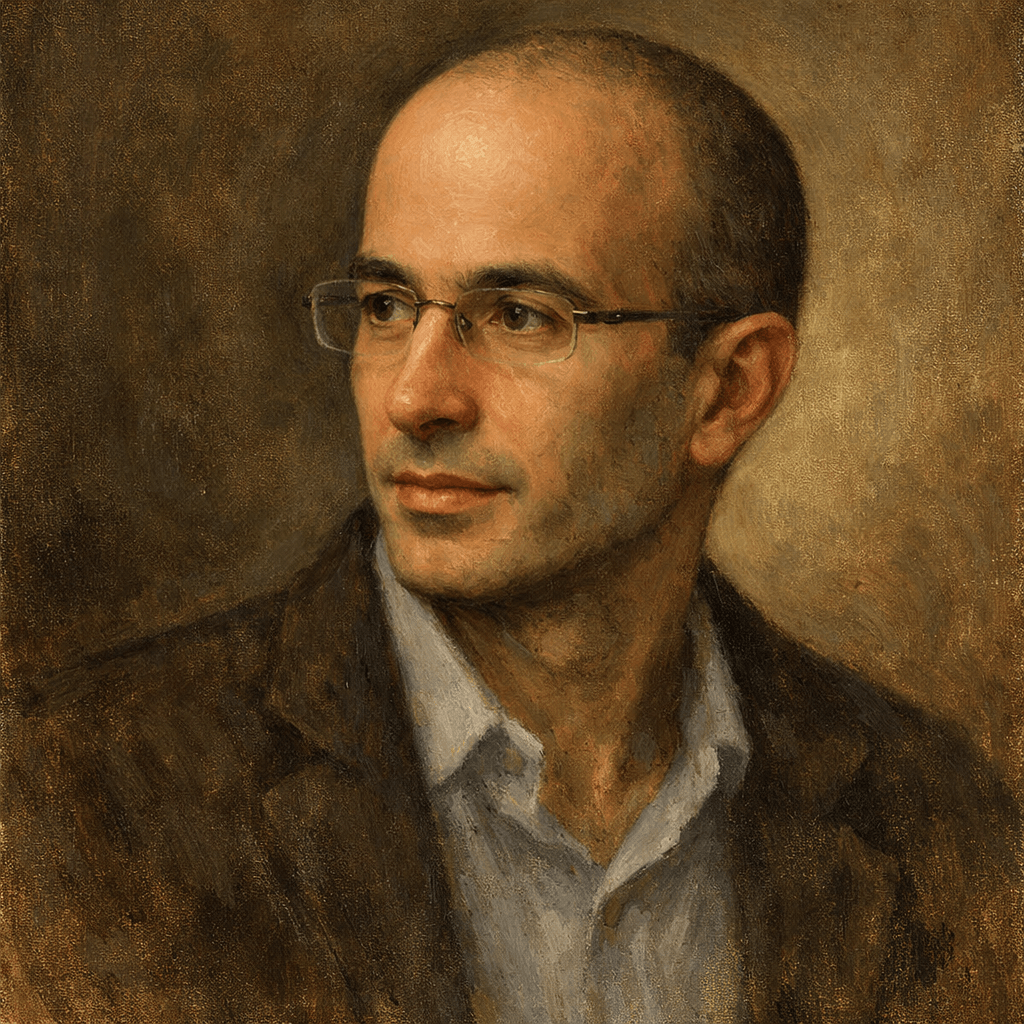
Yuval Noah Harari’s work transcends the boundaries of history, philosophy, and science, offering a mirror to humanity’s past, present, and uncertain future. His quotes—sharp, provocative, and profoundly insightful—have reshaped how millions understand the forces that define our species. By weaving together disciplines from biology to economics, Harari has not only illuminated the mechanics of human society but also challenged us to confront uncomfortable truths about power, progress, and our collective imagination. His legacy lies in his ability to distill complex ideas into accessible wisdom, urging readers to question the narratives we live by and reimagine what is possible.
Through themes like imagination, cooperation, and the duality of human progress, Harari reveals the paradoxes at the heart of our existence. He reminds us that history is shaped not just by facts, but by the stories we choose to believe; that happiness often eludes us because we chase the wrong goals; and that technology, while promising, demands ethical stewardship. His critiques of capitalism, religion, and environmental neglect are not mere complaints but calls to awareness—a reminder that systems we take for granted are human inventions, subject to change. In an age of unprecedented innovation and ecological crisis, Harari’s words are both a warning and a roadmap.
As we close this journey through his 150 best quotes, let Harari’s voice inspire us to think bigger, question deeper, and act with intention. The future is not written—it is shaped by those who dare to imagine it. Let us carry forward his challenge: to build a world where knowledge serves humanity, where empathy guides power, and where the stories we create unite rather than divide. The next chapter of Homo sapiens is ours to write.
Explore Quote Collections

Books & Knowledge
Explore the best quotes about the power of reading, the magic of libraries, book collecting, literary wisdom, and the timeless bond between reader and author.
Friendship
Explore the best friendship quotes about true friends, loyalty, trust, betrayal, love, and lifelong bonds. Browse curated quote collections by theme.

Life
Explore the deepest questions of existence. A curated collection of quotes on the journey of life, the pursuit of wisdom, the beauty of struggle, and the acceptance of mortality.
Persistence & Progress
Discover the power of steady progress. Explore curated quotes on overcoming challenges, simplifying complex problems, staying focused, and the art of getting things done.
You Might Also Like



Patrick Wright
Software engineer and creator of Quotesperation. I curate wisdom from history's greatest minds to inspire and guide modern life. When I'm not collecting quotes, I'm writing about technology and finding connections between timeless wisdom and today's challenges.