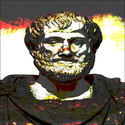
Aristotle
Aristotle was born in Stageira around 384 or 383 BCE. He worked in Ancient Greek and pursued a career that encompassed philosophy, writing, teaching, tutoring, astronomy, and epistemology. He has been described as a polymath, a characterization that reflects the range of roles he occupied across his working life.
Aristotle received his education at the Platonic Academy. He later became associated with the peripatetic school, a philosophical tradition connected to his activities as a teacher and tutor. His work in philosophy and epistemology ran alongside his engagement with astronomy and his sustained output as a writer.
Among his written works are the Nicomachean Ethics, Metaphysics, Physics, Politics, Poetics, and the Organon. These texts, composed in Ancient Greek, represent the scope of his written contributions across multiple areas of inquiry. His standing as a philosopher, epistemologist, and writer is grounded in this body of work, which spans what the available record identifies as a wide range of subjects.
Aristotle died in 321 BCE in Chalcis. The date of his death, recorded as falling within that year, marks the close of a life that had begun in Stageira decades earlier and had taken him through the Platonic Academy and into an association with the peripatetic school. His death in Chalcis in 321 BCE is the last recorded fact of his biography.
Quotes by Aristotle
Aristotle's insights on:

Metaphysics is universal and is exclusively concerned with primary substance. And here we will have the science to study that which is, both in its essence and in the properties which it has.


The wise man does not expose himself needlessly to danger, since there are few things for which he cares sufficiently; but he is willing, in great crises, to give even his life -- knowing that under certain conditions it is not worthwhile to live.

Happiness is something final and complete in itself, As being the aim and end of practical activities whatever... Happiness then we define as the active exercise of the mind In conformity with perfect goodness or virtue.

For contemplation is both the highest form of activity since the intellect is the highest thing in us, and the objects that it apprehends are the highest things that can be known, and also it is the most continuous, because we are more capable of continuous contemplation than we are of any practical activity.

The good of man is the active exercise of his souls faculties in conformity with excellence or virtue, or if there be several human excellences or virtues, in conformity with the best and most perfect among them.


