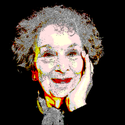
Margaret Atwood
Margaret Atwood is a Canadian poet, novelist, literary critic, and essayist born on 18 November 1939 in Ottawa, who writes in both English and French.
Her publishing career began in 1961 and has since produced a body of work remarkable in its breadth: eighteen novels, eighteen collections of poetry, nine collections of short fiction, eleven books of nonfiction, eight children's books, and two graphic novels. That range across forms — from science fiction to literary criticism, from children's literature to the essay — marks her as a writer who has worked with sustained productivity across multiple modes. Notable among her novels are The Edible Woman, Surfacing, Bodily Harm, Cat's Eye, Alias Grace, The Blind Assassin, Oryx and Crake, The Year of the Flood, The Heart Goes Last, and Hag-Seed, alongside story collections such as Dancing Girls and Other Stories and Stone Mattress: Nine Tales.
Her 1985 dystopian novel The Handmaid's Tale stands as her most widely cited work. Her awards include the Booker Prize, the Franz Kafka Prize, the Princess of Asturias Literary Prize, the Los Angeles Times Book Prize, the Trillium Book Award, a Guggenheim Fellowship, the Order of Ontario, and a place on Canada's Walk of Fame. Atwood is also credited as an inventor, a designation that sits alongside her literary roles and reflects the varied character of her public engagements. Her work as a pedagogue further extends her presence beyond the page, placing her in ongoing relationship with readers and students alike.
Across her career, the registers of science fiction, dystopia, and literary criticism recur as persistent coordinates in her output, with titles such as Oryx and Crake and The Handmaid's Tale anchoring her sustained engagement with speculative and cautionary modes of storytelling.
Quotes by Margaret Atwood
Margaret Atwood's insights on:

What else can I do? Once you’ve gone this far you aren’t fit for anything else. Something happens to your mind. You’re overqualified, overspecialized, and everybody knows it. Nobody in any other game would be crazy enough to hire me. I wouldn’t even make a good ditch-digger, I’d start tearing apart the sewer-system, trying to pick-axe and unearth all those chthonic symbols – pipes, valves, cloacal conduits... No, no. I’ll have to be a slave in the paper-mines for all time.

One and one and one and one doesn’t equal four. Each one remains unique, there is no way of joining them together. They cannot be exchanged, one for the other. They cannot replace each other.

We do not know how we’d behave. But a lot of people facing fascism didn’t become fascists. I don’t happen to believe that we are all monsters.


Vanity is becoming a nuisance, I can see why women give it up, eventually. But I’m not ready for that yet.

Its racist policies, for instance, were firmly rooted in the pre-Gilead period, and racist fears provided some of the emotional fuel that allowed the Gilead takeover to succeed as well as it did. Our.

For drinking Life there are two cups: The No Cup is bitter, the Yes Cup is yummy – Now, which one would you rather have in your tummy?

Nature is an expert in cost-benefit analysis,′ she says. ‘Although she does her accounting a little differently. As for debts, she always collects in the long run...

It isn’t running away they’re afraid of. We wouldn’t get far. It’s those other escapes, the ones you can open in yourself, given a cutting edge.

I try not to think too much. Like other things now, thought must be rationed. There’s a lot that doesn’t bear thinking about.