Max Jacob
In March 1944, Max Jacob died at Drancy concentration camp, a fate that earned him the posthumous designation mort pour la France — a stark and concrete measure of the era in which his life ended.
Born on July 12, 1876, in Quimper, France, Jacob pursued his education at the École coloniale and the Paris Law Faculty before establishing himself across an unusually wide range of creative disciplines. A French citizen who worked in both the French and Catalan languages, he built a career as a poet, prose writer, essayist, and critic, while simultaneously practicing as a painter, watercolorist, pastellist, lithographer, illustrator, and draftsperson. He also worked as a translator, extending his reach across linguistic and formal boundaries throughout his professional life.
Jacob became associated with the cubism movement, situating his output within one of the most consequential artistic currents of early twentieth-century France. His work as a critic placed him in a position to engage analytically with the visual and literary culture around him, while his practice as an illustrator and lithographer allowed him to move fluidly between word and image. The Concours général, an award he received, marked an early recognition of his abilities, and he was later named a Knight of the Legion of Honour, one of France's most formal acknowledgments of achievement.
Jacob died on March 5, 1944, at Drancy, the internment camp northeast of Paris from which tens of thousands were deported during the German occupation. He was sixty-seven years old. The posthumous designation mort pour la France, conferred upon him, stands as the final official recognition attached to his name — an acknowledgment, framed in the language of the French state, of the circumstances of his death and the period of history that claimed him.
Quotes by Max Jacob


We don’t know very well those we love But I understand them fairly well Being all these people myself I who am however but a baboon.

The poet’s expression of joy conceals his despair at not having found the reality of joy.
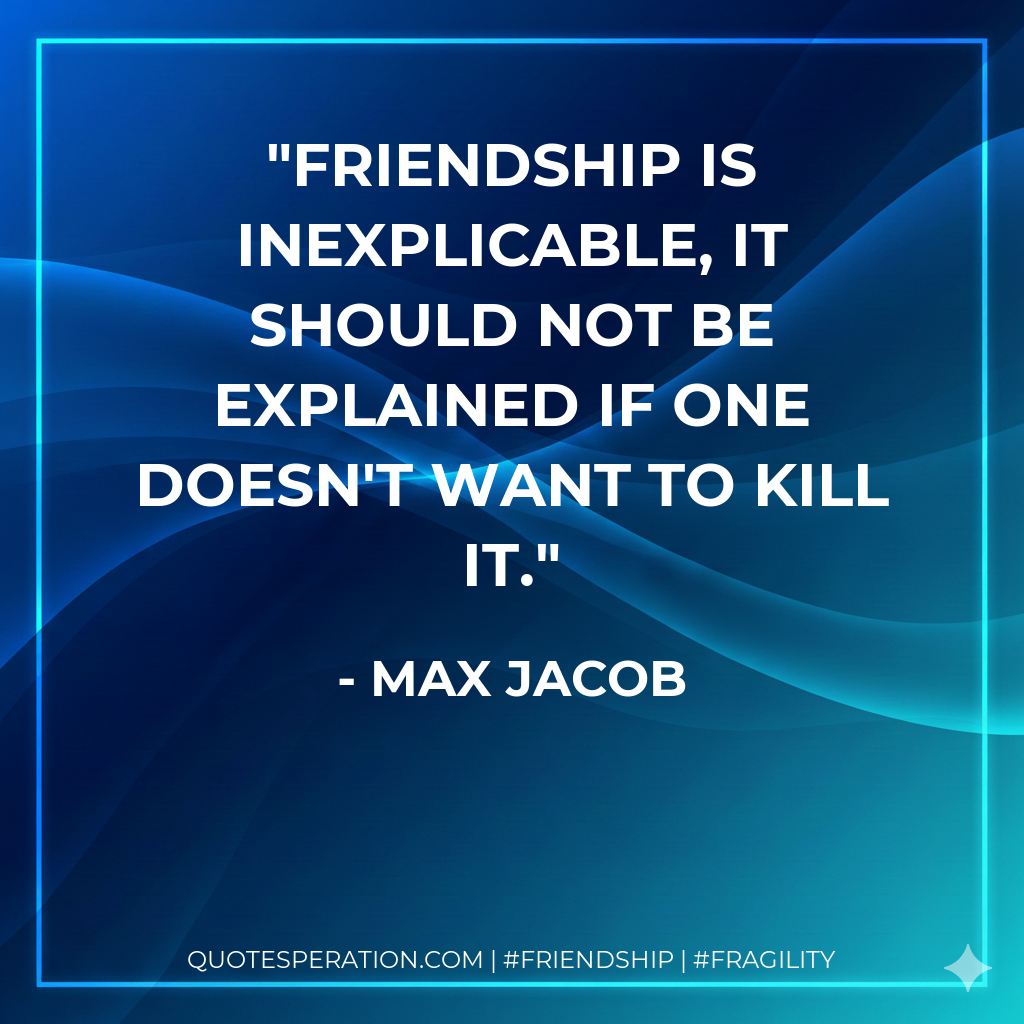

Man is a venerating animal. He venerates as easily as he purges himself. When they take away from him the gods of his fathers, he looks for others abroad.

Cubism is ... a picture for its own sake. Literary Cubism does the same thing in literature, using reality merely as a means and not as an end.

The poet's expression of joy conceals his despair at not having found the reality of joy.

What is called a sincere work is one that is endowed with enough strength to give reality to an illusion.


Cubism is ... a picture for its own sake.Literary Cubism does the same thing in literature, using reality merely as a means and not as an end.