Nat Hentoff
Nat Hentoff: A Life of Passionate Advocacy
=====================================================
Full Name and Common Aliases
--------------------------------
Nat Hentoff was born Nathan Irving Hentoff on October 10, 1925. He is often referred to as Nat.
Birth and Death Dates
-------------------------
October 10, 1925 – January 7, 2017
Nationality and Profession(s)
-------------------------------
American journalist, author, music critic, and human rights advocate
Nat Hentoff's life spanned nearly a century, during which he made significant contributions to the world of journalism, music criticism, and social activism.
Early Life and Background
---------------------------
Hentoff was born in Boston, Massachusetts, to Russian Jewish immigrant parents. His family struggled financially, but his father's love of music instilled in Nat an appreciation for jazz and classical music. This early exposure would later influence his career as a music critic. Hentoff attended American University in Washington, D.C., where he began writing for the campus newspaper, laying the groundwork for his future as a journalist.
Major Accomplishments
-------------------------
Hentoff's impact on journalism and social activism is multifaceted:
He was one of the first critics to recognize the genius of jazz musicians such as Charlie Parker and Thelonious Monk.
In 1960, he joined _The Village Voice_ , where he became a prominent music critic and columnist for over 50 years.
Hentoff's commitment to human rights led him to advocate for issues like police brutality, censorship, and freedom of speech.
He was a vocal opponent of the Vietnam War and an ardent supporter of civil liberties.
Notable Works or Actions
---------------------------
Some notable works and actions include:
"The Jazz Life" (1955): Hentoff's first book, which explores the lives of jazz musicians during the 1940s and 1950s.
"Peace Agitator" (1968): A collection of essays reflecting his views on the Vietnam War and social activism.
_The First Freedom: The Tumultuous History of Free Speech in America_ (2010): A comprehensive history of freedom of speech in the United States.Impact and Legacy
---------------------
Nat Hentoff's legacy extends far beyond his notable works:
He inspired a generation of journalists, music critics, and social activists with his unwavering commitment to truth and justice.
His writing continues to influence contemporary debates on human rights, freedom of speech, and the role of journalism in society.Why They Are Widely Quoted or Remembered
------------------------------------------
Nat Hentoff's impact is profound due to:
Passionate advocacy: He fearlessly spoke out against injustice and for the marginalized.
Innovative writing style: His engaging prose made complex issues accessible to a broad audience.
Lasting influence: His contributions continue to shape public discourse on essential human rights issues.
Nat Hentoff's life serves as a testament to the transformative power of passion, conviction, and dedication to truth.
Quotes by Nat Hentoff

I would bet there is no place in the United States where the First Amendment would survive intact.

Martin Williams persistently gets at essences, and that is why he has contributed so much to the very small body of authentic jazz criticism.

The ACLU sees the separation of church and state as so absolute that not a single religious word must be allowed to pass a schoolhouse door.

Why has slamming a ball with a racquet become so obsessive a pleasure for so many of us? It seems clear to me that a primary attraction of the sport is the opportunity it gives to release aggression physically without being arrested for felonious assault.

Whenever I see that kind of story, where everybody agrees, I know there’s something wrong.

Means and ends are central. If your means are corroded, your ends will be corroded. And if you’re fighting to preserve liberty and you use means that eviscerate our liberties, the end will be corroded, too.

I think Obama is possibly the most dangerous and destructive president we have ever had.

Whenever I see that kind of story, where everybody agrees, I know there's something wrong.
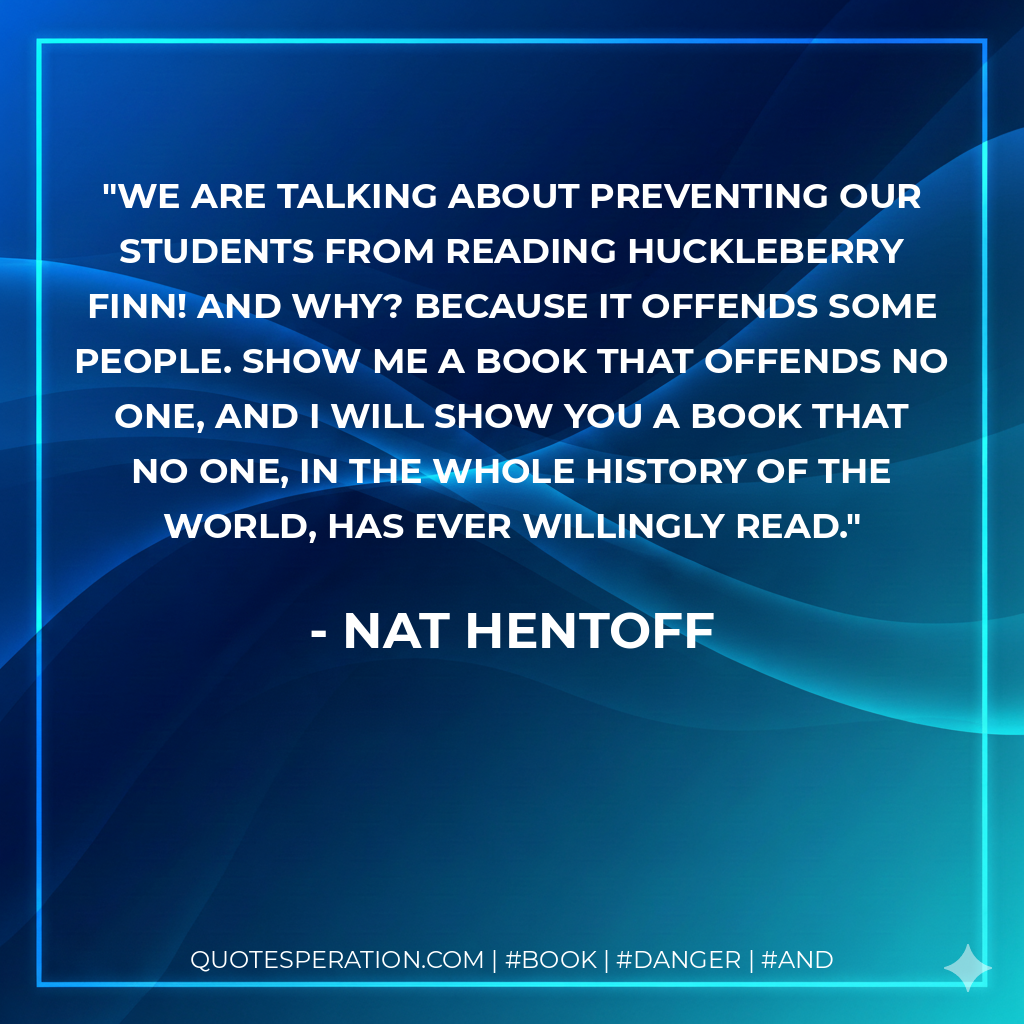
We are talking about preventing our students from reading Huckleberry Finn! And why? Because it offends some people. Show me a book that offends no one, and i will show you a book that no one, in the whole history of the world, has ever willingly read.
