Sir Thomas More
In 1516, a writer and politician from London published a Latin volume imagining a fictional island society. That book was Utopia, and its author was Thomas More.
Born on 16 February 1478 in London, More received his education at Magdalen College School and later at Lincoln's Inn. He built a career that ranged across several disciplines — working as a jurist, judge, politician, philosopher, historian, theologian, and writer, as well as a poet and novelist. He worked in Latin, Ancient Greek, English, and Italian, and his output extended well beyond Utopia to include Responsio ad Lutherum and the Dialogue of Comfort against Tribulation.
More's political career reached a high point when he served Henry VIII as Lord Chancellor, a position he held from October 1529 to May 1532. His departure from that office marked a turning point in his life. On 16 July 1535, he was executed at Tower Hill. He was fifty-seven years old.
The Catholic Church has since venerated More as both a martyr and a saint — a concrete measure of how his death has been understood in the centuries since. Utopia, published nearly two decades before his execution, remains the work most closely attached to his name, the product of a man who moved across law, politics, theology, and literature throughout his life.
Quotes by Sir Thomas More

Let them speak as lewdly as they list of me...as long as they do not hit me, what am I the worse?

God made the angels to show Him splendor, as He made animals for innocence and plants for their simplicity. But Man He made to serve Him wittily, in the tangle of his mind.

What part soever you take upon you, play that as well as you can and make the best of it.
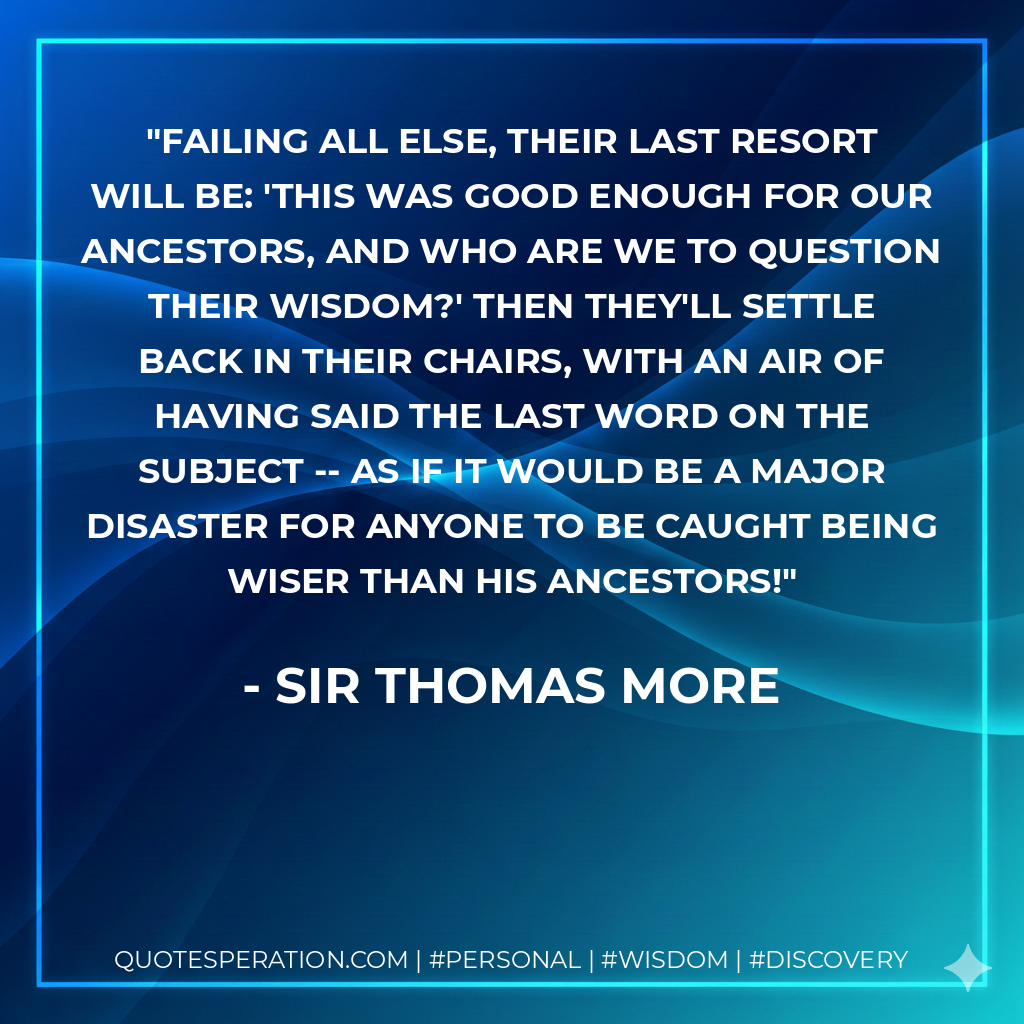
Failing all else, their last resort will be: 'This was good enough for our ancestors, and who are we to question their wisdom?' Then they'll settle back in their chairs, with an air of having said the last word on the subject -- as if it would be a major disaster for anyone to be caught being wiser than his ancestors!

Failing all else, their last resort will be: 'This was good enough for our ancestors, and who are we to question their wisdom?' Then they'll settle back in their chairs, with an air of having said the lst word on the subject -- as if it would be a major disaster for anyone to be caught being wiser than his ancestors!

The many great gardens of the world, of literature and poetry, of painting and music, of religion and architecture, all make the point as clear as possible: The soul cannot thrive in the absence of a garden. If you don't want paradise, you are not human; and if you are not human, you don't have a soul.


Kindness and good nature unite men more effectually and with greater strength than any agreements whatsoever, since thereby the engagements of men's hearts become stronger than the bond and obligation of words.

For if you suffer your people to be ill-educated, and their manners to be corrupted from their infancy, and then punish them for those crimes to which their first education disposed them, what else is to be concluded from this, but that you first make thieves and then punish them.