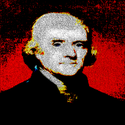
Thomas Jefferson

Thomas Jefferson

2,194quotes

Full Name and Common Aliases

Thomas Jefferson was a prominent American statesman, diplomat, and Founding Father. He is often referred to simply as Jefferson and is sometimes affectionately called the Sage of Monticello or the Man of the People.

Birth and Death Dates

Thomas Jefferson was born on April 13, 1743, in Shadwell, Virginia, and he passed away on July 4, 1826, at his beloved estate, Monticello, in Virginia. Notably, he died on the 50th anniversary of the Declaration of Independence, a document he was instrumental in crafting.

Nationality and Profession(s)

Jefferson was an American by nationality. His professional life was diverse and influential, encompassing roles as a lawyer, architect, philosopher, statesman, and diplomat. He is best known for his political career, serving as the third President of the United States from 1801 to 1809.

Early Life and Background

Thomas Jefferson was born into a prominent Virginia family. His father, Peter Jefferson, was a successful planter and surveyor, while his mother, Jane Randolph, belonged to one of the most distinguished families in Virginia. Jefferson was educated at the College of William & Mary, where he developed a lifelong passion for learning and the Enlightenment ideals that would later shape his political philosophy. His early life was marked by a deep commitment to education, which he believed was essential for the preservation of liberty and democracy.

Major Accomplishments

Jefferson's most enduring accomplishment is his role as the principal author of the Declaration of Independence in 1776. This seminal document articulated the American colonies' desire for independence from British rule and laid the foundation for the nation's democratic ideals. As President, Jefferson orchestrated the Louisiana Purchase in 1803, which doubled the size of the United States and opened vast tracts of land for exploration and settlement. He also commissioned the Lewis and Clark Expedition, which provided valuable information about the western territories.

Notable Works or Actions

In addition to his political achievements, Jefferson was a prolific writer and thinker. His Notes on the State of Virginia is considered one of the most important American works of the 18th century, offering insights into his views on society, politics, and nature. As an architect, Jefferson designed his home, Monticello, and the University of Virginia, both of which reflect his neoclassical aesthetic and commitment to education. His advocacy for religious freedom and the separation of church and state was groundbreaking, influencing the First Amendment of the U.S. Constitution.

Impact and Legacy

Thomas Jefferson's impact on the United States is profound and enduring. His vision of a nation built on the principles of liberty, equality, and democracy continues to inspire generations. Jefferson's emphasis on education and knowledge as the cornerstones of a free society led to the establishment of the University of Virginia, which he considered one of his greatest achievements. His ideas on religious freedom and the separation of church and state have become fundamental tenets of American democracy.

Why They Are Widely Quoted or Remembered

Thomas Jefferson is widely quoted and remembered for his eloquent articulation of the principles of liberty and democracy. His words in the Declaration of Independence, particularly the assertion that "all men are created equal," have become a rallying cry for freedom and justice worldwide. Jefferson's writings and speeches reflect his deep commitment to individual rights and the belief that government should be accountable to the people. His ability to express complex ideas in clear and compelling language has made his quotes timeless, resonating with those who seek to understand and promote the ideals of democracy and human rights.

In summary, Thomas Jefferson's life and work have left an indelible mark on the United States and the world. His contributions as a statesman, philosopher, and advocate for liberty continue to be celebrated and studied, ensuring that his legacy endures for future generations.

Quotes by Thomas Jefferson

Thomas Jefferson's insights on:

"
And even should the cloud of barbarism and despotism again obscure the science and liberties of Europe, this country remains to preserve and restore light and liberty to them. In short, the flames kindled on the fourth of July, 1776, have spread over too much of the globe to be extinguished by the feeble engines of despotism; on the contrary, they will consume these engines and all who work them.
"
We hold these truths to be self-evident, that all men are created equal; that they are endowed by their Creator with inherent and inalienable rights; that among these, are life, liberty, and the pursuit of happiness.
"
He who permits himself to tell a lie once, finds it much easier to do it a second and third time, till at length it becomes habitual, he tells lies without attending to it, and truths without the world's believing him.
"
But would the honest patriot, in the full tide of successful experiment, abandon a government which has so far kept us free and firm, on the theoretic and visionary fear that this government, the world's best hope, may by possibility want energy to preserve itself?
"
The earth belongs always to the living generation.
"
Those who labor on the earth are the chosen people of God if he ever had a chosen people.
"
We may consider each generation as a separate nation, with a right, by the will of the majority, to bind themselves, but none to bind the succeeding generation, more than the inhabitants of another country.
"
Health is the first requisite after morality.
"
Health must not be sacrificed to learning. A strong body makes the mind strong.
"
Beer, if drunk in moderation, softens the temper, cheers the spirit and promotes health.
Showing 1 to 10 of 2,194 results