Best Childrens Literature Education Quotes
Childrens Literature Education
Table of Contents
- Impact of Children's Books
- Writing and Creating Children's Books
- Books as Tools for Learning and Empathy
- The Joy and Magic of Reading
- Challenges and Critiques of Children's Literature
- Children's Books and Morality
- Books as Companions and Comfort
- Personal Experiences with Children's Books
- The Importance of Diverse and Inclusive Books
- Books and Imagination
- Other
Impact of Children's Books
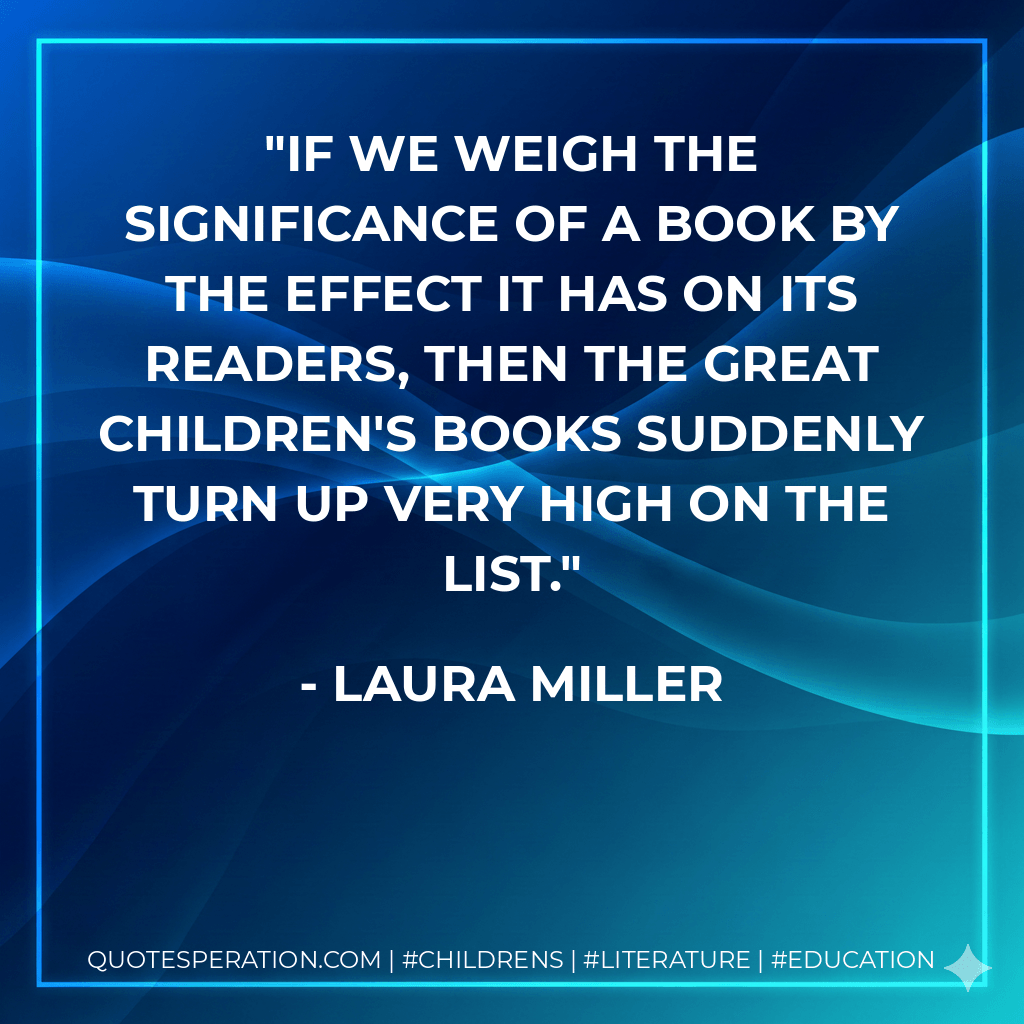
If we weigh the significance of a book by the effect it has on its readers, then the great children's books suddenly turn up very high on the list.
Children's books are not a hiding place, they are a seeking place.
There’s something almost miraculous about seeing a child’s eyes light up when you hand him a book that intrigues him. I’ve always thought that it’s those children—the ones who realize that books are magic—who will have the brightest lives.
What is childhood without stories? And how will children fall in love with stories without bookstores? You can't get that from a computer.
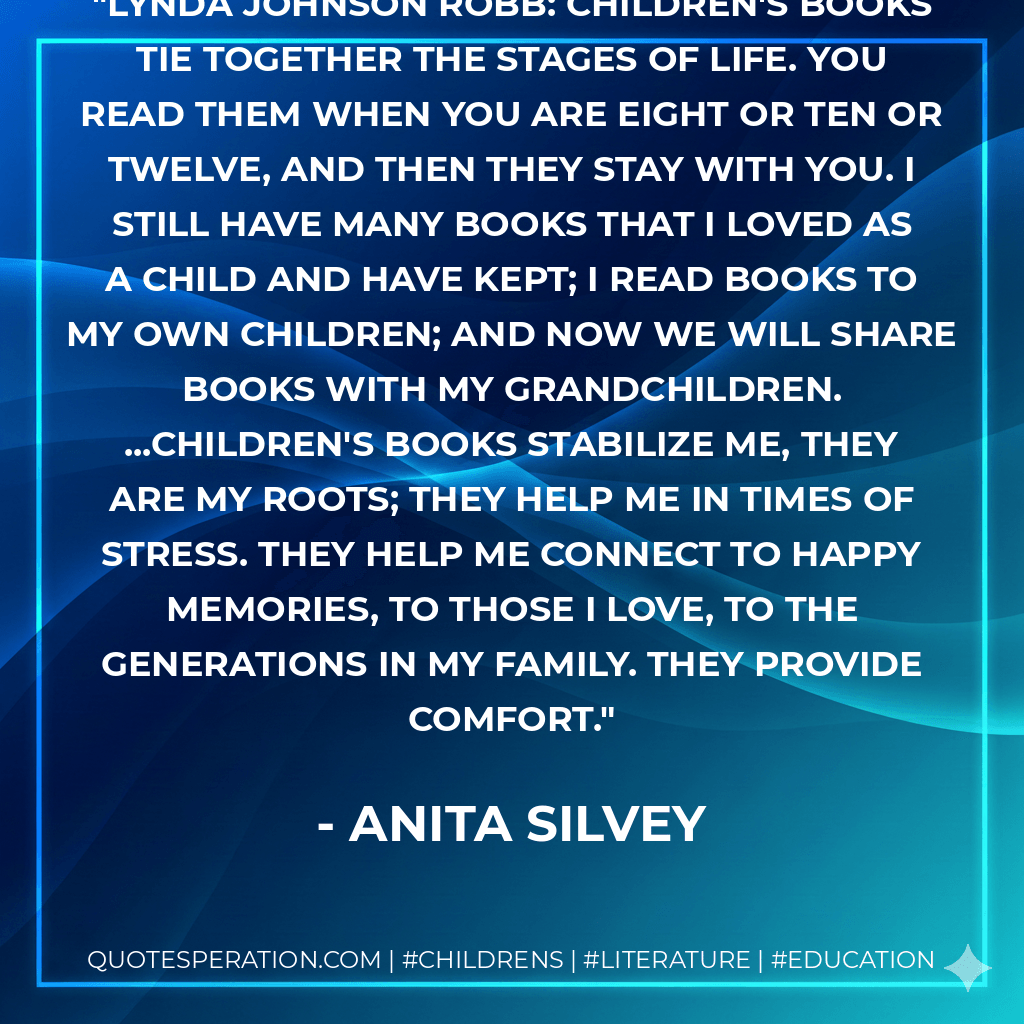
Lynda Johnson Robb: Children's books tie together the stages of life. You read them when you are eight or ten or twelve, and then they stay with you. I still have many books that I loved as a child and have kept; I read books to my own children; and now we will share books with my grandchildren. ...Children's books stabilize me, they are my roots; they help me in times of stress. They help me connect to happy memories, to those I love, to the generations in my family. They provide comfort.
I thought about adults. I wondered if that was true: if they were all really children wrapped in adult bodies, like children’s books hidden in the middle of dull, long adult books, the kind with no pictures or conversations.
The child who gets lost in a book can emerge from the experience a changeling.
Never worry about a book corrupting a child. Worry if your children are not getting ideas from books.
Books are the way to stretch out people's souls, and I won't have children with small souls.
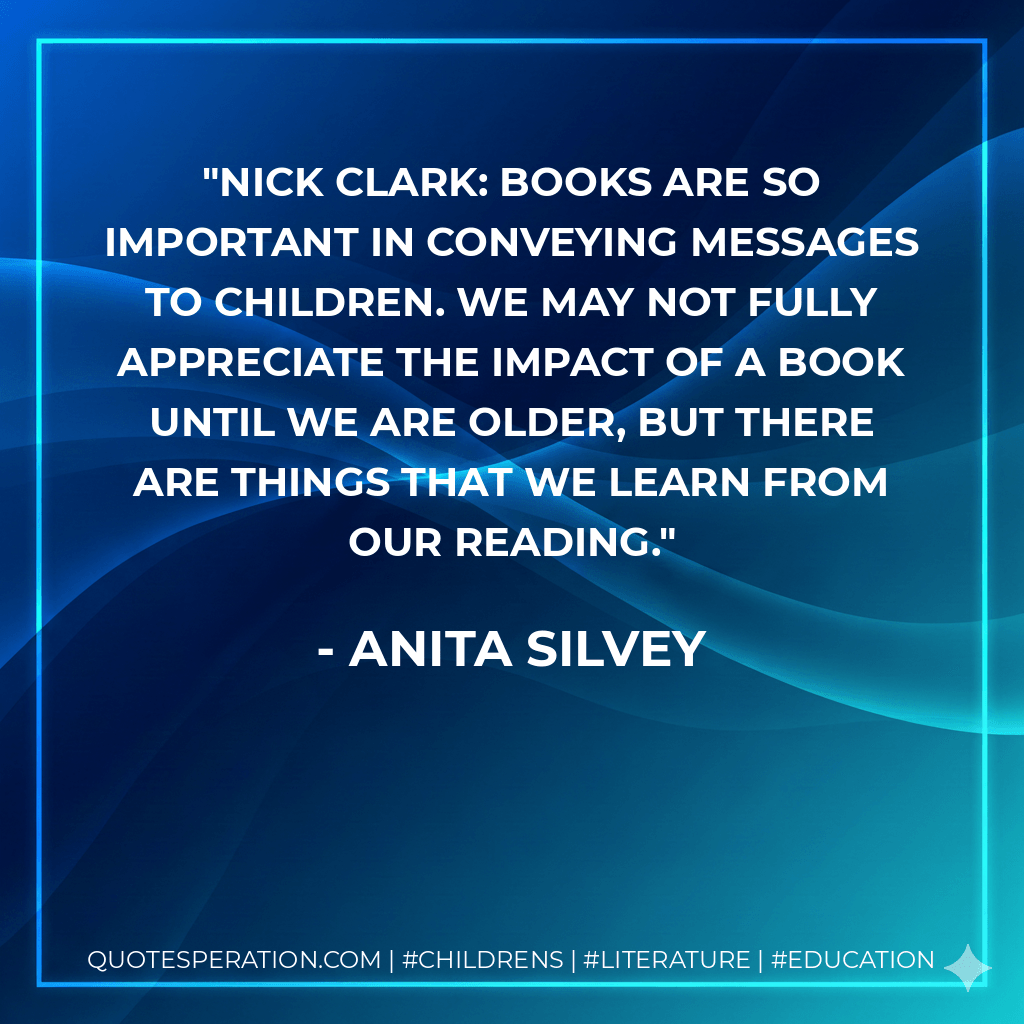
Nick Clark: Books are so important in conveying messages to children. We may not fully appreciate the impact of a book until we are older, but there are things that we learn from our reading.
The books we enjoy as children stay with us forever -- they have a special impact. Paragraph after paragraph and page after page, the author must deliver his or her best work.
There are many little ways to enlarge your child's world. Love of books is the best of all.
Writing and Creating Children's Books
Books aren’t made in the way that babies are: they are made like pyramids, There’s some long-pondered plan, and then great blocks of stone are placed one on top of the other, and it’s back-breaking, sweaty, time consuming work. And all to no purpose! It just stands like that in the desert! But it towers over it prodigiously. Jackals piss at the base of it, and bourgeois clamber to the top of it, etc. Continue this comparison.
It is easier to write a book with footnotes than the same book written so that children can understand it.
Kid's books should be just as good as any other books. No. They should be held to a *higher* standard than other literature for the same reason that we take extra care with children's food.The fact is, what you feed your kids is important, and that includes what they put in their heads as well as what they put in their bellies.
Books are like our children. They are often conceived by inspiration, but are born only by labor.
If you want to treat your book as a child, the finished book should be an adult, capable to stand on its own legs and able to weather the thunder. Not a baby that still needs to be defended.
Kid's books should be just as good as any other books. No. They should be held to a *higher* standard than other literature for the same reason that we take extra care with children's food.
The book arms kids with facts that are too often missing in today's textbooks and classrooms.
Books aren't made in the way that babies are: they are made like pyramids. There's some long-pondered plan, and then great blocks of stone are placed one on top of the other, and it's back-breaking, sweaty, time consuming work. And all to no purpose! It just stands there in the desert! But it towers over it prodigiously. Jackals piss at the base of it, and bourgeois clamber to the top of it, etc. Continue this comparison.
Writing for children is bloody difficult; books for children are as complex as their adult counterparts, and they should therefore be accorded the same respect.
There is the myth that writing books for children is easier than writing books for grownups, whereas we know that truly great books for children are works of genius, whether it's 'Alice in Wonderland' or the 'Gruffalo' or 'Northern Lights.' When it's a great book, it's a great book, whether it's for children or not.
The trick in writing children's books is to set up danger, mystery and excitement on page one. Force the kid to turn the page . . . Then in the middle of each chapter there's a dramatic point of excitement, and at chapter's end, a cliffhanger.
Normal people bring children into the world; we novelists bring books. We are condemned to put our whole lives into them, even though they hardly ever thank us for it. We are condemned to die in their pages and sometimes even to let our books be the ones who, in the end, will take our lives.
Books as Tools for Learning and Empathy
The best morals kids get from any book is just the capacity to empathize with other people, to care about the characters and their feelings. So you don't have to write a preachy book to do that. You just have to make it a fun book with characters they care about, and they will become better people as a result.
The man that I named the Giver passed along to the boy knowledge, history, memories, color, pain, laughter, love, and truth. Every time you place a book in the hands of a child, you do the same thing. It is very risky. But each time a child opens a book, he pushes open the gate that separates him from Elsewhere. It gives him choices. It gives him freedom. Those are magnificent, wonderfully unsafe things.[from her Newberry Award acceptance speech]
A book is not just paper and ink, it's a world full of dreams, imaginations, knowledge, awakening, emboldening and a lot, lot more invaluable treasures. Gift your child a book - introduce them to the joy of reading.
I hope children will pick up the lessons in the books. The younger they learn these lessons, the more they can benefit from them in life.
If a kid knows a book and meets the author, he will love it so much more.
We are going to try to bring in a well-known children's author if we can afford to do that,
Most adults, unlike most children, understand the difference between a book that will hold them spellbound for a rainy Sunday afternoon and a book that will put them in touch with a part of themselves they didn't even know existed.
Reading a book is a very human experience, and Betty engaged in the humanity of putting children and books together.
Books transmit values. They explore our common humanity. What is the message when some children are not represented in those books?
I believe that kids as well as adults are entitled to books of no socially redeeming value.
I don't think that children, if left to themselves, feel that there is an author behind a book, a somebody who wrote it. Grown-ups have fostered this quotient of identity, particularly teachers. Write a letter to your favorite author and so forth. When I was a child I never realized that there were authors behind books. Books were there as living things, with identities of their own.
As hardly anything can accidentally touch the soft clay without stamping its mark on it, so hardly any reading can interest a child, without contributing in some degree, though the book itself be afterwards totally forgotten, to form the character.
The Joy and Magic of Reading
It was a surprise, and a delight, to see children devour books. Without ever knowing it, they were receiving an education.
I wondered if that was true: if they were all really children wrapped up in adult bodies, like children's books hidden in the middle of dull, long adult books, the kind with no pictures or conversations.
The intensity of childhod reading, the instant and complete absorption in a book - a good book, a bad book, in any kind of book - is something I would give much to recapture
The child lives in the book; but just as much the book lives in the child.
A children's book is the perfect place where young readers can understand the world because they can take a deep breath and look at it and imagine and contemplate while they're looking at.
There are many little ways to enlarge your child's world. Love of books is the best of all.
Books are such a great way to spend time with your children, open lines of communication with your children, and just build that strong foundation.
A shame really, because putting the right book in the right kid’s hands is kind of like giving that kid superpowers.
So much for the right books; the right use of them is another matter. The children must enjoy the book. The ideas it holds must each make that sudden, delightful impact upon their minds, must cause that intellectual stir, which mark the inception of an idea.
Challenges and Critiques of Children's Literature
The effort of focusing all serious attention on a small number of books and authors is to diminish awareness of the richness and variety of children's literature. It becomes impossible to grasp the development of children's literature, or the context in which individual books were written. Ultimately, the study of children's literature is the poorer for ignoring so much fine material. And children are the poorer too, given fewer opportunities to hear of books that might enrich their lives.
People are usually surprised to hear this, but I don't really read children's books.
A nice thing about children's books, though I'm probably alone in this opinion among people who write and publish them, is that they did get to be in this unrecognized ghetto for a long time.
if a book is not good enough for a grownup, it is not good enough for a child.
We determine whether a book is for boys or girls long before the reader gets a chance to decide: we package them with soldiers and ballet slippers on their covers, war machines and glittering gowns.
Any kid who has two parents who are interested in him and has a houseful of books isn't poor.
Books transmit values. They explore our common humanity. What is the message when some children are not represented in those books?
It is Scholastic's and author J.K. Rowling's wish that all readers, especially children, have the opportunity to experience
It's bad rhyme and by and large, good books for kids are better than that.
I cannot think of any work that could be more agreeable and fun than making books for children.
We have never been so rich in books. But there has never been a generation when there is so much twaddle in print for children.
Children's Books and Morality
How above-the-law children's books are. Hansel and Gretel (littering, breaking and entering), Rumpelstiltskin (forced labor), Snow White (conspiracy to commit murder), Rapunzel (break of contract).
Never worry about a book corrupting a child. Worry if your children are not getting ideas from books.
Kid's books should be just as good as any other books. No. They should be held to a *higher* standard than other literature for the same reason that we take extra care with children's food.
if a book is not good enough for a grownup, it is not good enough for a child.
In the education of children there is nothing like alluring the interest and affection; otherwise you only make so many asses laden with books.
There are those who believe that the value of a children's book can be measured only in terms of the moral lessons it tries to impose or the perfect role models it offers. Personally, I happen to think that a book is of extraordinary value if it gives the reader nothing more than a smile or two. In fact, I happen to think that's huge.
Many adults feel that every children's book has to teach them something.... My theory is a children's book... can be just for fun.
We have never been so rich in books. But there has never been a generation when there is so much twaddle in print for children.
Books as Companions and Comfort
Books are not written about proper children. They would be so dull no one would read them.
I can think of few better ways to introduce a child to books than to let her stack them, upend them, rearrange them, and get her fingerprints all over them.
Lynda Johnson Robb: Children's books tie together the stages of life. You read them when you are eight or ten or twelve, and then they stay with you. I still have many books that I loved as a child and have kept; I read books to my own children; and now we will share books with my grandchildren. ...Children's books stabilize me, they are my roots; they help me in times of stress. They help me connect to happy memories, to those I love, to the generations in my family. They provide comfort.
Books should be cherished, like children, books are for the next generation, like children, like history.
Now, taking books, or anything else, from a little girl is like taking arms from an Arab, or candy from a baby...
What I hope is that the book [Bink & Gollie] delights children. What I hope is that they laugh and laugh and laugh, just as we did when we wrote them.
Books are like brothers. I am an only child. Gatsby [is] my imaginary eldest brother.
If you take 'The Hobbit' and 'The Lord of the Rings' as books, one is written for children, and one is an adult's book.
Sending a book out into the world is a lot like sending your child to the first day of kindergarten. You hope the other kids play nice and that she makes friends.
Personal Experiences with Children's Books
I wondered if that was true: if they were all really children wrapped up in adult bodies, like children's books hidden in the middle of dull, long adult books, the kind with no pictures or conversations.
I thought about adults. I wondered if that was true: if they were all really children wrapped in adult bodies, like children’s books hidden in the middle of dull, long adult books, the kind with no pictures or conversations.
People are usually surprised to hear this, but I don't really read children's books.
I didn't read children's books when I was a child. The only books in our house were ration books.
I've never written a children's book, but when people meet me for the first time and I say I write books, they invariably reply, 'Children's books?' Maybe it's something about my face.
My mother refused to give me coloring books as a child. She probably saved me, Because when you think about it, what a coloring book does is completely kill creativity.
A solitary child growing up in Africa, you're really quite dependent on books.
People are usually surprised to hear this, but I don’t really read children’s books.
Every book is different with it’s own personality just like children.
The Importance of Diverse and Inclusive Books
Any anxieties publishers have about putting a child on the front cover of a book who isn't white is very old fashioned.
We determine whether a book is for boys or girls long before the reader gets a chance to decide: we package them with soldiers and ballet slippers on their covers, war machines and glittering gowns.
And books are such an empowering way to give voice to some of these kids who aren't yet ready to tell their story. Or don't know what their story is, or are trying to figure it out.
Books transmit values. They explore our common humanity. What is the message when some children are not represented in those books?
Every child is different. I think it's important that we don't have maybe just one or two books that we're recommending to all children - but rather we cater the books to fit each individual child.
Books and Imagination
If you write a kid's book only for kids, then you have failed.
The child lives in the book; but just as much the book lives in the child.
Perhaps it is only in childhood that books have any deep influence on our lives.
I would like my books to stand as a tool to unbind children from expectations of poetry because it should free the child to self-expression and exploration.
In our eyes, the book is perfectly good and we stand by our Selection Committee and the rights of children to read this book.
In the education of children there is nothing like alluring the interest and affection; otherwise you only make so many asses laden with books.
I don't think that children, if left to themselves, feel that there is an author behind a book, a somebody who wrote it. Grown-ups have fostered this quotient of identity, particularly teachers. Write a letter to your favorite author and so forth. When I was a child I never realized that there were authors behind books. Books were there as living things, with identities of their own.
It is Scholastic's and author J.K. Rowling's wish that all readers, especially children, have the opportunity to experience
Other
Children read their favorite books to death, she said. They are careless in their devotions. They rip the pages, scribble, and spill things on them. And they are demon book thieves.
Anything can become a children's book if you give it to a child...Children are actually the best (and worst) audience for literature because they have no patience with pretence.
Leaving behind books is even more beautiful — there are far too many children.
Books in the YA genre, in particular, should use proper grammar because they're more of an example to young people than adults books are.
I have yet to meet an English teacher who assigned a book to damage a kid.
The Baby Name book can be a very dangerous tool in the hands of a prolific author.
There’s something nice about out-and-out children’s books with no sex and a happy ending—Ransome, Streatfeild, that kind of thing.
Every book is a children's book if the kid can read!
Books are not written about proper children. They would so so dull and boring nobody would read them.
Today, it's possible to read both erotica and books written for children without fear of social castigation.
Newly-born books are like birds… they shouldn’t be kicked out of the nest until they’re capable of flying. Wendy Anne Darling 5-1-15
The Paperbats book. Successful publication release with 30 books downloaded in first day and a half. "This delightful childrens' book has just been published on smashwords, where it can be read for free! I invite you to enjoy a lovely story with yany young children.
Why should every pregnant woman be expected to read the same book? Or any book? Being pregnant isn't that complicated. What to Expect When You're Expecting shouldn't be a book. It should be a Post-it: 'Take your vitamins. Don't drink vodka. Get used to empire waistlines.
Yesterday’s children got what was good for them. Today’s children get what they want. One of the things they don’t want very much is a book. Literacy itself is becoming yet another commodity in short supply.from "One Thumping Lie Only" in The Thorny Paradise (1975)
I've always said that Watership Down is not a book for children. I say: it's a book, and anyone who wants to read it can read it.
What do these children do without story books?" Naftali asked.And Reb Zebulun replied: "They have to make do. Storybooks aren't bread. You can live without them.""I couldn't live without them." Naftali said.
Babies move more than books and aren't as conveniently shaped.
If people like to read their books, it is all very well, but to be at so much trouble in filling great volumes, which, as I used to think, nobody would willingly ever look into, to be labouring only for the torment of little boys and girls, always struck me as a hard fate.
Every book is different with it's own personality just like children.
We have a fine collection of children's books.
I think I would have written more books if I'd had fewer kids or had them earlier, but I think the books in general would have had a little less spark to them.
My book group has one rule: no books for adults. We read young adult fiction only.
I don't think there is such a thing as a bad book for children.
My first two books, Letters to a Young Brother and Letters to a Young Sister, were... distributed pretty widely. Judges in juvenile justice facilities started citing the book as required reading.
You don't need to have kids to write a good book for kids. I don't want my kids to see themselves in my books. Their lives should be their lives.
Children simply don't make the distinction; a book is either good or bad. And some of the books they think are good are very, very bad indeed.
It is very risky. But each time a child opens a book, he pushes open the gate that separates him from Elsewhere.
The man that I named the Giver passed along to the boy knowledge, history, memories, color, pain, laughter, love, and truth. Every time you place a book in the hands of a child, you do the same thing. It is very risky. But each time a child opens a book, he pushes open the gate that separates him from Elsewhere. It gives him choices. It gives him freedom. Those are magnificent, wonderfully unsafe things. [from her Newberry Award acceptance speech]
I wouldn't let kids near half the stuff I've written so it is quite lovely to pass these little books out to children when they visit the house.
My books are just pure escapism for kids.
Every year we choose to add the wow factor to the book because we want adults to feel like they can be kids again.
There will be books written about Harry. Every child in the world will know his name.
I never expected to be in the papers. I personally never expected to be in the papers. The height of my ambition for these books was, well frankly, to get reviewed. A lot of children's books don't even get reviewed.. forget good review, bad review. Personally, no, I never expected to be in the papers so it's an odd experience when it happens to you .
Russell Brand has announced that he plans to write a series of children's books. First up: 'Horton Hears a Heroin Dealer.'
Anyone who was once a child should have at least one children's book in them.
I think today if we forbade our illiterate children to touch the wonderful things of our literature, perhaps they might steal them and find secret joy.
People think children's books are about teddy bears and little flowers. I realize people sometimes don't know what to do with my books because they say, 'Is it a children's book, and what age group?'
Children's books are looked on as a sideline of literature. A special smile. They are usually thought to be associated with women. I was determined not to have this label of sentimentality put on me so I signed by my intials, hoping people wouldn't bother to wonder if the books were written by a man, woman or kangaroo.
But by accident, not by cunning calculation, books, because of their weight and texture, and because of their sweetly token resistance to manipulation, involve our hands and eyes, and then our minds and souls, in a spiritual adventure I would be very sorry for my grandchildren not to know about.
To be making books for children is to be in a sort of state of grace.
That is the book, then, and the book of Shakespeare. And every day you must read a page of each to your child – even though you yourself do not understand what is written down and cannot sound the words properly. You must do this that the child will grow up knowing of what is great – knowing that these tenements of Williamsburg are not the whole world.” “The Protestant Bible and Shakespeare.
More Collections
Friendship Quotes Hub
Sports Team Confidence & Success Quotes
Persistence and Progress

Best Limited Social Circles Quotes
Best Life Quotes
Best Intense Rivalry Games Quotes
Related Articles
Patrick Wright
Software engineer and creator of Quotesperation. I curate wisdom from history's greatest minds to inspire and guide modern life. When I'm not collecting quotes, I'm writing about technology and finding connections between timeless wisdom and today's challenges.