Best Childrens Literature Safety Quotes
Childrens Literature Safety
Table of Contents
- The Importance of Books in Childhood Development
- Parental and Adult Influence on Children's Reading
- The Role of Imagination and Escapism
- Censorship and Access to Challenging Topics
- Encouraging a Love for Reading
- Children's Autonomy in Choosing Books
- The Impact of Popular Culture and Trends
- Books as a Tool for Learning and Growth
- The Commercialization of Children's Literature
- Other
The Importance of Books in Childhood Development
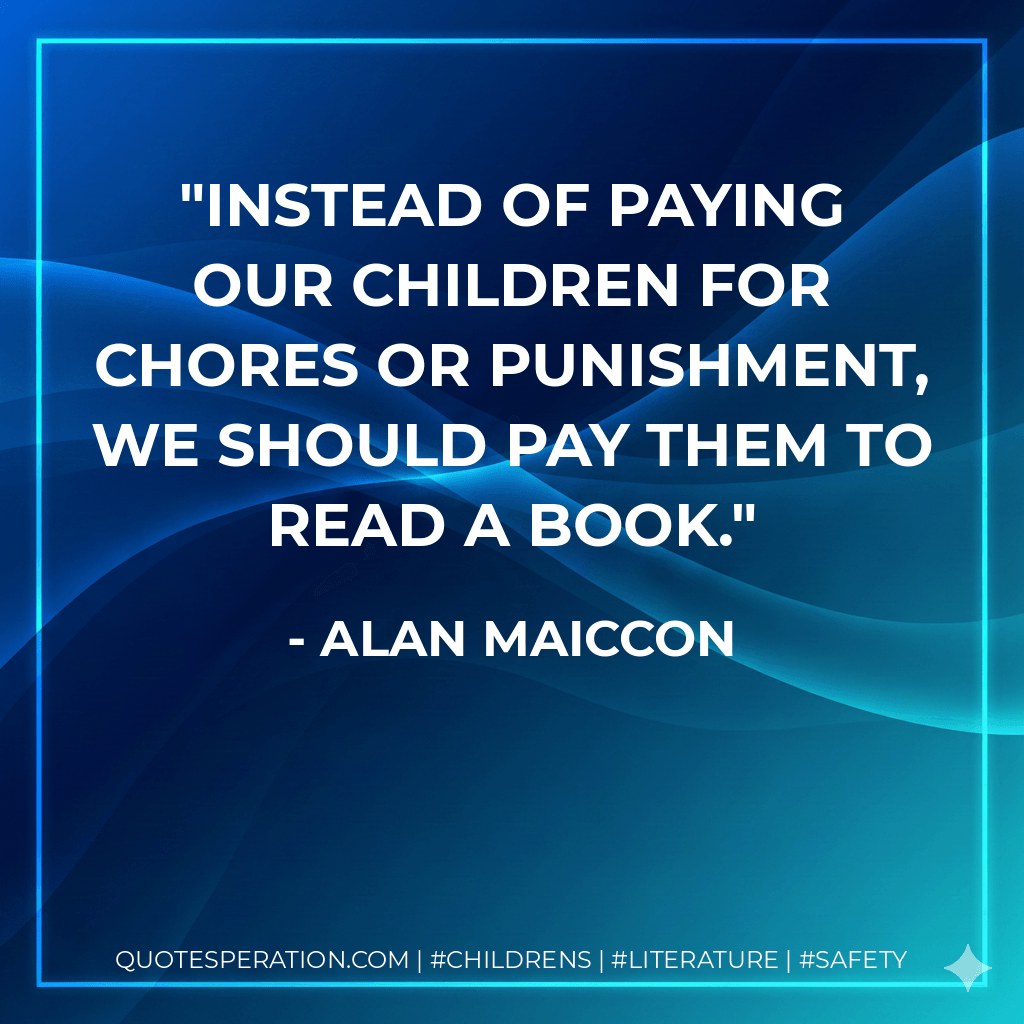
Instead of paying our children for chores or punishment, we should pay them to read a book.
What I worry about most is the loss to young people. If no one speaks out for them, if they don't speak out for themselves, all they'll get for required reading will be the most bland books available. And instead of finding the information they need at the library, instead of finding the novels that illuminate life, they will find only those materials to which nobody could possibly object.
That can be the most painstaking aspect of being a teen, figuring out what the world really looks like. If you find someone in a book, you know you're not alone and that's what's so comforting about books.
Books are a guide in youth, and an entertainment for age.
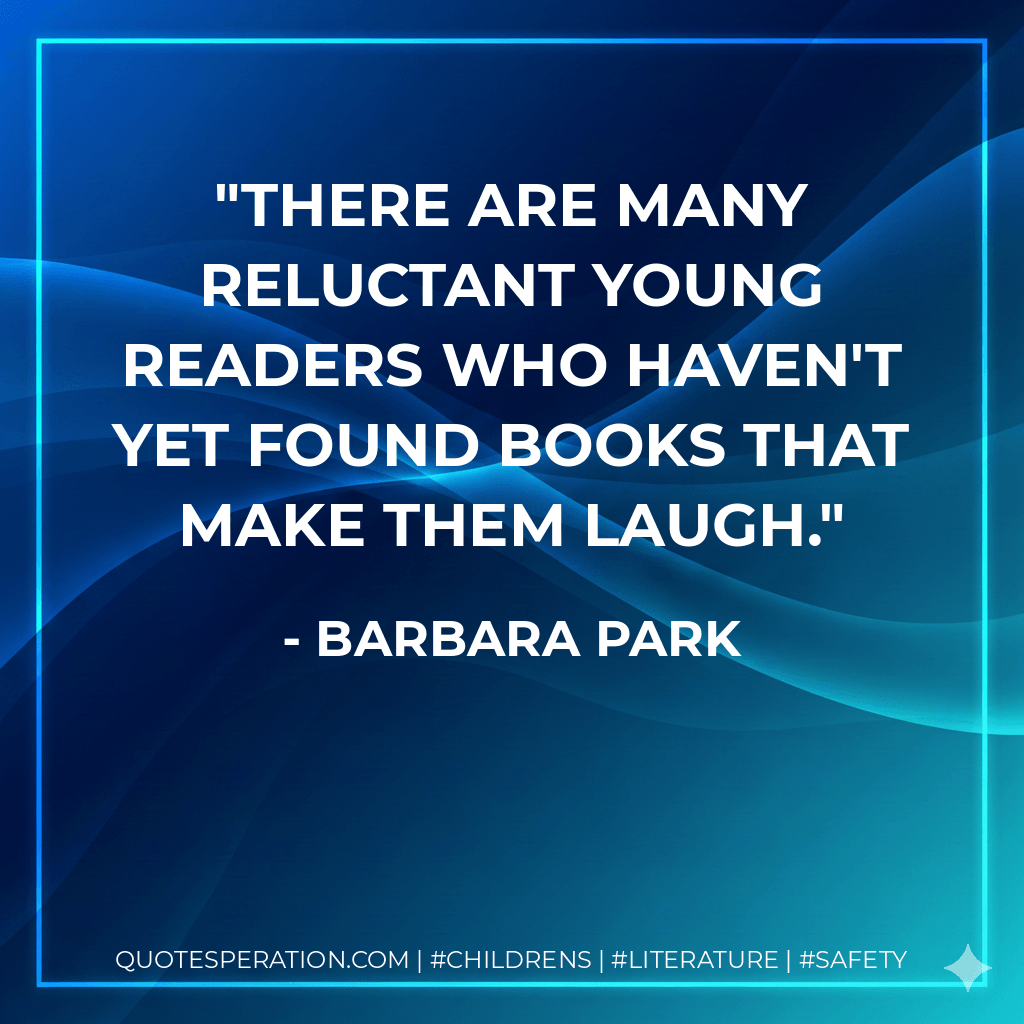
There are many reluctant young readers who haven't yet found books that make them laugh.
I believe we should spend less time worrying about the quantity of books children read and more time introducing them to quality books that will turn them on to the joy of reading and turn them into lifelong readers.
I think kids will read more good books than we can possibly produce.
If children haven't been read to, they don't love books. They need to love books, for books are the basis of literature, composition, history, world events, vocabulary, and everything else.
I wish that the adults who are 'in power' cared more about what their children read. Books are incredibly powerful when we are young - the books I read as a child have stayed with me my entire life - and yet, the people who write about books, for the most part, completely ignore children's literature.
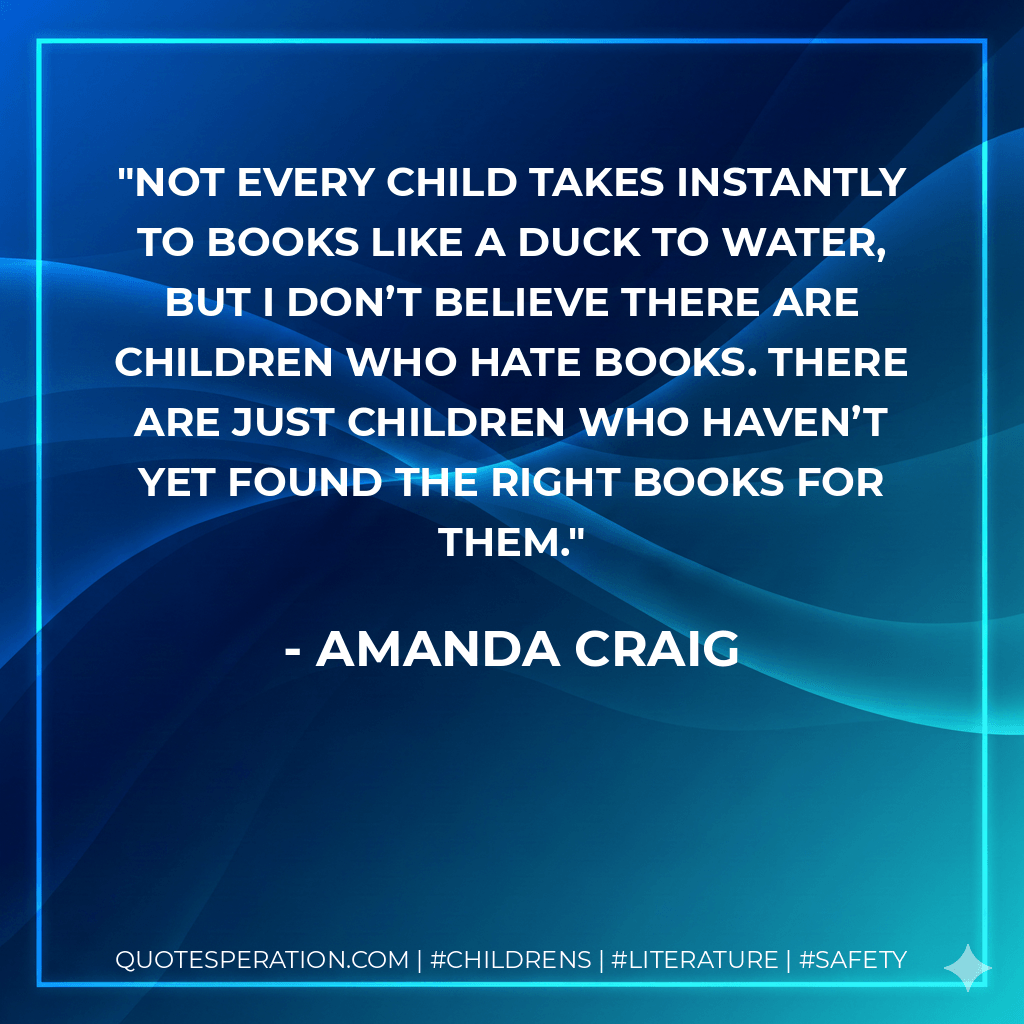
Not every child takes instantly to books like a duck to water, but I don’t believe there are children who hate books. There are just children who haven’t yet found the right books for them.
Every time we read to a child, we’re sending a ‘pleasure’ message to the child’s brain. You could even call it a commercial, conditioning the child to associate books and print with pleasure.
We need our kids to fall in love with stories before they are even taught their first letters, if possible, because everything else – phonics, comprehension, analysis, even writing – comes so much more easily when a child loves books.
I do not know when it is that the joy fades out of school for most children, so that they end not only by hating school but even worse, by hating books, and this is grave indeed, for in books alone is the accumulated wisdom of the whole human race, and to read no books is to deprive the self of ready access to wisdom.
Parental and Adult Influence on Children's Reading
...Shouldn't schools be the place where students interact with interesting books? Shouldn't the faculty have an ongoing laser-like commitment to put good books in our students' hands? Shouldn't this be a front-burner issue at all times?
Another reason I like reading books for kids is that the content is so very “safe” in comparison to books for adults. Disturbing elements are kept at a minimum. There’s always a undercurrent of hope running through the book, promising that maybe we don’t live in a cold, cruel, calculating universe that cares for us not one jot.
I don't like the idea of a book being a test or being used for a test. The way - in my opinion - to make good readers is to let kids choose their own books and not test them.
I haven't been very enthusiastic about the commercialization of children's literature. Kids should borrow books from the library and not necessarily be buying them.
I think parents should know what their children are reading, and if they truly object, they should tell their kids why, rather than summarily removing a book from their possession.
I understand why parents worry about books - they're worried about their kids. They want to keep their kids safe. But parents aren't always realistic.
Perhaps it is partly that we need to love books ourselves as parents, grandparents and teachers in order to pass on that passion for stories to our children. It's not about testing and reading schemes, but about loving stories and passing on that passion to our children.
In some families, parents don't read or don't have the money to spend on books.
It's our job - as parents, grandparents, aunts, uncles - to find books our kids are going to like.
It is a great thing for him to have read so many books. You just don't usually hear that about a first-grader.
When I was quite young my parents never said books were off limits.
Perhaps it is partly that we need to love books ourselves as parents, grandparents and teachers in order to pass on that passion for stories to our children. It’s not about testing and reading schemes, but about loving stories and passing on that passion to our children.
We need our kids to fall in love with stories before they are even taught their first letters, if possible, because everything else – phonics, comprehension, analysis, even writing – comes so much more easily when a child loves books.
The Role of Imagination and Escapism
Do the children who prefer books set in the real, ordinary, workaday world ever read as obsessively as those who would much rather be transported into other worlds entirely?
What my parents kept failing to understand was how happy I was when I was alone with my books. There was no pressure to perform or be cute, and books never disappoint-- unless, of course, you've chosen a bad one. But then, you can always put it down and pick up another one without any repercussions.
That can be the most painstaking aspect of being a teen, figuring out what the world really looks like. If you find someone in a book, you know you're not alone and that's what's so comforting about books.
Once you've got a child to the point that they've discovered books, they're safe. There's a world of the imagination that when they're hurt or upset, they can move into, and it is wonderful.
The most important thing whenever we're connecting kids to books, is that we try to match the book to the kid and make sure that reading is a fun, rewarding experience outside the classroom.
I try to craft books that are fun, that are sort of subversively educational so kids learn but they don't really feel like they're being lectured to, and I want kids to always finish one of my books and think, "That was great, where's the next one?"
Lesson number one, rule number one: You have to connect with your customer, ... If you're writing a children's book, you have to connect with the reader. Do you connect? Are you able to make an immediate connection with that publication that is going to be lasting, memorable, effective, teach a lesson or a moral? If you don't connect, you are not going to be successful.
You never love a book the way you love a book when you are ten. It is an honor to be in that sacred space in some children’s brains.
There’s a hunger for stories in all of us, adults too. We need stories so much that we’re even willing to read bad books to get them, if the good books won’t supply them.
We need our kids to fall in love with stories before they are even taught their first letters, if possible, because everything else – phonics, comprehension, analysis, even writing – comes so much more easily when a child loves books.
Authors all have at least one thing in common, which is that when we finally get finished copies of our books, we get giddy as kindergartners. We touch them constantly, and build towers with them, and take pictures of our cats and dogs reading them.
Censorship and Access to Challenging Topics
The best way to get kids to read a book is to say: 'This book is not appropriate for your age, and it has all sorts of horrible things in it like sex and death and some really big and complicated ideas, and you’re better off not touching it until you’re all grown up. I’m going to put it on this shelf and leave the room for a while. Don’t open it.
What I worry about most is the loss to young people. If no one speaks out for them, if they don't speak out for themselves, all they'll get for required reading will be the most bland books available. And instead of finding the information they need at the library, instead of finding the novels that illuminate life, they will find only those materials to which nobody could possibly object.
Pretending that there are no choices to be made - reading only books, for example, which are cheery and safe and nice - is a prescription for disaster for the young.
I understand why parents worry about books - they're worried about their kids. They want to keep their kids safe. But parents aren't always realistic.
I hate the idea of sheltering kids from challenging books. It's just another form of conservative fear that promotes ignorance more than anything else.
There are people who want their kids to read books about gays and lesbians. Therefore, we have an obligation to have those books. We select those books the same way we select all others -- based on their literary merit.
What I worry about most is the loss to young people. If no one speaks out for them, if they don’t speak out for themselves, all they’ll get for required reading will be the most bland books available. And instead of finding the information they need at the library, instead of finding the novels that illuminate life, they will find only those materials to which nobody could possibly object.
I understand why parents worry about books - they're worried about their kids. They want to keep their kids safe. But parents aren't always realistic.
There are no taboos. Every topic is open, however shocking. It is the way that the topics are handled that’s important, and that applies whether it is a 15-year-old who is reading your book or someone who is 55.
I hate the idea of sheltering kids from challenging books. It's just another form of conservative fear that promotes ignorance more than anything else.
There are no taboos. Every topic is open, however shocking. It is the way that the topics are handled that's important, and that applies whether it is a 15-year-old who is reading your book or someone who is 55.
Encouraging a Love for Reading
If it's not good enough for adults, it's not good enough for children. If a book that is going to be marketed for children does not interest me, a grownup, then I am dishonoring the children for whom the book is intended, and I am dishonoring books. And words.
These are books that want to be read out loud. These are books kids share with each other, and I think that's important.
Children will not pretend to be enjoying books, and they will not read books because they have been told that these books are good. They are looking for delight.
Kids think books are cool, especially when they see that people they think books are cool are reading.
Perhaps it is partly that we need to love books ourselves as parents, grandparents and teachers in order to pass on that passion for stories to our children. It's not about testing and reading schemes, but about loving stories and passing on that passion to our children.
It's hard recommending books for kids, and a huge responsibility. If you get it wrong, they don't tell you they hate that particular book, they tell you they hate reading.
I particularly like the fact that there is no set list of books. Whatever books children choose counts towards their tally for rewards. It's all about reading for pleasure.
Not every child takes instantly to books like a duck to water, but I don’t believe there are children who hate books. There are just children who haven’t yet found the right books for them.
We need our kids to fall in love with stories before they are even taught their first letters, if possible, because everything else – phonics, comprehension, analysis, even writing – comes so much more easily when a child loves books.
Perhaps it is partly that we need to love books ourselves as parents, grandparents and teachers in order to pass on that passion for stories to our children. It’s not about testing and reading schemes, but about loving stories and passing on that passion to our children.
We need to actually teach kids that books aren’t like broccoli. You don’t have to eat every bit on your plate. It’s like secret adult’s business. It’s the secret we never, ever tell our children. No adult ever read a book because it’s good for us. We read because it is fun.
Children's Autonomy in Choosing Books
I don't like the idea of a book being a test or being used for a test. The way - in my opinion - to make good readers is to let kids choose their own books and not test them.
Kids think books are cool, especially when they see that people they think books are cool are reading.
Parents should leave books lying around marked ‘forbidden’ if they want their children to read.
It’s our job – as parents, grandparents, aunts, uncles – to find books our kids are going to like.
Allow children to choose the books they wish to read to themselves, even if they don’t meet your high standards.
There’s something touching about a kid who’s reading a book that’s printed on actual paper. I think that anything that kids start reading, within reason, can lead to other discoveries.
It’s a gift of tranquility when your adult desires mesh with your childhood background. I don’t quite know why mine didn’t, although I think books, again, are partly to blame.
Not every child takes instantly to books like a duck to water, but I don’t believe there are children who hate books. There are just children who haven’t yet found the right books for them.
My attitude is that if anybody of any age wants to read a book, let them, but I do think that no child would want to read 'Boneland.'
I think parents should know what their children are reading, and if they truly object, they should tell their kids why, rather than summarily removing a book from their possession.
The Impact of Popular Culture and Trends
Don't you think you're a little old now to be quoting The Chronicles of Narnia?' I ask, raising an eyebrow at him.'You read Harry Potter,' Will protests.'Everyone reads Harry Potter,' I exclaim. 'It's an institution. Besides, it's not really a kids book, it's a metaphor for the world at large. It's almost philosophical in its way.
Kids definitely go into bookstores after reading 'Twilight' and want something else like it.
I love book signings: kids waiting in line for you to scribble on their new books, haha!
Next to the Bible, this has no competition. The great thing about the Harry Potter books is that it appeals to both children and adults, and 50 percent of its readers are adults.
I'll never forget a meeting with one publisher where they said, 'We don't publish books for teenage boys; teenage boys don't read.'
Anything that encourages a boy to open a book, in a world of more violent and therefore more compelling video games, is something I'm going to pay for.
We have a generation of kids who may never see a bookshelf or never see books in houses. What are they going to think about books? How will books become meaningful in their lives except as yet another form of digitalized content? A book is not just digitalized content.
Next to the Bible, this has no competition. The great thing about the Harry Potter books is that it appeals to both children and adults, and 50 percent of its readers are adults.
It makes it easier to adapt a book that is popular with kids because of how excited they are about the project; you don't get the criticisms you would get with other projects.
Kids definitely go into bookstores after reading 'Twilight' and want something else like it.
Books as a Tool for Learning and Growth
Another reason I like reading books for kids is that the content is so very “safe” in comparison to books for adults. Disturbing elements are kept at a minimum. There’s always a undercurrent of hope running through the book, promising that maybe we don’t live in a cold, cruel, calculating universe that cares for us not one jot.
And if boys enjoy books about aliens, which they certainly do, why not also books about girls?
I hope my books empower kids, and that they learn how to work out their problems themselves.
Books are as dark as what is available to teenagers through the media every day.
It's hard recommending books for kids, and a huge responsibility. If you get it wrong, they don't tell you they hate that particular book, they tell you they hate reading.
I think what makes good children's books is putting the same care and effort into it as if I was writing for adults. I don't write anything - put anything in my books - that I'd be embarrassed to put in an adult book.
Let the young know they will never find a more interesting, more instructive book than the patient himself.
The last thing you want first-graders thinking is that what they’re reading in first grade is as good as books are going to get!
What my parents kept failing to understand was how happy I was when I was alone with my books. There was no pressure to perform or be cute, and books never disappoint – unless, of course, you’ve chosen a bad one. But then, you can always put it down and pick up another one without any repercussions.
Young adults are honest readers. They won't stay with a book unless they have a reason, so it has to move along.
Lesson number one, rule number one: You have to connect with your customer, ... If you're writing a children's book, you have to connect with the reader. Do you connect? Are you able to make an immediate connection with that publication that is going to be lasting, memorable, effective, teach a lesson or a moral? If you don't connect, you are not going to be successful.
The Commercialization of Children's Literature
I haven't been very enthusiastic about the commercialization of children's literature. Kids should borrow books from the library and not necessarily be buying them.
There's always these giant baffling books, like 'The Da Vinci Code.' People say it's not as well written as 'Midnight's Children.' Why aren't people reading 'Midnight's Children?' Nobody knows why these phenomenons happen but they're great.
In my experience, adults rarely bother reading the reviews of children's books and almost never read the books themselves - particularly if they don't have children.
We have a generation of kids who may never see a bookshelf or never see books in houses. What are they going to think about books? How will books become meaningful in their lives except as yet another form of digitalized content? A book is not just digitalized content.
Releasing a book is a lot like sending your child to school for the first time. It’s terrifying. You just hope your kid isn’t the nerd in the back of the class, getting bullied because he picked his nose. -Observations from Mac.
Books are a bad family – there are those you love, and those you are indifferent to; idiots and mad cousins who you would banish except others enjoy their company; wrongheaded but fascinating eccentrics and dreamy geniuses; orphaned grandchildren; and endless brothers-in-law simply taking up space who you wish you could send straight to hell. Except you can’t, for the most part. You must house them and make them comfortable and worry about them when they go on trips and there is never enough room.
Kids don’t use paper book covers anymore. Why is that? They’re missing out on the best part of school, which is doodling genitals and curse words and hiding them in flowery vines.
It makes it easier to adapt a book that is popular with kids because of how excited they are about the project; you don't get the criticisms you would get with other projects.
I'll never forget a meeting with one publisher where they said, 'We don't publish books for teenage boys; teenage boys don't read.'
I love book signings: kids waiting in line for you to scribble on their new books, haha!
Other
Popularity of a book is not the criterion of its importance. A few very popular books are important experiences that we are glad to see many children having, but many popular books are, at best, commonplace experiences. The temptation in buying books for libraries is to buy those that “move,” that will not sit on the shelves. Yet very often the book that rests on the shelf may be the one that would be the most vivid experience of all to a certain child if he could but find it.
When I hear someone say, “Yes, it’s a good book but our children don’t like it,” I am inclined to think that either the librarian herself does not like it or has not read it. If a book is really good, if it is really alive, it is a potentially important experience for some children, perhaps only a few, but it may have a more far-reaching significance to those few than would a hundred mediocre books.
I was so sad to read recently that 32 percent of fourth- graders say they never read a book for pleasure,
We want a book to be a book. We'll have all the interactive bells and whistles but our intent is to engage young people in reading, not to show them a movie.
As a writer, you should care about reluctant readers. You want these kids to feel like books are amazing and cool and that they're an escape.
But it doesn't stop at school. We can all enjoy books throughout our lives - as I certainly continue to do.
Textbooks are no longer given to schoolchildren; they're too expensive. So they're given to the teachers, who probably need them more.
A boy has to peddle his book.
Mothers and daughters read the same book once a month. We get together in each other's homes, and while we are talking about the book, we also end up talking about life issues.
If one of my kids reads a book for school and I can have a conversation with her about the book and I sense that she gets what the book is about, then it doesn't really matter to me if she gets an A on the paper.
We want to allow adults to be exposed to new ideas whereas they are able to discuss different books from a different aspect and flex their minds a little.
My attitude is that if anybody of any age wants to read a book, let them, but I do think that no child would want to read Boneland.
Children will often write, 'We love your books because there are no adults in them.'
I look at my books the way parents look at their children. The fact that one becomes more successful than the others doesn't make me love the less successful one any less.
You like to think with young adults that with your books, a little part of it has reached them and will stay with them. It is great to be part of an eight-year-old's world.
I think there are probably just as many adults who would miss the humor of my books, if not more, as there are children.
I've nothing against kids reading anything they please, but I do have a problem with pink books for girls and black books for boys.
Grown-ups shouldn’t finish books they’re not enjoying. When you’re no longer a child, and you no longer live at home, you don’t have to finish everything on your plate. One reward of leaving school is that you don’t have to finish books you don’t like.
Kids and adults have a difference of opinion when it comes to what constitutes legitimate reading. Adults often push books that they loved as children, which, ironically, were often books that their parents weren't particularly keen on.
Kids have no sense of appropriateness. They can ask me whatever they want. You do develop a sense of intimacy with readers, and they tell you things about themselves. During a school year, I'll get e-mails asking about the books. I'll give them information, but I won't do their homework for them.
It worries me that undergrads and high school students are forced into books they aren't ready for, like Faulkner's, and then they are afraid of putting their toes in the water again.
The best way to get kids to read a book is to say: 'This book is not appropriate for your age, and it has all sorts of horrible things in it like sex and death and some really big and complicated ideas, and you're better off not touching it until you're all grown up. I'm going to put it on this shelf and leave the room for a while. Don't open it.
I'm the only kid in the world who doesn't want an eighth Harry Potter book.
Children's books aren't textbooks. Their primary purpose isn't supposed to be "Pick this up and it will teach you this." It's not how literature should be. You probably do learn something from every book you pick up, but it might be simply how to laugh.
For the price of a couple of Happy Meals, you can buy a digital textbook and stop your child from having to carry around a six-pound book.
Kids books Grownup books That's just marketing. Books are books,
We saw there was a need, not to take over, but to expand. It's been fun and we're hoping that during the summer people will see there's something to read when they're picking up books for their children or grandchildren.
The Chinese have a habit of reading. Many families regard books as the most valuable family asset.
Very young children eat their books, literally devouring their contents. This is one reason for the scarcity of first editions of Alice in Wonderland and other favorites of the nursery.
I look at my books the way parents look at their children. The fact that one becomes more successful than the others doesn’t make me love the less successful one any less.
This is for all you kids out there watching TV, when you should go open a book. Haha.
But it doesn’t stop at school. We can all enjoy books throughout our lives – as I certainly continue to do.
Therefore, the selection of their first lesson-books is a matter of grave importance, because it rests with these to give children the idea that knowledge is supremely attractive and that reading is delightful. Once.
I like to buy books for the kids in my family. I guess that’s why they call me the ‘mean’ aunt.
I’m the only kid in the world who doesn’t want an eighth Harry Potter book.
If children haven’t been read to, they don’t love books. They need to love books, for books are the basis of literature, composition, history, world events, vocabulary, and everything else.
The most important thing whenever we’re connecting kids to books, is that we try to match the book to the kid and make sure that reading is a fun, rewarding experience outside the classroom.
I’ve nothing against kids reading anything they please, but I do have a problem with pink books for girls and black books for boys.
Personally, I would rather have a boy notice the book I was reading and tell me he liked it, too. That seems like a better sign of caring about someone than a kiss some French guy invented.
If one of my kids reads a book for school and I can have a conversation with her about the book and I sense that she gets what the book is about, then it doesn’t really matter to me if she gets an A on the paper.
When I see kids standing next to their mothers at book signings, clutching a copy of 'Forever,' I know what's coming. They'll say to me, 'How old do I have to be to read this?' hoping I'll give them permission. But I can't do that.
What can happen if a young reader picks up a book he/she isn't yet ready for? Questions, maybe. Usually, that child puts down the book and says, 'Boring.' Or, 'I'm not ready for this.' Kids are really good at knowing what they can handle.
More Collections
Friendship Quotes Hub
Sports Team Confidence & Success Quotes
Persistence and Progress

Best Limited Social Circles Quotes
Best Life Quotes
Best Intense Rivalry Games Quotes
Related Articles
Patrick Wright
Software engineer and creator of Quotesperation. I curate wisdom from history's greatest minds to inspire and guide modern life. When I'm not collecting quotes, I'm writing about technology and finding connections between timeless wisdom and today's challenges.