
Best Philosophical Wisdom Love Quotes
Philosophical Wisdom Love
Table of Contents
- Marriage and Philosophy
- Philosophy as a Love for Wisdom
- Philosophy and the Pursuit of Truth
- Philosophy and Life
- Philosophy, Death, and Self-awareness
- Other
Marriage and Philosophy
My advice to you is get married: if you find a good wife you'll be happy; if not, you'll become a philosopher.
My advice to you is get married: if you find a good wife you'll be happy; if not, you'll become a philosopher." - Socrates (470-399 B.C.) "Advice is what we ask for when we already know the answer but wish we didn't
By all means marry. If you get a good wife you will become happy, and if you get a bad one you will become a philosopher. Socrates (470-399 B.C.)
My advice to you is get married: if you find a good wife you’ll be happy; if not, you’ll become a philosopher.
Blessings and burdens are not mutually exclusive. It’s a lot more complicated. Socrates had a mean, nagging wife; he always said that being married to her was good practice for philosophy.
Philosophy as a Love for Wisdom
Wisdom is the perfect good of the human mind; philosophy is the love of wisdom, and the endeavor to attain it.
Philosophy, rightly defined, is simply the love of wisdom.
Rightly defined philosophy is simply the love of wisdom.
Philosopher: A lover of wisdom, which is to say, Truth.
A philosopher's a lover of wisdom.
Philosophy is in fact a quest for wisdom based in sophia; that quest for wisdom has everything to do with a love of wisdom.
Philosophy is the love of wisdom: Christianity is the wisdom of love.
A philosopher’s a lover of wisdom.
A true philosopher is married to wisdom; he needs no other bride.
The philosophy I love is very selective. It is really just the bit that is involved in a search for wisdom, and this means a short roll call of names; Socrates, Marcus Aurelius, Seneca, Epicurus, Montaigne, Schopenhauer, Nietzsche.
Philosophy and the Pursuit of Truth
The Greek word for philosopher (philosophos) connotes a distinction from sophos. It signifies the lover of wisdom (knowledge) as distinguished from him who considers himself wise in the possession of knowledge. This meaning of the word still endures: the essence of philosophy is not the possession of the truth but the search for truth....Philosophy means to be on the way. Its questions are more essential than its answers, and every answer becomes a new question.
Philosophy ... bears witness to the deepest love of reflection, to absolute delight in wisdom.
The height of all philosophy is to know thyself; and the end of this knowledge is to know God.
The word philosophy simply means a pursuit of wisdom, the purpose of life, and a search for Truth. However, this quest, because it originates with man, can never find the answers. In fact, man cannot reach God or know God by intellectual pursuit.
People who turn to philosophy expecting to harvest a crop of formulas of wisdom or understanding do not understand-philosophy has such things, but they are merely incidental, not the essence of the matter. Philosophy is about subtilizing and tuning up the coherence and acuity of one's seeing, it is about opening new dimensions for insight, learning to think about what one is doing when one thinks instead of just blundering through the processes of putting thoughts together.
A philosopher is a lover of wisdom, not of knowledge, which for all its great uses ultimately suffers from the crippling effect of ephemerality. All knowledge is transient linked to the world around it and subject to change as the world changes, whereas wisdom, true wisdom is eternal immutable. To be philosophical one must love wisdom for its own sake, accept its permanent validity and yet its perpetual irrelevance. It is the fate of the wise to understand the process of history and yet never to shape it.
The guiding motto in the life of every natural philosopher should be, seek simplicity and distrust it.
To study philosophy is nothing but to prepare one's self to die.
To be a philosopher, just reverse everything you have ever been told and have a sense of humor doing it.
To be a philosopher is not merely to have subtle thoughts, nor even to found a school, but so to love wisdom as to live according to its dictates, a life of simplicity, independence, magnanimity, and trust. It is to solve some of the problems of life, not only theoretically, but practically.
To be a philosopher is not merely to have subtle thoughts, nor even to found a school, but so to love wisdom as to live according to its dictates, a life of simplicity, independence, magnanimity, and trust.
Philosophy and Life
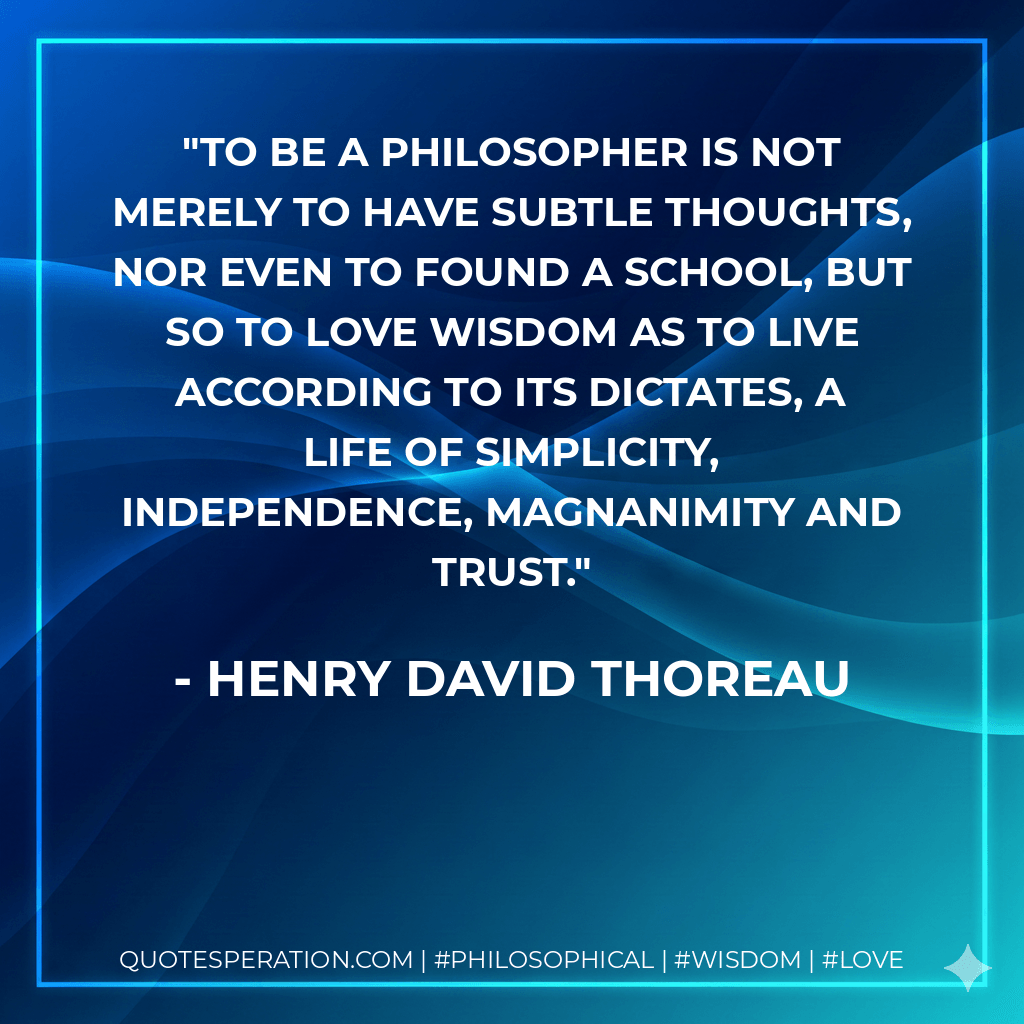
To be a philosopher is not merely to have subtle thoughts, nor even to found a school, but so to love wisdom as to live according to its dictates, a life of simplicity, independence, magnanimity and trust.
The savage lives simply through ignorance and idleness or laziness, but the philosopher lives simply through wisdom.
To be a philosopher is not merely to have subtle thoughts; but so to love wisdom as to live according to its dictates.
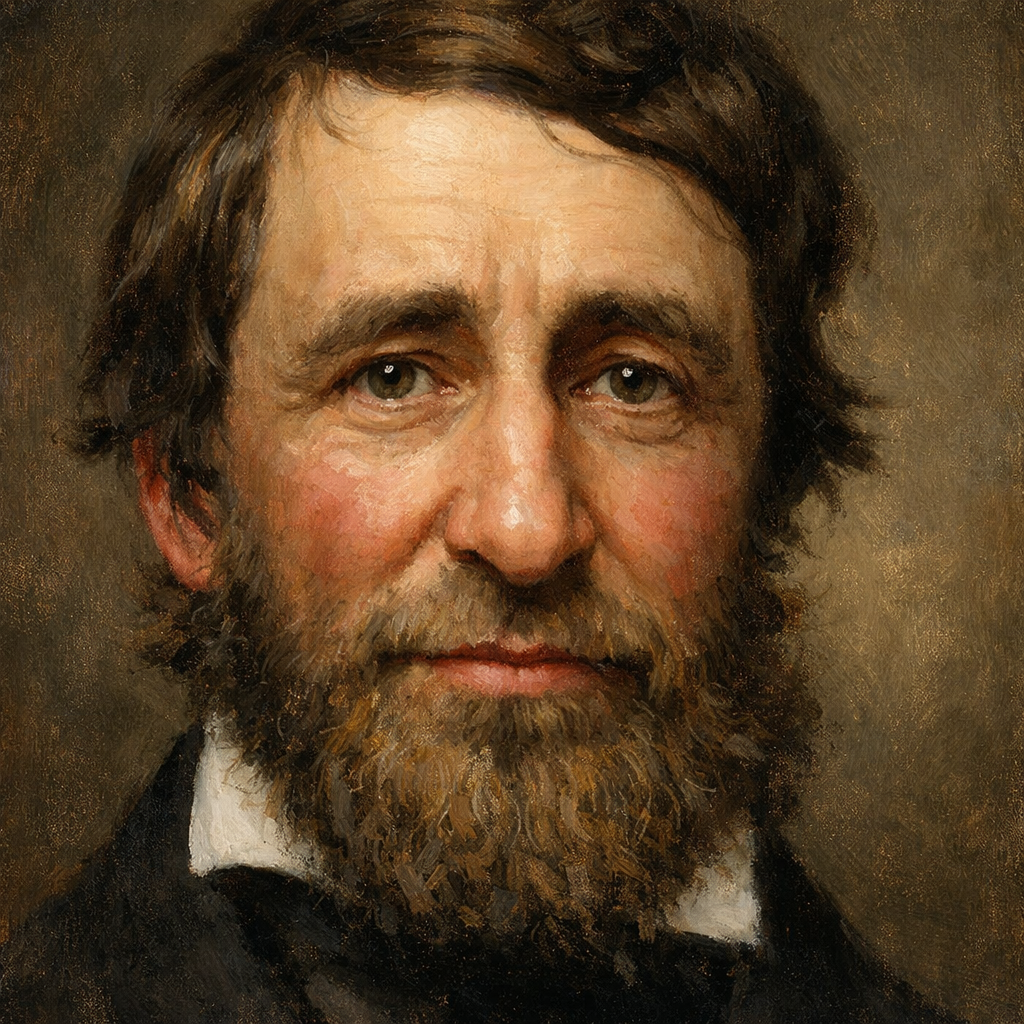
To be a philosopher,” said Thoreau, “is not merely to have subtle thoughts, nor even to found a school, but so to love wisdom as to live, according to its dictates, a life of simplicity, independence, magnanimity, and trust.
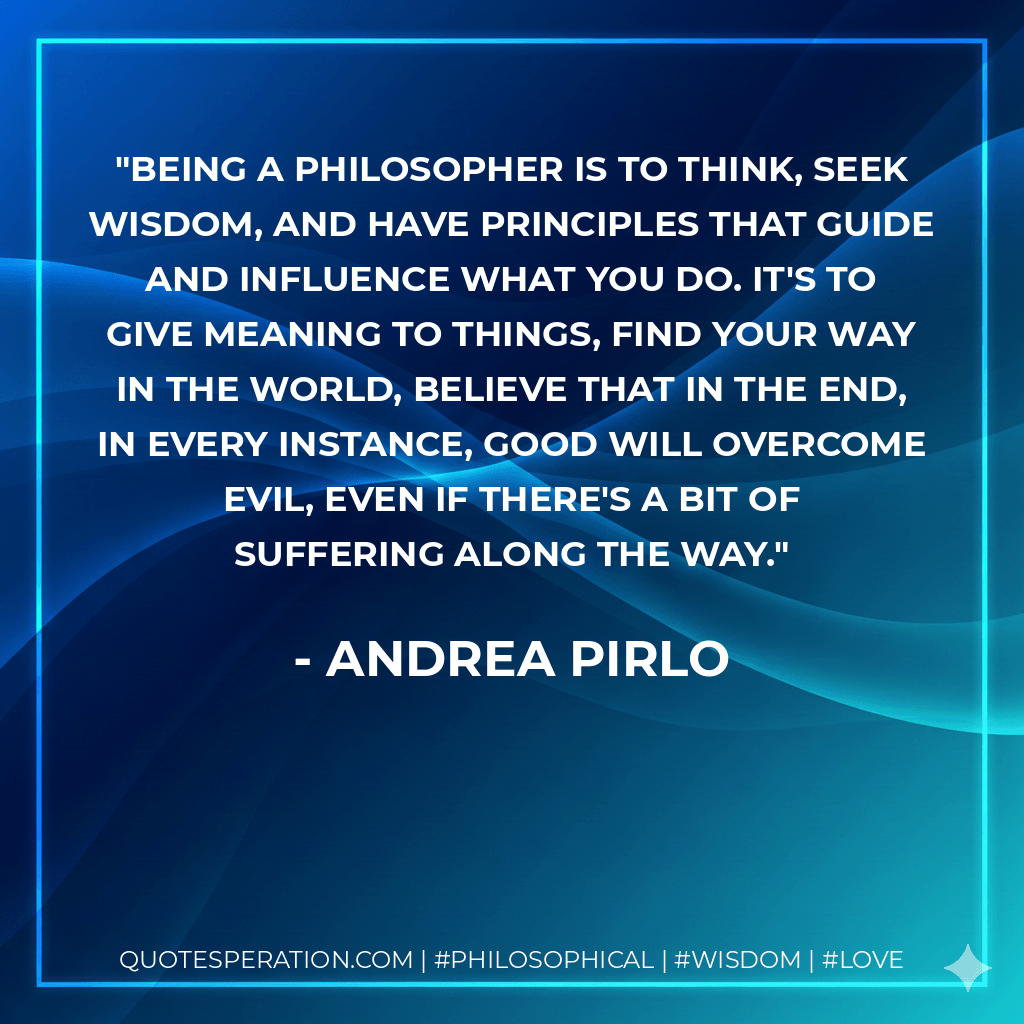
Being a philosopher is to think, seek wisdom, and have principles that guide and influence what you do. It's to give meaning to things, find your way in the world, believe that in the end, in every instance, good will overcome evil, even if there's a bit of suffering along the way.
To be a philosopher is not merely to have subtle thoughts, nor even to found a school, but so to love wisdom as to live according to its dictates, a life of simplicity, independence, magnanimity, and trust. It is to solve some of the problems of life, not only theoretically, but practically.
To be a philosopher is not merely to have subtle thoughts, nor even to found a school, but so to love wisdom as to live according to its dictates, a life of simplicity, independence, magnanimity, and trust.
What can a philosopher show for himself? His life. If someone writes a book, but it is not accompanied by a philosophical life, it is not worth our time. Wisdom is measured in details: it is found in what one says and doesn't say, what one does and doesn't do, what one thinks and doesn't think.
What can a philosopher show for himself? His life. If someone writes a book, but it is not accompanied by a philosophical life, it is not worth our time. Wisdom is measured in details: it is found in what one says and doesn’t say, what one does and doesn’t do, what one thinks and doesn’t think.
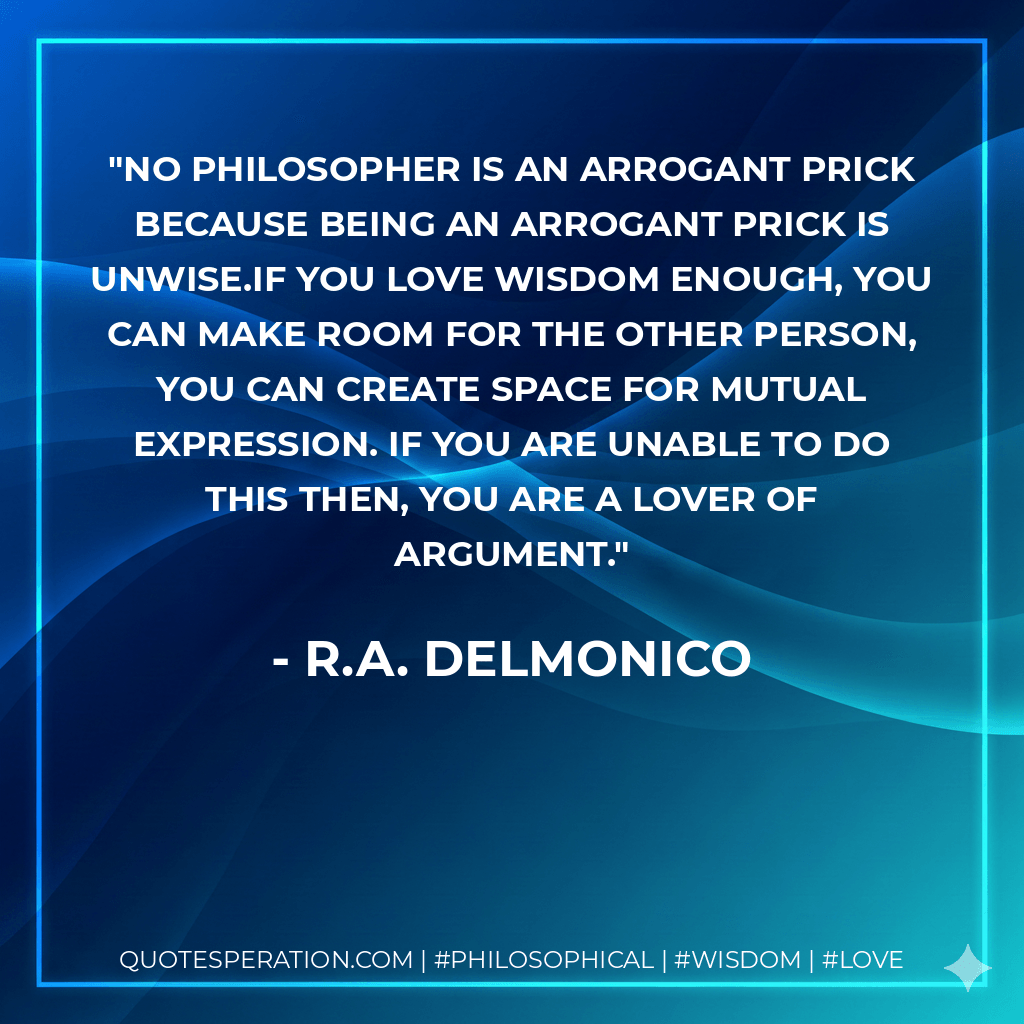
No philosopher is an arrogant prick because being an arrogant prick is unwise.If you love wisdom enough, you can make room for the other person, you can create space for mutual expression. If you are unable to do this then, you are a lover of argument.
Philosophy, to be relevant, must offer us a wisdom to live by.
A philosopher is a lover of wisdom, not of knowledge, which for all its great uses ultimately suffers from the crippling effect of ephemerality. All knowledge is transient linked to the world around it and subject to change as the world changes, whereas wisdom, true wisdom is eternal immutable. To be philosophical one must love wisdom for its own sake, accept its permanent validity and yet its perpetual irrelevance. It is the fate of the wise to understand the process of history and yet never to shape it.
Scholars love knowledge.Philosophers love wisdom.The most knowledgeable become professors.The most wise become sages.
Philosophy, Death, and Self-awareness
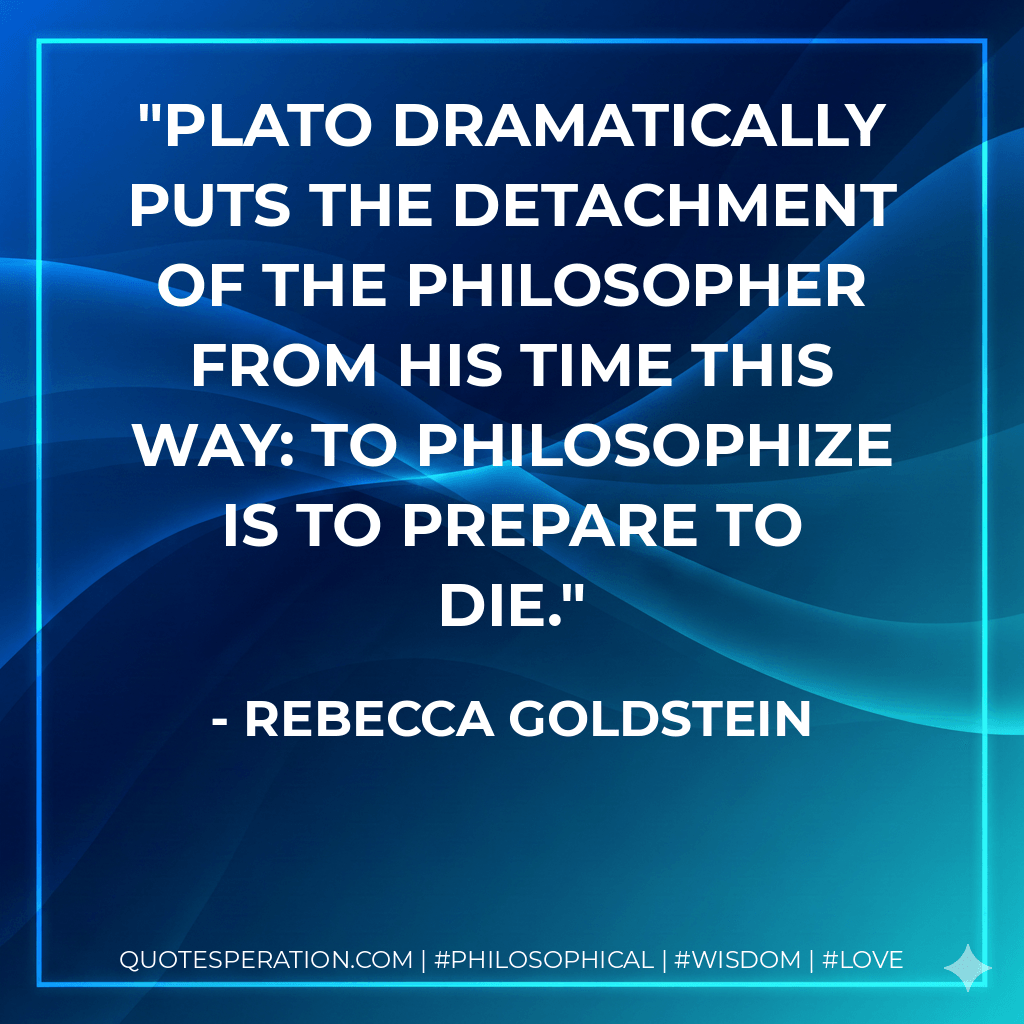
Plato dramatically puts the detachment of the philosopher from his time this way: to philosophize is to prepare to die.
To study philosophy is nothing but to prepare one’s self to die.
Inside you, there is an Eagle (courage to face the unknown) and a Serpent (knowledge). Both should grow equally. If the Eagle grows more, you become a wandering ascetic. If the Serpent grows more, you become a philosopher. When they grow equally, one day the Eagle flies away with the Serpent. Then only the Enlightened being remains for whom there is nothing known or unknown.
To philosophize is nothing else than to prepare oneself for death.
Philosophy is one reason which could lead to death.
To study philosophy is nothing but to prepare one's self to die.
Alas, I have studied philosophy, the law as well as medicine, and to my sorrow, theology; studied them well with ardent zeal, yet here I am, a wretched fool, no wiser than I was before.
I've studied now Philosophy and Jurisprudence, Medicine - and even, alas! Theology - from end to end with labor keen; and here, poor fool with all my lore I stand, no wiser than before.
I've studied now Philosophy and Jurisprudence, Medicine -- and even, alas! Theology -- from end to end with labor keen; and here, poor fool with all my lore I stand, no wiser than before.
To be a philosopher, just reverse everything you have ever been told...and have a sense of humor doing it.
The foundation stone of all philosophy is self-knowledge and being true to thy self. A person must address an inner necessity in order to realize the fundamental truth about oneself, seek self-improvement, and gain knowledge through experience.
Philosophy is harmonized knowledge making a harmonious life; it is the self-discipline which lifts us to serenity and freedom. Knowledge is power, but only wisdom is liberty.
I do not presume that I have found the best philosophy, I know that I understand the true philosophy.
Other

I cannot allow or encourage anyone to become a philosopher. But once you find the inspiration to become one of them, there will be no one to stop you.
I have studied many philosophers and many cats. The wisdom of cats is infinitely superior.
The delight we take in our senses is an implicit desire to know the ultimate reason for things, the highest cause. The desire for wisdom that philosophy etymologically is is a desire for the highest or divine causes. Philosophy culminates in theology. All other knowledge contains the seeds of contemplation of the divine.
You discuss philosophy about what you read but never really live the wisdom.
First, anyone who seriously intends to become a philosophermust "once in his life" withdraw into himself and attempt,within himself, to overthrow and build anew all the sciencesthat, up to then, he has been accepting. Philosophy wisdom(sagesse) is the philosophizer's quite personal affair. It mustarise as His wisdom, as his self-acquired knowledge tendingtoward universality, a knowledge for which he can answer fromthe beginning, and at each step, by virtue of his own absoluteinsights.
A philosopher is a lover and searcher of truth, beauty, meaning, and wisdom.
Great philosophy is always a trailblazer.
In that light, philosophy is not so much--or not simply--'the love of wisdom,' but instead marks the passage from wonder as a noun to wonder as a verb. Philosophy is the love of wisdom to the extent that it remains an incitement to it.
to be a philosopher is not merely to have subtle thoughts, nor even to found a school, but so to love wisdom as to live according to its dictates, a life of simplicity, independences, magnanimity, and trust. it is to solve some of the problems of life, not only theoretically but practically. the success of great scholars and thinkers is commonly a courtier-like success, not kingly, not manly
Alas, I have studied philosophy, / the law as well as medicine, / and to my sorrow, theology; / studied them well with ardent zeal, / yet here I am, a wretched fool, / no wiser than I was before.
Socrates, whose mother was a midwife, used to say that his art was like the art of the midwife. She does not herself give birth to the child, but she is there to help during its delivery. Similarly, Socrates saw his task as helping people to 'give birth' to correct insight, since real understanding must come from within. . . . Everybody can grasp philosophical truths if they just use their innate reason.
To understand a philosopher requires a philosopher.
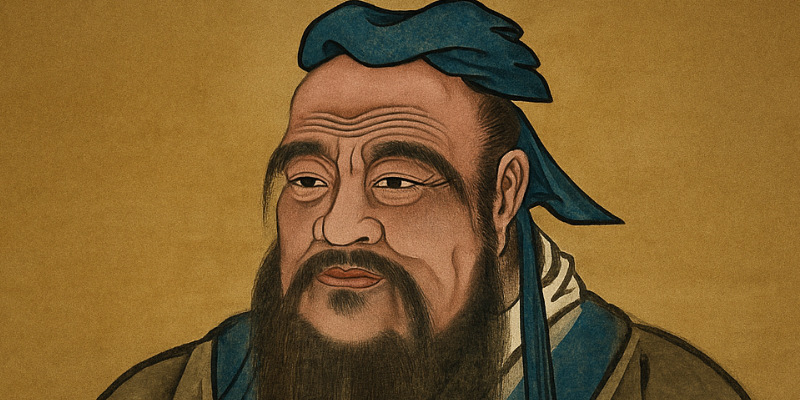
Here is an example of Confucius sayings: "It does not matter how slowly you go so long as you do not stop." In a few words, Confucius teaches us about patience, perseverance, discipline, and hard work. But if you probe further, you will see more layers. Confucius' philosophies have significantly influenced spiritual and social thought. His views bear insight and depth of wisdom. You can apply his teachings in every sphere of life. Confucius' profound teachings are based on humanism.
Even if I am but a pretender to wisdom, that in itself is philosophy.
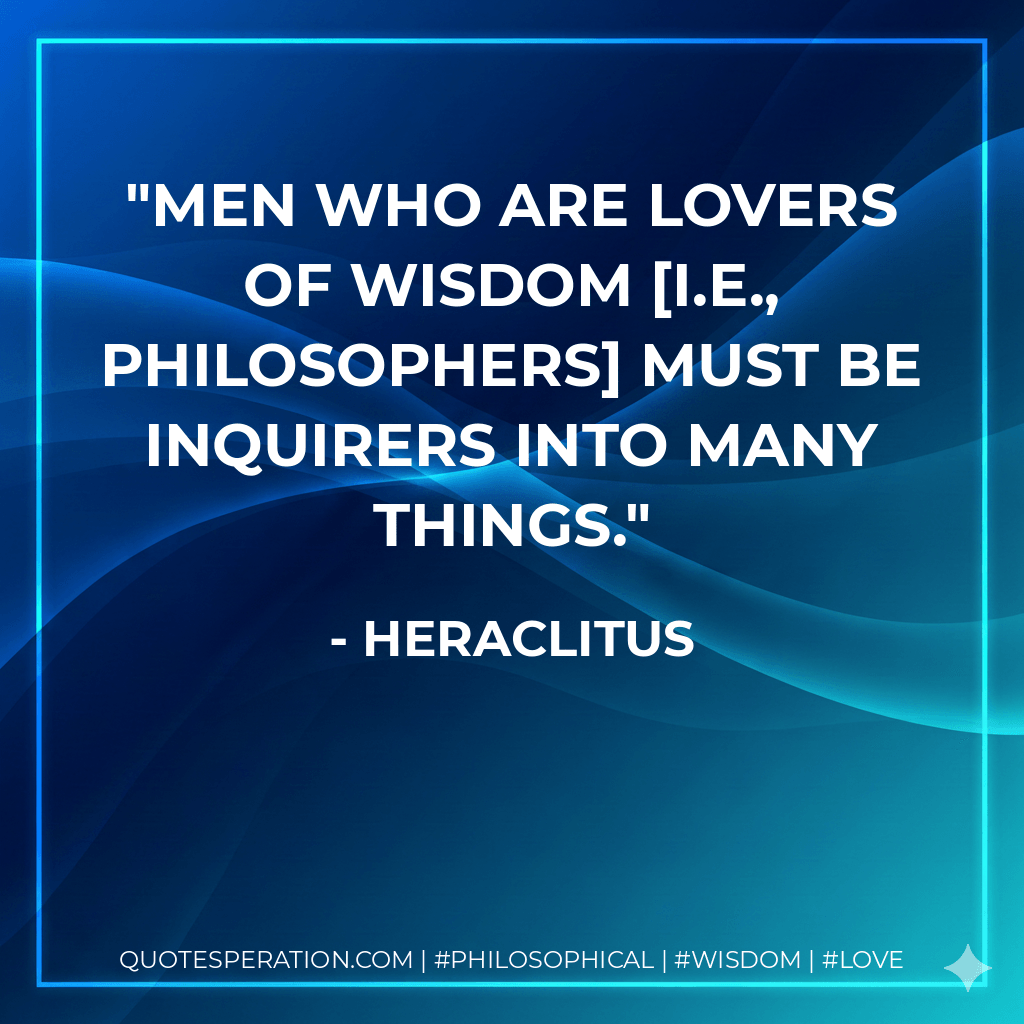
Men who are lovers of wisdom [i.e., philosophers] must be inquirers into many things.
Philosophy is the sum total of all that you know and what you decide is valuable.
Philosophy, the love of Wisdom, is at the very bottom defence against the incomprehensible.
Champions invariably have fervent philosophical beliefs. Philosophy, in its simplest terms, means 'the love of wisdom.'
More Collections

Friendship Quotes Hub

Sports Team Confidence & Success Quotes

Persistence and Progress

Best Limited Social Circles Quotes

Best Life Quotes

Best Intense Rivalry Games Quotes
Related Articles

Patrick Wright
Software engineer and creator of Quotesperation. I curate wisdom from history's greatest minds to inspire and guide modern life. When I'm not collecting quotes, I'm writing about technology and finding connections between timeless wisdom and today's challenges.