Best Book Collection Philosophy Quotes
Book Collection Philosophy
Table of Contents
- Book Theft and Borrowing
- Personal Connection to Books
- Philosophy of Book Collecting
- Books and Their Impermanence
- Books as a Status Symbol
- Books and Knowledge
- Book Collecting as an Obsession
- Book Sharing and Accessibility
- Other
Book Theft and Borrowing
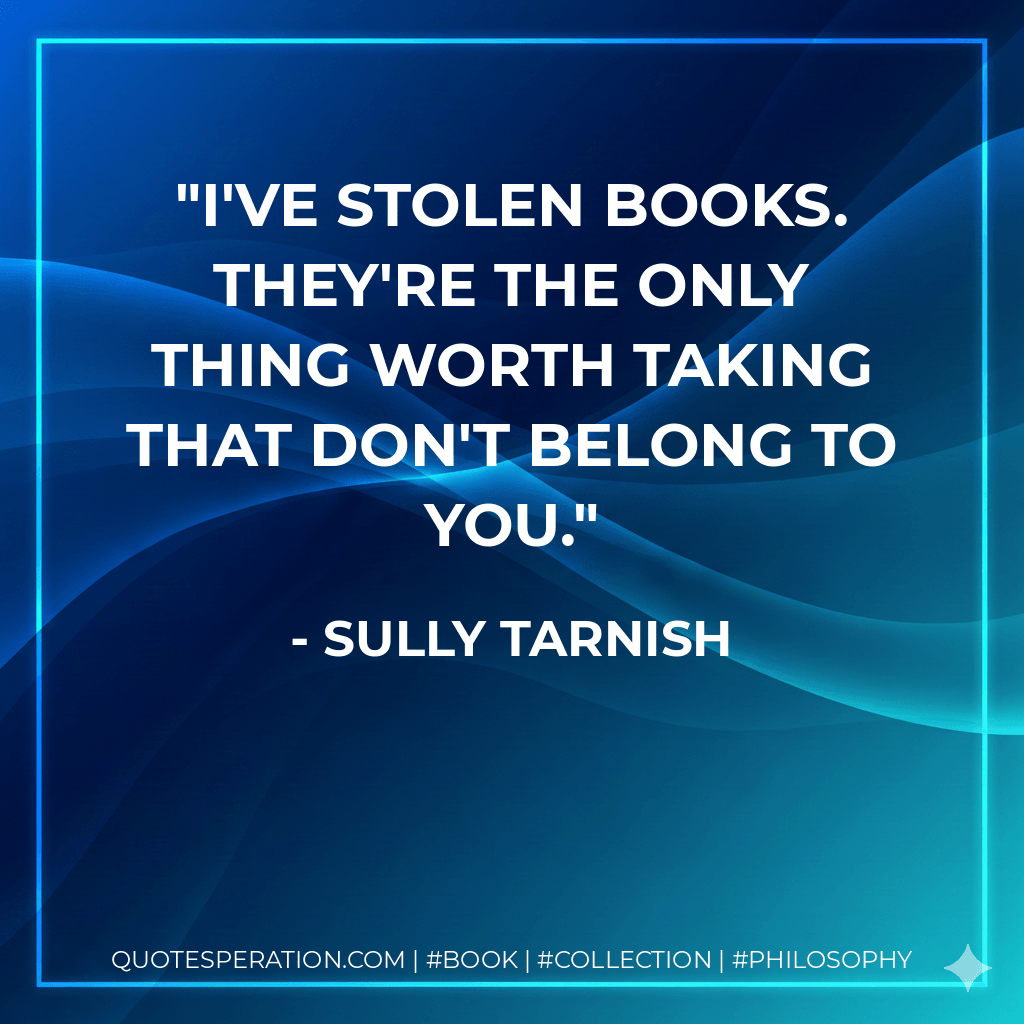
I've stolen books. They're the only thing worth taking that don't belong to you.
Professors of literature collect books the way a ship collects barnacles, without seeming effort.
Some men borrow books; some men steal books; and others beg presentation copies from the author.
Nobody steals books but your friends.
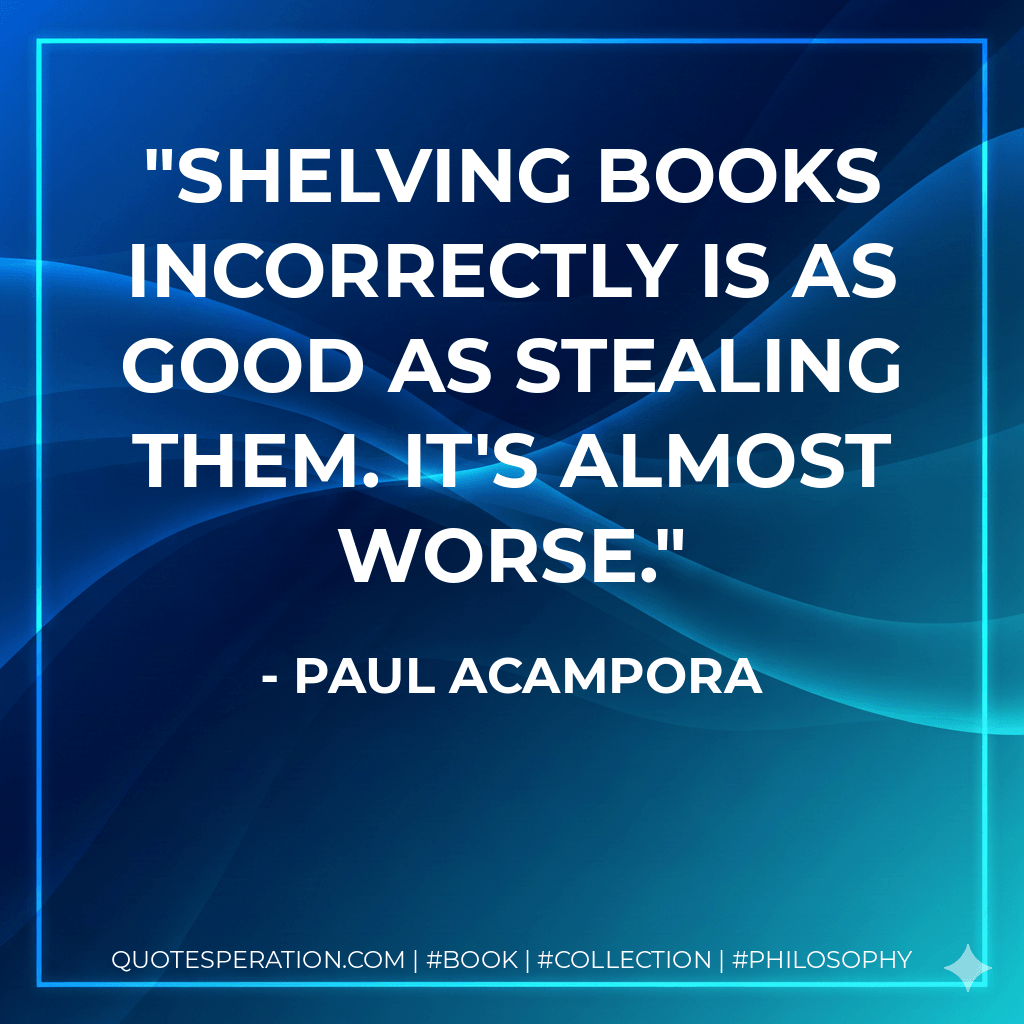
Shelving books incorrectly is as good as stealing them. It's almost worse.
When you steal from the library, you are preventing anyone else from reading that book, and the very notion makes me want to drop you in the Void.
It's amazing […] how perfectly honest people who would starve rather than steal sixpence, will steal books without compunction.
Borrowed books and umbrellas are seldom returned
Books were not looked upon as things unobtainable due to economic circumstances or class status. My grandfather stole an entire set of Dicken's from the local library.
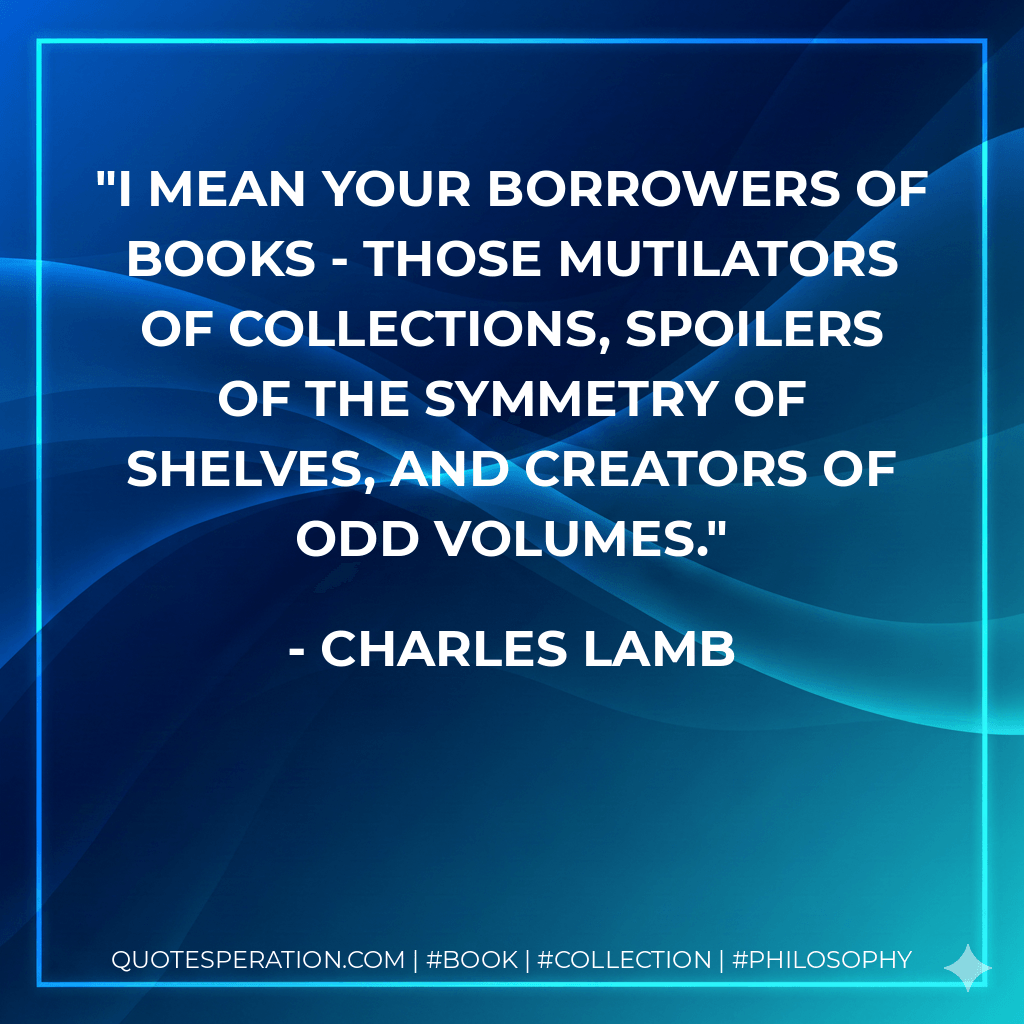
I mean your borrowers of books - those mutilators of collections, spoilers of the symmetry of shelves, and creators of odd volumes.
Borrowers of books --those mutilators of collections, spoilers of the symmetry of shelves, and creators of odd volumes.
Books were not looked upon as things unobtainable due to economic circumstances or class status. My grandfather stole an entire set of Dicken’s from the local library.
Personal Connection to Books
book collecting is only meaningful if it’s personal,” Oscar clarified. “If it’s just another way of accumulating wealth instead of for the books themselves it isn’t right. Collectors are trying to protect themselves. To separate themselves. It’s a hierarchy.
Her seven-year-old self had decided that stealing books was morally bankrupt, but since the books hadn’t actually left the library—they’d merely been relocated—it wasn’t technically stealing. Echo looked around at her sea of tomes, and a single word came to mind: Tsundoku. It was the Japanese word for letting books pile up without reading them all.
Like all collectors, I exist in a perpetual state of want that bears no reasonable relationship to the quantity of unread books mounting up on my shelves.
Individuals somehow are led to find my books at times that are important to them. The mail that I get very, very often will say, "I was at a difficult time in my life, and someone gave me a copy."

To a book collector, you see, the true freedom of all books is somewhere on his shelves.
Once a book falls into our possession, it is ours, the same way children lay their claim: 'That's my book.' As if it were organically part of them. That must be why we have so much trouble returning borrowed books. It's not exactly theft (of course not, we're not thieves, what are you implying?); it's simply a slippage in ownership or, better still, a transfer of substance. That which belonged to someone else becomes mine when I look at it. And if I like what I read, naturally I'll have difficulty giving it back.
What I would most like to think they would take away, is what I take away when I read my favorite books. Which is the knowledge that there is always somewhere you can go, that you love, and where you're safe. And that's how I feel about my favorite books, wherever I am, if I've got that book with me, I've got a place where I can go and be happy. So if that place is Hogwarts for anyone, then I couldn't be more honored or humbled.
There were books everywhere, hundreds of them on shelves that had been designed to fit into every nook and cranny, and it goes without saying that anyone who collects books can’t be all bad.
I find it almost impossible to throw a book away. Anyway, what some call hoarding, others might call building a library. So, I can justify my books. I believe I justify them in a perfectly rational way.
Individuals somehow are led to find my books at times that are important to them. The mail that I get very, very often will say, “I was at a difficult time in my life, and someone gave me a copy.”
I am happy if I can give them away or donate them. But I can’t throw a book in the trash, no matter how hard I try.
Philosophy of Book Collecting
Book collecting is an obsession, an occupation, a disease, an addiction, a fascination, an absurdity, a fate. It is not a hobby. Those who do it must do it. Those who do not do it, think of it as a cousin of stamp collecting, a sister of the trophy cabinet, bastard of a sound bank account and a weak mind.
Book collecting is a full-time occupation, and one wouldn't get far if one took time off for frivolities like reading.
If you steal from one book you are condemned as a plagiarist, but if you steal from ten books you are considered a scholar, and if you steal from thirty or forty books, a distinguished scholar.
Book-hunters are the most determined and interesting collectors in the world. I know of no passion to equal it.
Real bibliophiles do not put their books on shelves for people to look at or handle. They have no desire to show off their darlings, or to amaze people with their possessions. They keep their prized books hidden away in a secret spot to which they resort stealthily, like a Caliph visiting his harem, or a church elder sneaking into a bar. To be a book collector is to combine the worst characteristics of a dope-fiend with those of a miser.
It is a good thing to read books, and need not be a bad thing to write them, but in any case, it is a pious thing to collect them.
I don't collect books just because other people collect them, and I'm not going to have books in my collection if I think it's badly written.
I've never been a collector - just a consumer - and these days unless a book is signed to me by another author, I don't normally have any qualms about passing it to a friend or donating it to the library.
Do you know what they call people who hoard books? Smart.
Book collecting is an obsession, an occupation, a disease, an addiction, a fascination, an absurdity, a fate. It is not a hobby. Those who do it must do it.
Digital texts are all well and good, but books on shelves are a presence in your life. As such, they become a part of your day-to-day existence, reminding you, chastising you, calling to you. Plus, book collecting is, hands down, the greatest pastime in the world.
Books and Their Impermanence

As historian Albert L. Hurtado wrote, "War, pestilence, and famine blow books around the planet like so many hostages to uncertain fortune. Thieves steal, vandals deface, pious clergy burn, and worms eat books. Whether threatened by worms or war, there is nothing permanent about books and libraries.
Trithemius' concern for conservation was rare, indeed, and is a lesson to modern library managers who discard printed volumes, believing that e-books are the only way of the future.
We collect books in the belief that we are preserving them when in fact it is the books that preserve their collector.
It is fortunate that Literature is in no ways injured by the follies of Collectors, since though they preserve the worthless, they necessarily defend the good.
Great collections of books are subject to certain accidents besides the damp, the worms, and the rats; one not less common is that of the borrowers, not to say a word of the purloiners
The extermination of Poland’s literary heritage was frighteningly efficient. Researchers have estimated that 70 percent of all books in Poland were destroyed or lost through plunder. Over 90 percent of collections belonging to public libraries or schools were lost or destroyed.
Apparently Lord Wyndham did regularly donate books to various museums around London. They were usually ones which he had collected earlier, but which were no longer of interest to him or his associates. Irene twitched at the very notion. Give books away? How very frivolous, she finally said.
The reason why borrowed books are seldom returned, is that it is easier to retain books themselves than what is inside of them.
Great collections of books are subject to certain accidents besides the damp, the worms, and the rats; one not less common is that of the borrowers, not to say a word of the purloiners.
The books that are most likely to be stolen from libraries are books on ethics, especially those that are likely to be read by faculty and advanced students in moral philosophy. Those books go missing at a rate 50 to 150 percent higher than comparable texts not about ethics. And if it is any consolation, books by Nietzsche are among the most likely to be snatched, and another target is Alasdair MacIntyre’s After Virtue. Again, maybe businesspeople are not the most dishonest group after all.8.
Books as a Status Symbol
Books are the only things worth stealing.
Everyone has a bookplate these days, and the collectors are after it. The fool and his bookplate are soon parted. To distribute one's ex libris is inanely to destroy the only significance it has, that of indicating the past or present ownership of the volume in which it is placed.
SCRAP-BOOK, n. A book that is commonly edited by a fool. Many persons of some small distinction compile scrap-books containing whatever they happen to read about themselves or employ others to collect.
I've often thought that my scruples about stealing books were the only thing that stood in the way of my being a really great scholar.
To be a book-collector is to combine the worst characteristics of a dope fiend with those of a miser.
What is this obsession people have with books? They put them in their houses like they're trophies. What do you need it for after you read it?
As a rule people don’t collect books; they let books collect themselves.
What is this obsession people have with books? They put them in their houses like they’re trophies. What do you need it for after you read it?
I’ve often thought that my scruples about stealing books were the only thing that stood in the way of my being a really great scholar.

Everyone has a bookplate these days, and the collectors are after it. The fool and his bookplate are soon parted. To distribute one’s ex libris is inanely to destroy the only significance it has, that of indicating the past or present ownership of the volume in which it is placed.
Books and Knowledge
I have stolen ideas from every book I have ever read.
Of all the ways of acquiring books, writing them oneself is regarded as the most praiseworthy method.— Walter Benjamin, "Unpacking My Library
Is there anywhere on earth exempt from these swarms of new books? Even if, taken out one at a time, they offered something worth knowing, the very mass of them would be an impediment to learning from satiety if nothing else
The book borrower...proves himself to be an inveterate collector of books not so much by the fervor with which he guards his borrowed treasures...as by his failure to read these books.
I read individual stories a lot in magazines and other places, too, but I really think there’s something to be said for reading story collections as collections. That’s not true of all story collections, to be honest, but for good ones I think it often is true.
Is there anywhere on earth exempt from these swarms of new books? Even if, taken out one at a time, they offered something worth knowing, the very mass of them would be an impediment to learning from satiety if nothing else.
If it weren’t for the law, I would steal books; if it weren’t for my purse, I would buy them.
To steal book seems like stealing the soul out of someone.
The books that are most likely to be stolen from libraries are books on ethics, especially those that are likely to be read by faculty and advanced students in moral philosophy. Those books go missing at a rate 50 to 150 percent higher than comparable texts not about ethics. And if it is any consolation, books by Nietzsche are among the most likely to be snatched, and another target is Alasdair MacIntyre’s After Virtue. Again, maybe businesspeople are not the most dishonest group after all.8.
Book Collecting as an Obsession
Book collecting is an obsession, an occupation, a disease, an addiction, a fascination, an absurdity, a fate. It is not a hobby. Those who do it must do it. Those who do not do it, think of it as a cousin of stamp collecting, a sister of the trophy cabinet, bastard of a sound bank account and a weak mind.
The most discouraging feature of the mania for book-collecting is, that it grows by what it feeds on, and becomes the more insatiable the more it is gratified.
Book collecting is an obsession, an occupation, a disease, an addiction, a fascination, an absurdity, a fate. It is not a hobby. Those who do it must do it.
Book collecting is a largely solitary, mostly male, and completely absorbing activity.

Book collectors are thrill-seekers. It is a vegetarian hunt to be sure, without much exertion or risk, but the endorphin rush of the chase and the adrenaline high of the capture are much the same with first editions as I imagine they must be in the pursuit of 10-point stags, largemouth bass, or 20-foot waves at Maverick's.
Digital texts are all well and good, but books on shelves are a presence in your life. As such, they become a part of your day-to-day existence, reminding you, chastising you, calling to you. Plus, book collecting is, hands down, the greatest pastime in the world.
I do not feel happy when a collection is understood too well.
Book Sharing and Accessibility

The Gainesville Chamber of Commerce organized a drive to collect books to be donated to the Gainesville Victory ship. Two hundred books were collected.
That was the impetus behind writing it, was to have the collection be more accessible to more people,
There are many ways of discarding [books]. You can give them to friends,--or enemies,--or to associations or to poor Southern libraries. But the surest way is to lend them. Then they never come back to bother you.
Apparently Lord Wyndham did regularly donate books to various museums around London. They were usually ones which he had collected earlier, but which were no longer of interest to him or his associates. Irene twitched at the very notion. Give books away? How very frivolous, she finally said.
I like thinking of the writer as a kind of curator; the collection as curiosity cabinet – in a non-demeaning, non-objectifying sense – but an array, a set of offerings.
I’m not a collector. I don’t keep letters, or books, or souvenirs. But I do keep one copy of each translation of my books into a foreign language. Have you ever seen a murder story printed in Singhalese? Wow!
Intrigued by how people became intrigued by this topic, The Hoarders is a book about how some people’s things unsettle some accepted conceptions of material culture, why documentaries, articles, and websites dedicate themselves to eradicating this activity.
Other

And the non-reading of books, you will object, should be characteristic of all collectors? This is news to me, you may say. It is not news at all. experts will bear me out when I say that it is the oldest thing in the world. Suffice it to quote the answer which Anatole France gave to a philistine who admired his library and then finished with the standard question, “And you have read all these books, Monsieur France?” “Not one-tenth of them. I don’t suppose you use your Sevres china every day?
Those who stole and loot from ShopRite in the reprisal attacks of Xenophobia in South Africa left the bookshelf untouched. Readers don't steal and thieves don't read.
I once wrote deduceable instead of deducible in a book, though nobody then or since has taken me up on it. A small point as they go, perhaps, but Rule I of writing acceptably is to get everything right as far as you can, and in this case I had neglected to.
As a rule people don't collect books; they let books collect themselves.

We knew that French bibliophiles would be horrified to see their books falling into a trough like candy or soda. So we installed a mechanical arm that grabs the book and delivers it safely.
I just thought it made sense to call a book 'Not Garbage,' even though the majority of it was going to be the scraps from people's studios; like newspaper clippings, weird drawings and stuff they might not necessarily show as artists.
One of the freedoms you get if you earn a lot of money from a book is to throw away what you want. And if you throw a lot away, the good stuff always comes back; nothing is lost.
There are copies and copies of copies. We're sorting through it.
I like thinking of the writer as a kind of curator; the collection as curiosity cabinet - in a non-demeaning, non-objectifying sense - but an array, a set of offerings.

I once stole a book. It was really just the once, and at the time I called it borrowing. It was 1970, and the book, I could see by its lack of date stamps, had been lying unappreciated on the shelves of my convent school library since its publication in 1945.
I got my books stolen. They wanted my work.
Books are so cheap and easy to get that people don't bother stealing them, which is the essential rule of piracy that the music business learned much too late.
They will be given as gifts; books that are especially pretty or visual will be bought as hard copies; books that are collectible will continue to be collected; people with lots of bookshelves will keep stocking them; and anyone who likes to make notes in books will keep buying books with margins to fill.
'The Things They Carried' is labeled right inside the book as a work of fiction, but I did set out when I wrote the book to make it feel real... I use my own name, and I dedicated the book to characters in the book to give it the form of a war memoir.
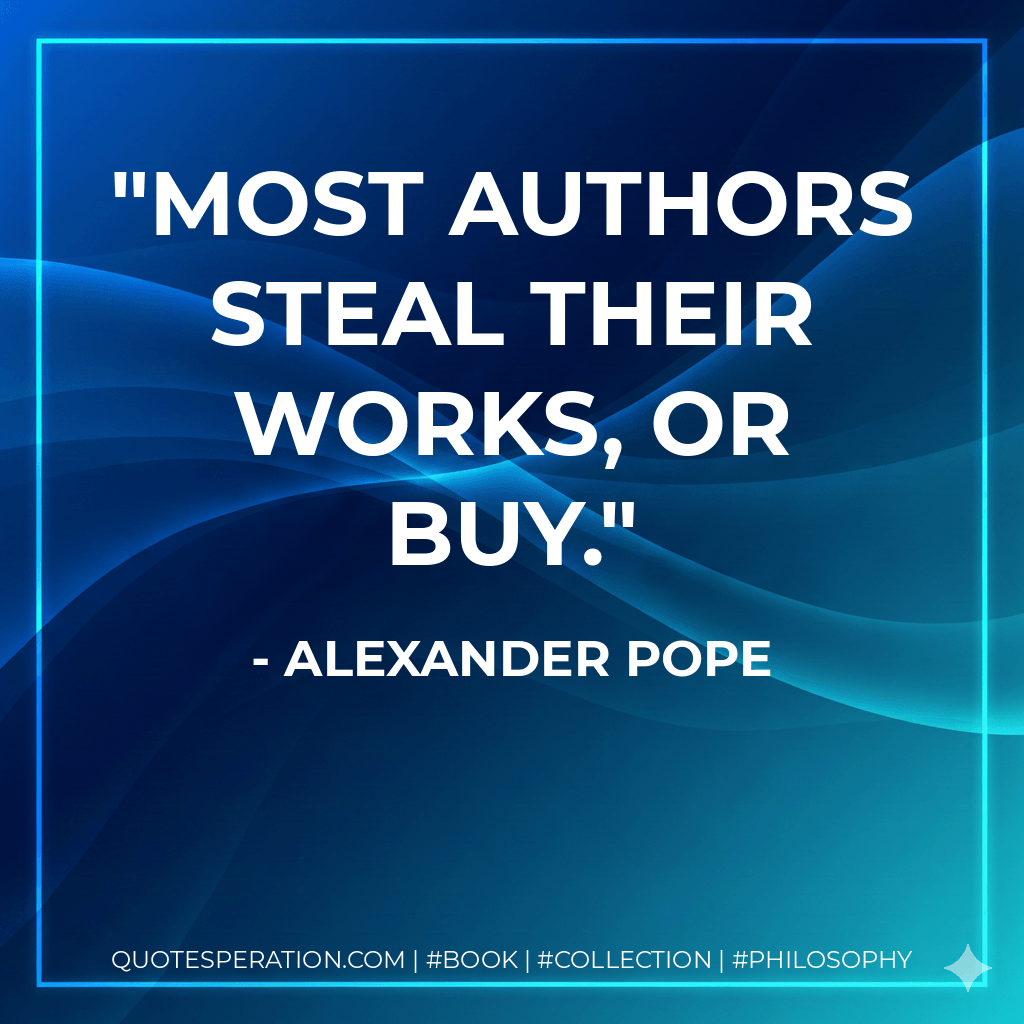
Most authors steal their works, or buy.
Any and all copyright holders ... can tell us which books they'd prefer that we not scan if we find them in a library.
I'm not a collector. I don't keep letters, or books, or souvenirs. But I do keep one copy of each translation of my books into a foreign language. Have you ever seen a murder story printed in Singhalese? Wow!
I mean your borrowers of books – those mutilators of collections, spoilers of the symmetry of shelves, and creators of odd volumes.
If you going to steal a book thought, you should at least take the nicest one, otherwise what’s the point?

Hef holds the Guinness Book of World Records title for largest scrapbook collection at over 2,000 volumes.
Shelving books incorrectly is as good as stealing them. It’s almost worse.
My books were all on their shelves. Nobody steals books but your friends.
It’s a fair-sized job to write a book that people can be bothered just to read; when they begin to steal copies, you are really getting some place.
I’ve stolen books. They’re the only thing worth taking that don’t belong to you.

I'm the farthest thing from a bibliophile. I purge my collection regularly: If I haven't read a book in a couple of years, I try to give it to someone who will.
More Collections
Friendship Quotes Hub
Sports Team Confidence & Success Quotes
Persistence and Progress

Best Limited Social Circles Quotes

Best Life Quotes

Best Intense Rivalry Games Quotes
Related Articles



Patrick Wright
Software engineer and creator of Quotesperation. I curate wisdom from history's greatest minds to inspire and guide modern life. When I'm not collecting quotes, I'm writing about technology and finding connections between timeless wisdom and today's challenges.