
Best Book Publishing Economics Quotes
Book Publishing Economics
Table of Contents
- Book Sales and Market Performance
- E-book and Digital Publishing
- Challenges in Publishing
- Publishing Trends and Innovations
- Economics of Book Production
- Marketing and Promotion
- Cultural and Social Impact
- Authors' Perspectives
- Book Collecting and Valuation
- Other
Book Sales and Market Performance
My book sales are way down today. Also, I've received two scathing reviews. One of them calls me “a purveyor of insipid wet-dreams.
Just think how many books I could've sold if Harry had been a bit more creative with his wand." -[On the success of 50 Shades of Grey]
Seriously, when you see a new book fresh on the stand and in big letters it says “A Million Copies Sold,” did you ever wonder who bought them?
Here's the truth, simply stated...bookstores are suffering from a serious crisis of falling sales. Don't believe a single zero of all those editions claimed to be 100,000! 40,000!...even 400 copies! just for the suckers! Alack!...Alas!...only love and romance...and even then!...manage to keep selling...and a few murder mysteries...
I'm always prepared for the worst. I was prepared to have the book come out, sell seven copies, and have to keep working in advertising, so it was just great that it was received so well and by such a huge audience.
It was the No. 1-selling e-book on the planet. With about 12 copies.
There are a lot of copies out there.
What I'm pretty sure is, it is not going to be a No. 1 bestseller for 26 weeks, ... And I'm also pretty sure it's not a disaster. So it's somewhere in the middle.
I gauge success in years, not weeks. The weekend box-office approach to book launches is short sighted and encourages crappy books.
I didn't expect the book to sell in the first place. I was hoping for a quick and merciful death at the hands of reviewers but at the same time I sort of hoped that maybe someone would like it enough to give me encouragement. Public encouragement. I hoped for a little, as I said, but I got rather a whole lot, and in some ways this was just about as frightening as the quick, merciful death I'd expected.
These are pretty much the most critically-acclaimed books I've ever written and the sales have been literally twice what we were all expecting.
With this new book, we expect an even bigger jump in sales and revenue. We've sold eight-and-a-half-million copies already of the new book. That's an enormous number, and we expect to hit over $100 million in sales.
It's been a fantastic best seller. I think it has been, given our expectations, a success, and we expect more out of the book.
E-book and Digital Publishing
To all my friends, a few of my e-book titles are now listed at 99 cents, if you are interested, pick up a copy, leave a review too would sure be appreciated. Thank you, Sincerely Laura Lee. **Happy Reading**
We're kidding on that. One of the things I insisted upon when we went into this project was that we are full partners, going fifty-fifty, both on the money and on the say of what's going on with the books.
Another thing that we share is a need to earn a living after we leave the White House. Rosalyn asked me to announce, by the way, that our books are still on sale.
I think Walking Dead is one of the friendliest new reader type books in that every time a new trade is shipped out, a new issue is shipped out at the same time.
The market for unabridged, full-length books only started taking off over the last few years. And we think Hemingway will be especially popular for audio downloads.
Back in 1999 and 2000, a few of us... a very few of us... Douglas Clegg, Seth Godin and I... offered free electronic copies of our books in an effort to reach an audience we otherwise wouldn't have reached and to test out a new marketing concept for books. Despite the industry screaming we were crazy, it worked.
Harry Potter and the Half-Blood Prince will be the best selling pre-order book in publishing history.
When it came time to make the audiobook, Audible did an ingenious thing: they asked both Wil Wheaton and Amber Benson to record entire versions of the book. As the author, I'm impressed with Audible's commitment to my narrative -- and I'm geeking out that both Wil and Amber are reading my book. This is fantastic.
It's increased sales of my book probably at least three-fold, maybe more,
Challenges in Publishing
The average buyer in bookshop spends 8 seconds on the front cover and 15 seconds on the back cover before deciding whether to purchase the book or not. On average, he does not get past page 18. See? The odds are stacked against us writers!
The book looked doomed, assailed on all sides by those who'd see it superseded by the synthetic-new and those who didn't give two shiny ones. With the recession forging ahead with renewed vigour, bookselling too was going the way of papyrus, taking with it what was left of Richard's self-esteem, his beer money and his comedic persona.
I remember going into a bookshop, and the only book I saw with a black child on the cover was 'A Thief in the Village' by James Berry, and I thought, 'Is this still the state of publishing?' Then I thought, 'Either I can whine about it or try to do something about it.'
I hadn't published a book in six years so I didn't know what to expect. It has been going very well. They've all been packed.
In many ways, it was much, much harder to get the first book contract. The hardest thing probably overall has been learning not to trust people, publicists and so forth, implicitly.
That hurt us big time. We had invested a lot into those books.
We sometimes received - and I would read - 200 manuscripts a week. Some of them were wonderful, some were terrible; most were mediocre. It was like the gifts of the good and bad fairies.
At one library that got that resource, 80 percent of the titles were checked out in 48 hours. Those should be successful. There's a great demand for audio books.
New York publishing is about, 'What's the next Harry Potter? What's the next Twilight?' When I've approached people, I've asked, 'What is the book you've been dying to do, but New York won't do?' I want the books that they think won't sell - because I think they will.
It's really kind of shocking. I mean it's not common for publishers to pull a book before there's any sort of legal discussion.
Publishing Trends and Innovations
There is real hope for a culture that makes it as easy to buy a book as it does a pack of cigarettes."--a civic leader quoted in a New American Library ad (1951) American Pulp tells the story of the midcentury golden age of pulp paperbacks and how they brought modernism to Main Street, democratized literature and ideas, spurred social mobility, and helped readers fashion new identities.
There was enormous interest from multiple publishers. It will be a complete and candid book.
I can understand the allure of a venerable Big Six imprint, of a shot at the New York Times list, of a publisher-sponsored book tour, of seeing your hardbacks in bookstores and your paperbacks in supermarkets.
We held a very long meeting to decide how many of the paperbacks we would buy. And the number we decided on was staggering compared to other books. It's the largest buy I've made for one book in 20 years.
We did not commission a book. The idea was brought to us by an outside consultant. We explored it, provided some background information ... but in the final analysis, decided it wasn't the right thing for us to do.
We've always reached the hardcover buyer more than the paperback buyer.
Being the first to do something like this also registers a lot of attention that the line might not have gotten if all four books had just appeared from one company.
The books are all very, very different so the publishers really had to be different too.
I don't think the magic will wear off. This is a real classic that has all the ingredients as a C.S. Lewis or Roald Dahl that sells as many books as they did 50 years ago,
Back in 1999 and 2000, a few of us... a very few of us... Douglas Clegg, Seth Godin and I... offered free electronic copies of our books in an effort to reach an audience we otherwise wouldn't have reached and to test out a new marketing concept for books. Despite the industry screaming we were crazy, it worked.
Estimates are that in 2012, more than 32 million books were available - the explosion, thanks to the ease of self-publishing; 2013 could see even more titles grace our virtual bookstores! That means we are going to be awash in covers and titles, plot descriptions and characters.
Economics of Book Production
Any book without a mistake in it has had too much money spent on it.
It is hard to remember that every forgotten book (and we have published hundreds such) once seemed to its publisher something of value and likely to live for a long time.
—Amy said that would be an imprudent expense; but as soon as he had got a good price for a book. Will not the publishers be kind? If they knew what happiness lurked in embryo within their foolish cheque-books!
They did the book design and layout and we did the production.
I am at a loss to reconcile the expensive and glossy production values of this book with the breathtaking inanity of the content.
The first edition was 100,000 copies, a huge economic risk for the publisher. I was quite proud of the fact that the book was not banned or censored.
Yes, I'm disappointed it has not sold at a stronger level. But I'm thrilled we put as much effort as we did into this book.
The best way for him to win over people was to have come clean and not have a book going on sale. The book is a lot of the reason people are sour.
The mass-market paperback, for one, is too expensive.
Marketing and Promotion
All four Dirty Affliction books are on sale for .99 each on Amazon in celebration of my upcoming release! Melody the final book in the series will release in March.
All 3 Dirty Affliction Novels are only .99 each until March, 31st on Amazon!
I sometimes wonder what would have happened if the first book had not sold... doesn't bear thinking about, but I suppose we'd have made it work somehow.
The very quick and high sales of the book caught us off guard, but fortunately we got the second edition from the printers at the end of last week and the shops should now be stocked again,
I think it's a great attempt to popularize the book business, and boy, do we need it. It's a good thing, as we try to expand our readers, to put the public into this. I think it's important to have the consumer not only buy the book, but confirm that this is the best book of the year.
This book, 'Stupid White Men,' has sold now over four million copies worldwide. Probably about half of that may be in the U.S. and Canada, and the rest, overseas.
We feel like we're offering a service and the immediate gratification to order the book right there and then.
I wanted my book to make people cry, but I feel like I'm the only person who my book is going to make cry, if they show me the sales numbers.
What most people wanted was a reproduction of the book, because the book made money,
Cultural and Social Impact
America is now wholly given over to a damned mob of scribbling women, and I should have no chance of success while the public taste is occupied with their trash--and should be ashamed of myself if I did succeed. What is the mystery of these innumberable editions of The Lamplighter (by Maria Susanna Cummins), and other books neither better nor worse? Worse they could not be, and better they need not be, when they sell by the hundred thousand.
These books portray people in ways that are hurtful and wrong. Ceasing sales of these books is only part of our commitment and our broader plan to ensure Dr. Seuss Enterprises' catalog represents and supports all communities and families
I remember going into a bookshop, and the only book I saw with a black child on the cover was 'A Thief in the Village' by James Berry, and I thought, 'Is this still the state of publishing?' Then I thought, 'Either I can whine about it or try to do something about it.'
I really want people to read the book, and bookstores never sold an issue of Eightball because nobody knew what it was.
I don't think a novel's main donation, main gift, is the document. The document is there, but a novel goes beyond documentation. It goes into opening a new vista, opening a new perspective, showing familiar things in an unfamiliar way, and making the reader reconsider the documentary facts which he or she may have known before.
Sure, best seller. I'd love to knock Stephen King off the top of the list. I know I won't, but, after all, I spend my life inventing a different reality.
The millionaire says to a thousand people, 'I read this book and it started me on the road to wealth.' Guess how many go out and get the book? Very few. Isn't that incredible? Why wouldn't everyone get the book?!
It fills a little niche; nobody's ever written about this before in this way because it's a book about a serious subject but told with such a respectful, light touch. It's one of those books you sit down and read start to finish because you can't put it down. And after you finish, you say 'My aunt would like this, and so would my great-grandmother and my sister.' And so people will buy one, and then come back and buy 10.
Governor Perry has been the most open book in terms of a long-standing history of releasing his complete tax returns for years so the public is able to totally examine his sources of income.
Authors' Perspectives
Early in 1967 Highsmith's agent told her why her books did not sell in paperback in America. It was, said Patricia Schartle Myrer, because they were 'too subtle', combined with the fact that none of her characters were likeable. 'Perhaps it is because I don't like anyone,' Highsmith replied. 'My last books may be about animals'.
CUSTOMER: I don’t know why she wants it, but my wife asked for a copy of The Dinosaur Cookbook.BOOKSELLER: The Dinah Shore Cookbook?
Douglas has more books- and comic books- than anyone I know. Still, if you wanted to borrow one, and took it down off the shelf and forgot to mention it to him, Douglas would notice right away it was missing, even though there are maybe a thousand other ones that look exactly like it right on the shelf beside it. Douglas is one of those books people
This is a great surprise and a great pleasure. Any one of these books could have won. To my colleagues I say just hang around and it will come. I have hung around for many years.
I sometimes wonder what would have happened if the first book had not sold... doesn't bear thinking about, but I suppose we'd have made it work somehow.
I didn't expect the book to sell in the first place. I was hoping for a quick and merciful death at the hands of reviewers but at the same time I sort of hoped that maybe someone would like it enough to give me encouragement. Public encouragement. I hoped for a little, as I said, but I got rather a whole lot, and in some ways this was just about as frightening as the quick, merciful death I'd expected.
I don't think the magic will wear off. This is a real classic that has all the ingredients as a C.S. Lewis or Roald Dahl that sells as many books as they did 50 years ago,
For all you book writers out there, you can't write a better book than that. There's not a better Christmas present that I could have this year than to watch our team go into the playoffs and win the championship.
It's a strange feeling to see one's books come up at auction and also, to some extent, a sign of my miserable early failings as an author.
So, in effect, my first sale was actually two books.
Producing came about because I never wanted to be in one of those books, Where Are They Now?
Book Collecting and Valuation
Well, a copy was auctioned last year at a charity auction in Berlin, and it became the most expensive single book of the 20th Century.
It's a strange feeling to see one's books come up at auction and also, to some extent, a sign of my miserable early failings as an author.
The books one has written in the past have two surprises in store: one couldn't write them again, and wouldn't want to.
I was lucky enough to be given books that weren't top sellers; books that were kind of under the radar
Relatively complete copies of the Folio in contemporary or near contemporary bindings very rarely come to the market. This sale will be a truly exceptional event.
The First Folio preserves 18 of his plays, which otherwise would have been lost for all time. Relatively complete copies of the Folio in contemporary or near contemporary bindings very rarely come to the market.
I am sure this book would soon become a collector's item.
No matter how beautiful and loved a cover may be, the jury on it remains uncommitted until the book has been in the world for a while. Perhaps bookstore buyers will be indifferent. Perhaps it will be lost on store shelves. Perhaps there's another book or two out there using the same or a similar photo.
I am not a book collector, and I am not fussy about particular editions. As long as the words are there I don't mind.
Other
And the book (#7) is for whenever the hunt involves a lot of waiting around. Entertainment that won't eat up my batteries is always worth bringing.
It seems kind of light for a dozen books. I think it's probably that unnatural number of Jason Statham DVDs you ordered."He has to have filmed a nude scene at some point in his career. I don't care how many shoot-'em-up action movies I have to watch, I will find it," I said solemnly. "Oh, yes, I will find it.
I cannot tell you how exciting it is when you first see your book in paperback, then when the good reviews roll in it is just the red bow on the present under the tree.
The problem is, there's a whole lot of people who say "I'm a limited edition".
Once in every few publishing seasons there is an Event. For no apparent reason, the great heart of the Public gives a startled jump, and the public's great purse is emptied to secure copies of some novel which has stolen into the world without advance advertising and whose only claim to recognition is that The Licensed Victuallers' Gazette has stated in a two-line review that it is 'readable'.
What has seven editions (the book had already gone into no less) got to do with the value of it? Was not writing poetry a secret transaction, a voice answering a voice? So that all this chatter and praise and blame and meeting people who admired one and meeting people who did not admire one was as ill suited as could be to the thing itself — a voice answering a voice.
They are all cheap copies and every one of them is forgotten.
At your next book club meeting, picture me sitting quietly in the corner, taking notes on your preferences. Imagine the next day you get an email from me trying to sell you a new grill — or a book — or accessories for your Glock. That's the Amazon/Goodreads deal. It's appalling. But everywhere in the press, you'll read about the genius of Amazon."(Michael Herrmann and the booksellers of Gibson's)
It's guff. It doesn't advance the action. It makes for nice fat books such as the American market thrives on, but it doesn't actually get you anywhere.
A couple of customers interrupted [...] who wanted to know if we had some YA book about ants and aliens I'd never heard of.
Used books,” as if someone else has had the best of them and you get the sere husk, or the lees, as if a book isn’t the one thing, the one product, that is forever new. There’s no such thing as a used book. Or there’s no such thing as a book if it’s not being used.
What's most interesting about some books is the question: How did this crap ever get published?
I, alone, could never have produced this book. I say this mainly in case there are lawsuits.
There was enormous interest from publishers in this book. We met with numerous publishers and ultimately conducted a traditional literary auction.
In 2004, I wrote 'What We've Lost,' a book about the Bush administration. It sold only reasonably well, in part, I think, because the book was a horrific downer, an unrelenting account of the administration's actions, bungles, deceptions, half-truths, untruths, and downright corruptions.
Our goal is to create that book that every Wednesday 52 is the one book you can't wait to get.
We're taking requests from customers who are looking for certain used copies. We already found 18 to 20 Louis L'Amour books that were on a customer's request list.
I think it's pretty pathetic they want to drag my father into this. I've moved on. I mean that's just sad that someone would try and do that to sell a book.
My specialty as a collector is books that almost have value. When I love a book, I don't buy the first edition, because those have become incredibly expensive. But I might buy a beat-up copy of the second edition, third printing, which looks almost exactly the same as the first edition except that a couple of typos have been fixed.
America is now wholly given over to a d--d mob of scribbling women, and I should have no chance of success while the public taste is occupied with their trash - and should be ashamed of myself if I did succeed. What is the mystery of these innumerable editions of the Lamplighter, and other books neither better nor worse? - worse they could not be, and better they need not be, when they sell by 100,000.
I don't think of "High Fidelity" as a real hip book.
There's been million-seller books and million-seller CDs. But there hasn't been, until now, million-seller art.
I kept thinking maybe in the future editions [of Dark Money] I should sell it along with, like, some kind of, you know, Pepto Bismol or something. I wanted it to read a little bit like a thriller, so that it truly grabbed people.
The Penguin books are splendid value for sixpence, so splendid that if other publishers had any sense they would combine against them and suppress them.
It's been a fantastic best-seller, ... I think it has been, given our expectations, a success, and we expect more out of the book. I think it will have a long life both in hardcover and eventually in paperback.
Sometimes it was September or October before we would get the books.
I don't really read 'business books,' and I didn't think 'The Paradox of Choice' was a business book. I'm very surprised and gratified that the business world thought it was one.
If 'Big Phil' gets the job we will be quite happy from a bookmaking point of view as we will make a five figure profit.
The first chapter sells the book; the last chapter sells the next book.
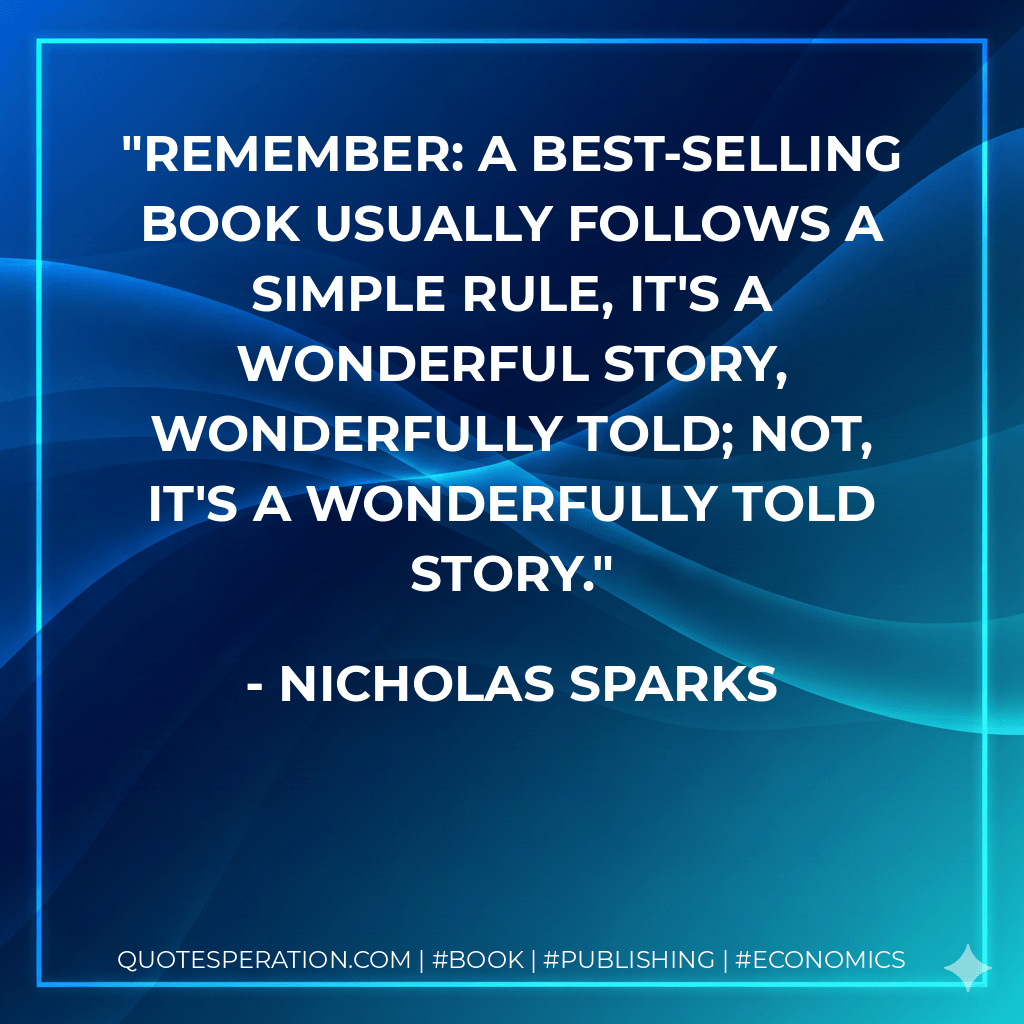
Remember: A best-selling book usually follows a simple rule, It's a wonderful story, wonderfully told; not, It's a wonderfully told story.
I don't think these books will stay on the best-seller list forever, but I think this puzzle is here to stay like the crossword.
Obviously the publishers, because of historical curiosity or the significance of it, I think expected more, ... It obviously was not as much as some of my other books, but I don't know how much a writer can get involved in trying to second-guess that.
I am disappointed by this controversy surrounding A Million Little Pieces because I rely on the publishers to define the category that a book falls within and also the authenticity of the work.
It's always difficult to pare down so many books. There's only room for five on the raft. So there was give and take. There has to be compromise, but it was very amicable. We had a fair degree of consensus. And we're happy with the choices. We think these five books represent the best of Canadian fiction this year.
More Collections
Friendship Quotes Hub

Sports Team Confidence & Success Quotes
Persistence and Progress

Best Limited Social Circles Quotes

Best Life Quotes

Best Intense Rivalry Games Quotes
Related Articles

Patrick Wright
Software engineer and creator of Quotesperation. I curate wisdom from history's greatest minds to inspire and guide modern life. When I'm not collecting quotes, I'm writing about technology and finding connections between timeless wisdom and today's challenges.