
Best Publishing Industry Critique Quotes
Publishing Industry Critique
Table of Contents
- Digital vs. Print
- Censorship and Freedom of Expression
- Quality and Content of Books
- The Business of Publishing
- Technological Impact on Reading
- Endurance of Books
- Market Trends and Reader Behavior
- Other
Digital vs. Print
There will be more words written on Twitter in the next two years than contained in all books ever printed.
Books have survived television, radio, talking pictures, circulars (early magazines), dailies (early newspapers), Punch and Judy shows, and Shakespeare's plays. They have survived World War II, the Hundred Years' War, the Black Death, and the fall of the Roman Empire. They even survived the Dark Ages, when almost no one could read and each book had to be copied by hand. They aren't going to be killed off by the Internet.
I fear the day when the technos decide that paper books are obsolete and we are reading from PC screens and iPods and eBooks, and we never again experience the little rush of opening a new book and cracking the spine and smelling the print and diving deep into the thoughts of the writer.
So I think that some of the fears that people have posed about what this type of publication directly on the Internet will mean for the book publishing industry have been vastly overstated.
More and more books are published every year. If people were not reading them, they wouldn't be published. We are now reading electronic books or whatever else, but people are still reading, and people still need stories.
The Internet, cable TV, and computer games, account for much more of the trend away from books.
I am a big fan of the electronic book. I hate to see the old bookstores close, but they have to reinvent themselves. I believe the First Edition bookstore will be the next thing. People will read electronically, then decide they want to own that book. The author will then be invited to the old bookstores to sign. I think books will always be with us, but they will fill a different need.
Remember that just because major publishing is having trouble, that doesn't mean people have stopped reading books. Printed books won't go away, but ebooks won't go away, either.
I hate those e-books. They cannot be the future. They may well be.
The advent of ebooks is no more going to kill the pleasure of reading than the introduction of the internal combustion engine made horses extinct.
In terms of the economics, yes obviously the rise of e-books and how people choose to read books has a big effect on the economics of the game. But whether people are buying them on paper or downloading them there's still some poor wretch in a room who is trying to write a poem, write a story, write a novel. And so my job doesn't change. It's just how people receive it and economic conditions on the ground change, but that doesn't affect what I write.
We authors certainly don't know what is going to happen to our books. Are they going to disappear into the ether, following music downloads, or are ebooks going to open up a whole new world of readers? And how much are we being paid per copy? We haven't a clue.
Censorship and Freedom of Expression
![[I]t's not just the books under fire now that worry me. It is the books that will never be written. The books that will never be read. And all due to the fear of censorship. As always, young readers will be the real losers. - Judy Blume](/_vercel/image?url=https:%2F%2Flakl0ama8n6qbptj.public.blob.vercel-storage.com%2Fquotes%2Fquote-179779.png&w=1536&q=100)
[I]t's not just the books under fire now that worry me. It is the books that will never be written. The books that will never be read. And all due to the fear of censorship. As always, young readers will be the real losers.
The books that will never be read. And all due to the fear of censorship. As always, young readers will be the real losers.
The net's future is far from assured, and history offers much warning. Within a few decades of Gutenberg's creation, princes and priests moved to restrict the right to print books.
If only it were God's will that printed and written materials have as much influence on the people as the princes and their censors fear! Considering the countless good books we have, the world would have changed for the better a long time ago.

All people, even secular people, are seeing books on the market like The End of History.
If only it were God’s will that printed and written materials have as much influence on the people as the princes and their censors fear! Considering the countless good books we have, the world would have changed for the better a long time ago.
As soon as the printing press started flooding Europe with books, people were complaining that there were too many books and that it was going to change philosophy and the course of human thought in ways that wouldn't necessarily be good.
Quality and Content of Books
Books are like lovers;you always love the latest,more than the previous,but you always fearthe latest is going to releasetoo soon.
Even if there were no more books published ever, there are still more books in existence today than anyone can read. And most of them suck. Good luck trying to find a good one. It's like finding a needle in a hay stack.
Just because everyone CAN publish a book these days, doesn't mean everyone SHOULD. The world doesn't need 1000 knock-offs of 50 Shades of Grey. I'm not so sure the world even needed ONE 50 Shades of Grey.
The thing that I think a lot of us forget is that part of the fault is the books . . . you get this sort of cycle that as they become less important commercially they begin protecting their egos by talking more and more to each other and establishing themselves as this kind of tight cloistered world that doesn't really have anything to do with regular readers.
In the old days, books had awful covers and marvelous content; nowadays, the opposite happens.
Most new books are forgotten within a year, especially by those who borrow them.
The current publishing scene is extremely good for the big, popular books. They sell them brilliantly, market them and all that. It is not good for the little books. And really valuable books have been allowed to go out of print. In the old days, the publishers knew that these difficult books, the books that appeal only to a minority, were very productive in the long run. Because they're probably the books that will be read in the next generation.
Ten years from now, no one is going to care how quickly the books came out. The only thing that will matter, the only thing anyone will remember, is how good they were. That's my main concern, and always will be.
I think people need to remember that a book isn't done after a few rewrites and a publisher isn't going to buy an 'undone' book so the hard part is making it a book that at least ten other people want to pay for to read.
People keep saying that books will never die out. Well, books may never die out, but hundreds of thousands of individual writers will, and for them, it's as if books did die out.
The Business of Publishing
It began to falter not when the book publishers who loved books gave way to those who preferred profits to reading. It happened when publishers and editors cut back on their drinking. If there is one national flower in book publishing, it is the martini.
It's great people still care about books, and it's great you can still fashion a life from literature.
People don't read text books and 400-page biographies anymore.
The current publishing scene is extremely good for the big, popular books. They sell them brilliantly, market them and all that. It is not good for the little books. And really valuable books have been allowed to go out of print. In the old days, the publishers knew that these difficult books, the books that appeal only to a minority, were very productive in the long run. Because they're probably the books that will be read in the next generation.
Until very recently, ... publishers weren't aware of the fact that African-Americans do so much reading.
The only pressure I feel is to write good books. And to not replicate the previous book. Whether you have a thousand readers or a million readers it doesn't change the pressure. I never feel tempted to give the reader what I think the reader wants.
The reason why books endure is because there are enough people who like them. It's the only reason why books last.
Unfortunately writers take a very small part of the profit on their books, and I think in the e-book world there is a real danger they will take even less, unless they are vigilant and robust about protecting their own interests.
Publishers, naturally, loathe used books and have developed strategies to depress the secondhand market. They bring out new, even more expensive editions of popular textbooks every three to four years, in a classic cycle of planned obsolescence.
I am not so naïve as to believe that this slim volume will change the course of history or shake the conscience of the world. Books no longer have the power they once did. Those who kept silent yesterday will remain silent tomorrow.
The only pressure I feel is to write good books. And to not replicate the previous book. Whether you have a thousand readers or a million readers it doesn’t change the pressure. I never feel tempted to give the reader what I think the reader wants.
For a variety of reasons, my books struck the marketplace like a thunderclap; and one of those reasons was that there were so few alternatives available. Readers who loved Tolkien, and who were not satisfied by Terry Brooks, had nowhere else to turn.
Technological Impact on Reading
The problem with being an author in this modern world is such: computers break often; books don't
Books will soon be obsolete in the schools... Our school system will be completely changed in the next ten years.
In our day, computer technology and the proliferation of books on CD-ROM have not affected - as far as statistics show - the production and sale of books in their old-fashioned codex form.
There's been resistance to every new technology that's ever been introduced. When books came out hundreds of years ago, there were complaints that it would destroy the oral tradition. Some of those fears were justified, but it didn't stop the rise of the written word. And books have proven to be incredibly useful.
We have to tell the American public that they're missing the boat, that they have to get into writing and reading. Not only that, but books won't crash in the year 2000.
Blooks are the hottest new publishing and online trend. So, the newest thing in publishing is the oldest thing: the printed book, reinvented as the blook.
The unadmitted reason why traditional readers are hostile to e-books is that we still hold the superstitious idea that a book is like a soul, and that every soul should have its own body.
Fine, I’ll admit it, I’ve read all of the books in the trilogy, which have sold more copies than there are people in the world because a lot of girls have hoarded multiple copies of each book and hidden the backup copies under their beds or in their lockers or in hollow trees, in case there’s a nuclear holocaust.
I am a really big Harry Potter fan and I’ve seen all the sets, I’ve lived Harry Potter and I don’t think it’s destroyed the books at all, I think it’s really spot on.
It is a most gratifying sign of the rapid progress of our time that our best text-books become antiquated so quickly.
Magazine articles are the new books.
Endurance of Books
There is no literature anymore, there are just single books that arrive in bookstores, just as letters, newspapers, advertising pamphlets arrive in mailboxes.
It's the accursed inventions of the age that are ruining everything - the artillery, the muskets, the cannons, and above all the printing press, that scourge brought from Germany. No more manuscripts, no more books. Printing is ruining bookselling. The end of the world is upon us.
If every book was judged by its cover, very few would be read; education would be limited, and fewer movies would be made.
I'm imagining that paper books will evolve to become something akin to candles we have them in our homes and cherish their light but don't light our homes with them. Readers of Lincoln's era would likely be surprised at how well-lit our homes are and I think it's likely that we will be surprised at how well-read future book readers will be.
The reason is that till date, in spite of advances in information technology and strategies of information, the written word in the form of books still remains one of humanity's most enduring legacies.
I believe books will never disappear. It is impossible for it to happen. Of all man's diverse tools, undoubtedly the most astounding are his books... If books were to disappear, history would disappear. So would man.
I can't believe there will ever be a time when the book is truly obsolete. It is the perfect technology and feeds the soul.
I can’t believe there will ever be a time when the book is truly obsolete. It is the perfect technology and feeds the soul.
We have to tell the American public that they’re missing the boat, that they have to get into writing and reading. Not only that, but books won’t crash in the year 2000.
People keep saying that books will never die out. Well, books may never die out, but hundreds of thousands of individual writers will, and for them, it's as if books did die out.
Market Trends and Reader Behavior
Beast Books will be longer than conventional long-form magazine articles but shorter than conventional nonfiction books. They will be published digitally and distributed on multiple platforms, and will soon thereafter be available as handy paperbacks.
Many people ask, 'Why are they coming back?' The answer is that these books never went away,
We're optimistic that the new Harry Potter will bring more foot traffic to stores and perhaps become a catalyst to drive sales of other books as well.
If it's (a certain book) not being used, that's a pretty good indicator. Fiction generally has a shorter shelf life than nonfiction, though if, for instance, we have the last copy of 'Tom Sawyer' I don't care if it hasn't been checked our for five years, we're not getting rid of it.
Each new book that comes out kind of pulls up the old ones a little bit. The new releases are always going to bolster the old releases.
We have a lot of books so this will be a new element that should be exciting.
This innovative publication strategy takes the e-book from the realm of novelty and directly into the very mainstream of today's culture. And it reaffirms the publisher-author relationship at a moment when it is fashionable to predict its demise.
For myself, I haven't been content to carry on producing books that merely strain against the conventions - as I've grown older, and realised that there aren't that many books left for me to write, so I've become determined that they should be the fictive equivalent of ripping the damn corset off altogether and chucking it on the fire.
But it's never just been the journals that have made the difference, I don't think. It's also the way the students are with one another . . . the way they talk about books and authors and themselves. Not just their problems, but their passions too. The way they form a little society and discuss whatever matters to them. Books light the fire-whether it's a book that's already written, or an empty journal that needs to be filled in.
More and more books are published every year. If people were not reading them, they wouldn’t be published. We are now reading electronic books or whatever else, but people are still reading, and people still need stories.
I don’t know how I feel about a canon anymore... The sheer volume of books that exist out there means that a canon is no longer possible.
For a variety of reasons, my books struck the marketplace like a thunderclap; and one of those reasons was that there were so few alternatives available. Readers who loved Tolkien, and who were not satisfied by Terry Brooks, had nowhere else to turn.
Other
Magazines all too frequently lead to books and should be regarded by the prudent as the heavy petting of literature.
Books are completely disappearing. Remember in Fahrenheit 451 where the fireman's wife was addicted to interactive television and they sent fireman crews out to burn books? That mission has been largely accomplished in middle-class America and they didn't need the firemen. The interactive electronics took care of it without the violence,
What do you think books will look like 50 years from now.
I don’t know how I feel about a canon anymore ... The sheer volume of books that exist out there means that a canon is no longer possible.
It's potentially a good thing, if it succeeds in getting the public's attention on books and reading. We would hope some of the benefit would spill over to lesser-known titles.
It breaks my heart that we are always being nudged toward the most recently published books, when so many worthy books have gone unexplored.
But the vast majority of books ever written are not accessible to anyone except the most tenacious researchers at premier academic libraries. Books written after 1923 quickly disappear into a literary black hole.
As any student of literature knows, the books that last are often not the books that are most popular when they are written. Both 'Moby Dick' and 'The Great Gatsby' were complete failures, critically and commercially, when they first appeared.
It used to be that a book changed editions every five years.
As far as 'Birdsong' is concerned, I think the television program made a very honorable attempt at it, but the truth of the matter is that adaptations of long, ambitious books very seldom transfer well to the screen, and why would they?
As soon as the printing press started flooding Europe with books, people were complaining that there were too many books and that it was going to change philosophy and the course of human thought in ways that wouldnt necessarily be good.
In proportion as society refines, new books must ever become more necessary.
Having been unpopular in high school is not just cause for book publications.
Having been unpopular in high school is not a just cause for book publication
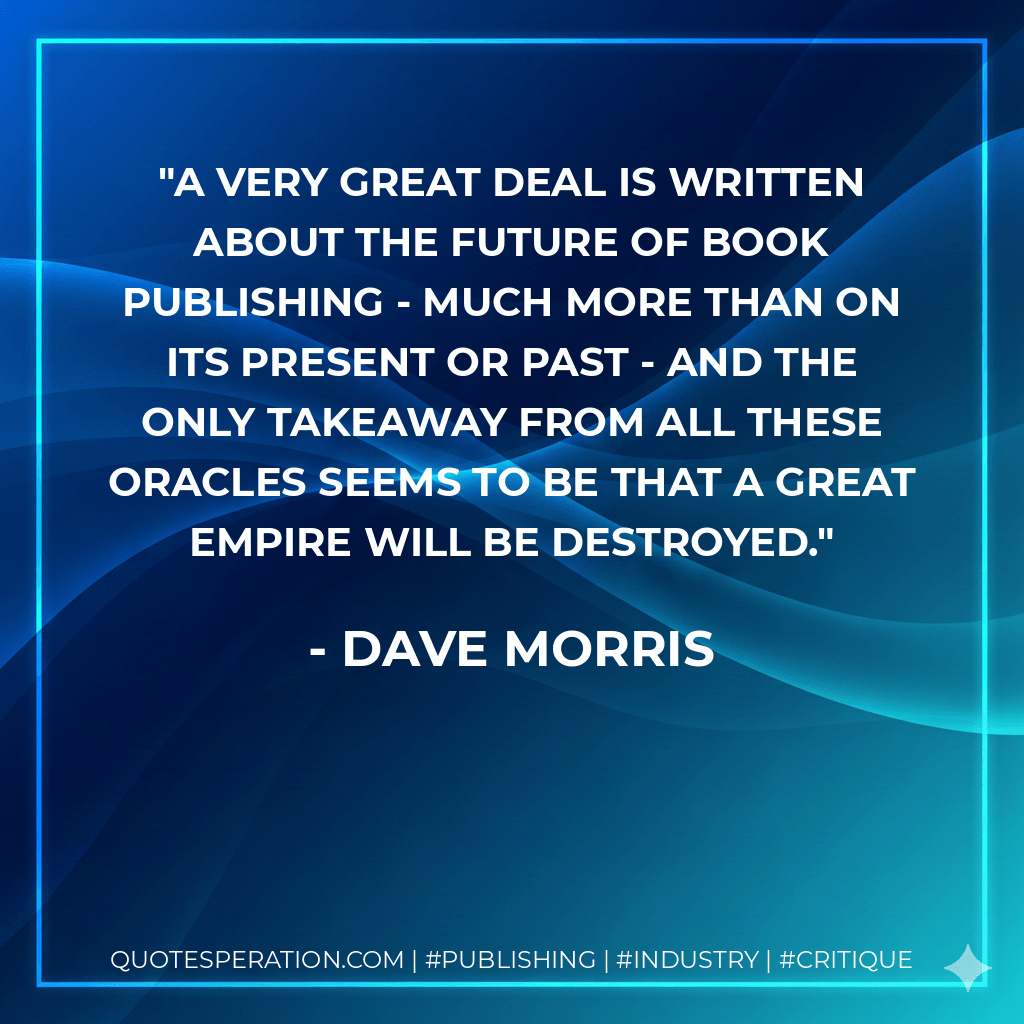
A very great deal is written about the future of book publishing - much more than on its present or past - and the only takeaway from all these oracles seems to be that a great empire will be destroyed.
I think the purveyors of e-books are only too happy for this atmosphere of 'everything belongs to everybody' to increase because it means they don't have to think so much about the original maker of the thing, or they can get away with paying them less.
I hate those e-books. They can not be the future... they may well be... I will be dead.
That is sad until one recalls how many bad books the world may yet be spared because of the busyness of writers.
I think the purveyors of e-books are only too happy for this atmosphere of ‘everything belongs to everybody’ to increase because it means they don’t have to think so much about the original maker of the thing, or they can get away with paying them less.
More Collections
Friendship Quotes Hub
Sports Team Confidence & Success Quotes
Persistence and Progress

Best Limited Social Circles Quotes
Best Life Quotes
Best Intense Rivalry Games Quotes
Patrick Wright
Software engineer and creator of Quotesperation. I curate wisdom from history's greatest minds to inspire and guide modern life. When I'm not collecting quotes, I'm writing about technology and finding connections between timeless wisdom and today's challenges.