
Best Success And Personal Fulfillment Quotes
Success And Personal Fulfillment
Table of Contents
- Success and Society's Influence
- Success and Personal Responsibility
- Success and Mindset
- Success and Failure
- Success and Its Challenges
- Success and Wealth
- Success and Relationships
- Success and Innovation
- Success and Cultural Perspectives
- Other
Success and Society's Influence
We may well discover that the business failure we avoid and the business success we strive for do not lead us to personal success at all. Most of us have inherited notions of "success" from someone else or have arrived at these notions by facing a seemingly endless line of hurdles extending from grade school through college and into our careers. We constantly judge ourselves against criteria that others have set and rank ourselves against others in their game.
Because we so profoundly personalize success, we miss opportunities to lift others onto the top rung. We make rules that frustrate achievement. We prematurely write off people as failures. And, most of all, we become much too passive. We overlook just how large a role we all play—and by "we" I mean society—in determining who makes it and who doesn't.
Our nation is ripe with a multitude of successful people, who have achieved much for themselves with little impact on anyone else
Many individuals are doing what they can. But real success can only come if there is a change in our societies and in our economics and in our politics.

We cling to the idea that success is a simple function of individual merit and that the world in which we all grow up and the rules we choose to write as a society don't matter at all.
Basically, success the way we've defined it is no longer sustainable. It's no longer sustainable for human beings or for societies.
Don't buy society's definition of success. Because it's not working for anyone. It's not working for women, it's not working for men, it's not working for polar bears, it's not working for the cicadas that are apparently about to emerge and swarm us. It's only truly working for those who make pharmaceuticals for stress, diabetes, heart disease, sleeplessness, and high blood pressure.
A successful society is a progress machine. It takes in the raw material of innovations and produces broad human advancement. America’s machine is broken. When the fruits of change have fallen on the United States in recent decades, the very fortunate have basketed almost all of them.
We cling to the idea that success is a simple function of individual merit and that the world in which we all grow up and the rules we choose to write as a society don’t matter at all.
We pretend that success is exclusively a matter of individual merit. But there’s nothing in any of the histories we’ve looked at so far to suggest things are that simple. These are stories, instead, about people who were given a special opportunity to work really hard and seized it, and who happened to come of age at a time when that extraordinary effort was rewarded by the rest of society. Their success was not just of their own making. It was a product of the world in which they grew up.
Let’s recognize that success in life is a reflection not only of enterprise and willpower but also of chance and early upbringing, and that compassion isn’t a sign of weakness but a mark of civilization.
It is a deep-seated belief on the part of almost all Americans that their successes will be better assured as they help to build the success of others.
We may well discover that the business failure we avoid and the business success we strive for do not lead us to personal success at all. Most of us have inherited notions of “success” from someone else or have arrived at these notions by facing a seemingly endless line of hurdles extending from grade school through college and into our careers. We constantly judge ourselves against criteria that others have set and rank ourselves against others in their game.
Success and Personal Responsibility

Success demands a price that only a few are willing to pay ... blood, flesh, time, money, pride, heartbreak and energy. Anyone who has ever succeeded has the battle scars to prove the sacrifices they've made.
Successful people put in place the habits that gives birth to victory.
Minority of people are destined for success while majority succeed because they are determined for success. Where upon, work hard in silence and let success make the noise .
I don't know many people, if any, who have had some straight line toward success. I mean, they start here, they work hard, they've got what it takes, and they just go straight to the top over some number of years. Most people get a little failure.
A price has to be paid for success. Almost invariably those who have reached the summits worked harder and longer, studied and planned more assiduously, practiced more self- denial, overcame more difficulties than those of us who have not risen so far.
Success comes to those who have an entire mountain of gold that they continually mine, not those who find one nugget and try to live on it for fifty years.
Most very successful people can remember that their success was discovered and built out of adversity of some kind. It's not the problems that beset us-problems are surprisingly pretty much the same for millions of others-it's how we react to problems that determines not only our degree of growth and maturity but our future success-and, perhaps, much of our health.
If we become one of those societies that attack success, why not come as certain there will be a lot less success? And that's not who we are.
In reality, nobody gets successful in America by being lazy.
People on the success curve live a life of responsibility. They take full responsibility for who they are, where they are, and everything that happens to them.
The successful among us delay gratification. The successful among us bargain with the future.
Let’s recognize that success in life is a reflection not only of enterprise and willpower but also of chance and early upbringing, and that compassion isn’t a sign of weakness but a mark of civilization.
I don’t know many people, if any, who have had some straight line toward success. I mean, they start here, they work hard, they’ve got what it takes, and they just go straight to the top over some number of years. Most people get a little failure.
Success and Mindset
Success, just like poverty, is a state of mind.
Many people who became successful were once first time global failures. But because they didn't give up on their dreams, failure could not sink them. They triumphed at last!
Success is not about Wealth but the ability to be in a Comfortable Lead in a particular Domain
Success is no accident or serendipity. I had all the odds against me, and I crushed each and everyone along the way. Not because I was a Democrat or a Republican. Not because of my attitudes about social issues. Not because of what my background is or isn’t. Not because people think I’m a nice guy. I succeeded because I’m a capitalist, I’m an entrepreneur, and I’m a warrior. That is the mindset I want to teach others so they can create their own wealth and American success story.
Positivity is such a high predicator of success rates.
I discovered that success has very little to do with education or race or disposition; it has more to do with principles and following those principles.
Some authorities believe that one prosperous thought is more powerful than a thousand failure thoughts; and that two prosperous attitudes steadily held and expressed are more powerful than ten thousand failure attitudes!
The great high-road of human welfare lies along the old highway of steadfast, well-doing; and they who are the most persistent, and work in the truest spirit, will invariably be the most successful; success treads on the heels of every right effort.
Every great success is an accumulation of thousands of ordinary efforts that no one else sees or appreciates.
We give kudos to people who have succeeded. We don't care in what they succeeded as long as they succeeded. The worst thing that can happen to anybody in this cultural environment is to fail.
The successful among us delay gratification. The successful among us bargain with the future.
I am also realizing the nonlinear effect behind success in anything: It is better to have a handful of enthusiastic advocates than hordes of people who appreciate your work – better to be loved by a dozen than liked by the hundreds. This applies to the sales of books, the spread of ideas, and success in general and runs counter to conventional logic. The information age is worsening this effect.
In a 2006 speech then-senator Barack Obama gave to a group of college students, he offered these sage words about success: “Focusing your life solely on making a buck shows a certain poverty of ambition. It asks too little of yourself. Because it’s only when you hitch your wagon to something larger than yourself that you realize your true potential.
Success and Failure
The ultimate story of success: When a nobody, who has never once in his entire life known the feeling of being remembered or respected, suddenly snaps and becomes a world dictator. On one hand it sounds just, but on the other, it illustrates the reason why a prosperity message has and needs its limitations.
Many people who became successful were once first time global failures. But because they didn't give up on their dreams, failure could not sink them. They triumphed at last!
I don't know many people, if any, who have had some straight line toward success. I mean, they start here, they work hard, they've got what it takes, and they just go straight to the top over some number of years. Most people get a little failure.
The more successful enterprises are the more they try to replicate, duplicate, codify what makes us great. And suddenly they're inward thinking. They're thinking how can we continue to do what we've done in the past without understanding that what made them successful is to take risks, to change and to adapt and to be responsive. And so in a sense success breeds its own failure. And I think it's true of a lot of successful businesses.
I think we impress people by our success, but I think we impact them by our failures.
Most very successful people can remember that their success was discovered and built out of adversity of some kind. It's not the problems that beset us-problems are surprisingly pretty much the same for millions of others-it's how we react to problems that determines not only our degree of growth and maturity but our future success-and, perhaps, much of our health.
Success brings with it pressure to conform. I always thought that success would lead to freedom, but the opposite is true: more people get involved, and committees make decisions, and it becomes a fight to stay free.
The only thing that makes people and organizations great is their willingness to be not great along the way. The desire to fail along the way to reaching a bigger goal is the untold secret of success.
It was Sir Winston Churchill, in the midst of Nazi bombings, who said to the people of London, “This is not the end. It is not even the beginning of the end. But it is, perhaps, the end of the beginning.“′ He was the one who offered the best definition of success I’ve ever read: “Success is moving from one failure to another with no loss of enthusiasm.
Everything we have learned in Outliers says that success follows a predictable course. It is not the brightest who succeed. If it were, Chris Langan would be up there with Einstein. Nor is success simply the sum of the decisions and efforts we make on our own behalf. It is, rather, a gift. Outliers are those who have been given opportunities – and who have had the strength and presence of mind to seize them.
Success causes us to be more praised than known.
That’s the definition of ‘success’ for the modern Democrat Party. As many people dependent on government as possible is the objective.
I don’t know many people, if any, who have had some straight line toward success. I mean, they start here, they work hard, they’ve got what it takes, and they just go straight to the top over some number of years. Most people get a little failure.
Success and Its Challenges
Success is messy. But so is life. Deal with it. Poverty is messier.
My friend Richard Carrion, the CEO of Puerto Rico’s top bank, once shared a line with me that I’ll never forget: “Robin, nothing fails like success.” Powerful thought. Your business is most vulnerable when it’s most successful. Success actually breeds complacency, inefficiency and – worst of all – arrogance. Whenever I share this point with a roomful of CEOs, every one of them nods their head at this one. Please let me give you a real-world example from my own life.
The more successful enterprises are the more they try to replicate, duplicate, codify what makes us great. And suddenly they're inward thinking. They're thinking how can we continue to do what we've done in the past without understanding that what made them successful is to take risks, to change and to adapt and to be responsive. And so in a sense success breeds its own failure. And I think it's true of a lot of successful businesses.
That's the definition of 'success' for the modern Democrat Party. As many people dependent on government as possible is the objective.
Success comes to those who have an entire mountain of gold that they continually mine, not those who find one nugget and try to live on it for fifty years.
Success usually breeds a degree of hubris.
Success brings with it pressure to conform. I always thought that success would lead to freedom, but the opposite is true: more people get involved, and committees make decisions, and it becomes a fight to stay free.
Success is like death. The more successful you become, the higher the houses in the hills get and the higher the fences get.
Basically, success the way we’ve defined it is no longer sustainable. It’s no longer sustainable for human beings or for societies.
Do you see the consequences of the way we have chosen to think about success? Because we so profoundly personalize success, we miss opportunities to lift others onto the top rung. We make rules that frustrate achievement. We prematurely write off people as failures. We are too much in awe of those who succeed and far too dismissive of those who fail. And, most of all, we become much too passive.
The top two ways to destroy success are greed and impatience.
We may well discover that the business failure we avoid and the business success we strive for do not lead us to personal success at all. Most of us have inherited notions of “success” from someone else or have arrived at these notions by facing a seemingly endless line of hurdles extending from grade school through college and into our careers. We constantly judge ourselves against criteria that others have set and rank ourselves against others in their game.
That’s the definition of ‘success’ for the modern Democrat Party. As many people dependent on government as possible is the objective.
Success and Wealth
Success is not about Wealth but the ability to be in a Comfortable Lead in a particular Domain
Too often success is confused with popularity and profits.
Success is doing the best you possibly can with what you've been given. There are an alarming number of wealthy failures in the world today.
Success is not like a cake that needs to be divided. It's more like a heap of stones - a cairn. If someone is successful, they add a stone to the cairn. It gets very high and can be seen from all over the world. That's how I see it.
The odds of being successful are the same for every group that is educated in America. It's just that the group that is not wealthy is 95 percent of the population. So if there are 100 successful people in a room, probably 95 out of 100 came from more modest means.
Success, instead of giving freedom of choice, becomes a way of life. There's no country I've been to where people, when you come into a room and sit down with them, so often ask you, "What do you do?" And, being American, many's the time I've almost asked that question, then realized it's good for my soul not to know. For a while! Just to let the evening wear on and see what I think of this person without knowing what he does and how successful he is, or what a failure. We're ranking everybody every minute of the day.
The only way to success in American public life lies in flattering and kowtowing to the mob
Success is the American Dream. And that success is not something to be ashamed of, or to demonize.
In America, as opposed to the old country, success was based on merit.
In order to become a success, a business doesn't just have to do well, it has to to better than its competitors. Being number one isn't just about bragging rights. Often it means the difference between prospering and merely hanging on.
If we become one of those societies that attack success, why not come as certain there will be a lot less success? And that's not who we are.
A successful society is a progress machine. It takes in the raw material of innovations and produces broad human advancement. America’s machine is broken. When the fruits of change have fallen on the United States in recent decades, the very fortunate have basketed almost all of them.
The formula for achieving middle-class success is simple: Finish high school; don’t have a child before the age of 20; and get married before having the child.
Success and Relationships
Success follows those who champion a cause greater than themselves.
It is with excellence that we'll revolutionize our world, not with success. Look at all those successful people - not a single concern for the downtrodden - not a single act of genuine compassion for those who have nothing - if this is success, then let me remain unsuccessful the rest of my life while struggling to elevate my society.
There’s plenty of emphasis on success in our culture, but we have to help people focus on significance as well.
Is it a coincidence that success follows those who hand out its credit to their parents or teachers. Ironically, the converse is true as well.
Successful People Find Good within The World. Impossibilities do not limit them. They seek the estimable lesson in every impediment.
We are more heavily invested in the theories of failure than we are in the theories of success.
Successful societies-those which progress economically and politically and can control the terms on which they deal with the outside world-succeed because they have found ways to match individual self-interest to the collective good.
If you are lucky enough to be a success, by all means enjoy the applause and adulation of the public. But never, never believe it.
The reason for our success is no secret. It comes down to one single principle that transcends time and geography, religion and culture. It’s the Golden Rule – the simple idea that if you treat people well, the way you would like to be treated, they will do the same.
The key to success is in the minds of the people. How do they see the problems and the opportunities in a town.
We give kudos to people who have succeeded. We don't care in what they succeeded as long as they succeeded. The worst thing that can happen to anybody in this cultural environment is to fail.
And Dunbar points out that in our ultrasocial species, success is largely a matter of playing the social game well. It’s not what you know, it’s who you know.
It is a deep-seated belief on the part of almost all Americans that their successes will be better assured as they help to build the success of others.
Success and Innovation
The more the problems in a society, the greater the chances of success.
Success will come when the societal attitude changes and not a single woman in America asks herself the question 'What did I do?'.
What's the third metric beyond money and power? I think it's a combination of wellbeing and wisdom. Because the problem also with defining success just in terms of money and power means that people feel that they have to work around the clock, burn out, and the result is people making terrible decisions.
... success always worries academics, when it moves into the popular world.

From the very beginning Europe has been not only a success story but also a story of success achieved by learning.
I think that if you ask what's made us successful, it's because we've been fortunate enough to identify, in a number of cases, great people early. Then we throw all the resources behind them and are aligned with them.
The big question is: how do you institutionalize success and still keep that edge of craziness and wildeness?
The word 'success' - who's defining it? It's about whether or not it makes me feel good. Four billion people don't have to see or hear it. If I've enjoyed the process of creation and I'm at peace, then what happens next is just entertainment. If mass appeal were actually something, Marilyn Monroe wouldn't be dead.
The one single factor that determines society’s success is the percentage of change-makers within it.

Success is not like a cake that needs to be divided. It’s more like a heap of stones – a cairn. If someone is successful, they add a stone to the cairn. It gets very high and can be seen from all over the world. That’s how I see it.
Contra the prevailing belief, “success” isn’t being on top of a hierarchy, it is standing outside all hierarchies.
I am also realizing the nonlinear effect behind success in anything: It is better to have a handful of enthusiastic advocates than hordes of people who appreciate your work – better to be loved by a dozen than liked by the hundreds. This applies to the sales of books, the spread of ideas, and success in general and runs counter to conventional logic. The information age is worsening this effect.
In a 2006 speech then-senator Barack Obama gave to a group of college students, he offered these sage words about success: “Focusing your life solely on making a buck shows a certain poverty of ambition. It asks too little of yourself. Because it’s only when you hitch your wagon to something larger than yourself that you realize your true potential.
Success and Cultural Perspectives
The most twisted but perennial of American myths is that everyone has an equal opportunity to succeed. (p. 174)
Do you see the consequences of the way we have chosen to think about success? Because we so profoundly personalize success, we miss opportunities to lift others onto the top rung...We are too much in awe of those who succeed and far too dismissive of those who fail. And most of all, we become much too passive. We overlook just how large a role we all play—and by “we” I mean society—in determining who makes it and who doesn’t.
The key to success in any kind of start up is your level of persistence. It's not so much your intellect. The Zuckerburg's, Pages and Brins, that succeed have such a level of belief in what they are doing that they will put up with the kind of crap that most people won't put up with, they are incredibly persistent and resilient.
The success that Americans are said to worship is success of a specific sort: accomplished not through hard work, primarily, but through the ingenious angle, the big break. Sit down at a lunch counter, stand back up a star. Invest in a new issue and watch it soar. Split a single atom, win a war.

In America, as opposed to the old country, success was based on merit.
To leave the world richer—that is the ultimate success.
Success as a result of industry is a peasant's ideal.
It doesn’t matter how “successful” each of us is in life. We’re all doomed to die. Why can’t anyone else see that?
Because success is such a weasel word anyway, it’s such a horribly American word, and it’s such a vamp and, I think it’s a death trap.

The only way to success in American public life lies in flattering and kowtowing to the mob.
We cling to the idea that success is a simple function of individual merit and that the world in which we all grow up and the rules we choose to write as a society don’t matter at all.
Success is the result of what sociologists like to call “accumulative advantage.” The.
The odds of being successful are the same for every group that is educated in America. It’s just that the group that is not wealthy is 95 percent of the population. So if there are 100 successful people in a room, probably 95 out of 100 came from more modest means.
Other
Success breeds success while broke breeds broke
Those who become successful are those who have decided to ‘take the bull by the horns
There is no recipe for success, just like there is no universal definition of it. A poor yet happy fisherman may be more successful that a lonely billionnaire.
Delicacy in shaping desires of any kind will help to reach excellence, but failure will bring disaster.

The path that leads through Latin and alebra is not the path to material success. But it may suggest much more: that understanding things is a waste of time; that if you want to succeed in the world and have a happy family and a nice home and a BMW you should not try to understand things but just add up the numbers or press the buttons or do whatever else it is that marketers are so richly rewarded for doing.
The path that leads through Latin and alebra is not the path to material success. But it may suggest much more: that understanding things is a waste of time; that if you want to succeed in the world and have a happy family and a nice home and a BMW you should not try to understand things but just add up the numbers or press the buttons or do whatever else it is that marketers are so richly rewarded for doing
Success is easy. Any mug can be successful and make a fist of it. It's how you deal with it afterwards that is the test of character. I've watched a lot of people lose everything. Now Keating in a sense has lost everything. If you add up all the things he's lost, it's pretty significant. But there is still an absolutely remarkable, unbroken, interesting, involved bloke who is not crushed by what he's been through at all. He's still defiant, he's still funny, he's still full of ideas.
Because success is such a weasel word anyway, it's such a horribly American word, and it's such a vamp and, I think it's a death trap.
Success is not only for the elite. Success is there for those who want it, plan for it, and take action to achieve it.
Success is as ice cold and lonely as the North Pole.
I believe that success brings responsibility. It also does not bring immunity to the consequences of our quickening march towards oblivion. The bottom line is that all of us should be invovled in our own futures to create a world that our children will want to live in.
The formula for achieving middle-class success is simple: Finish high school; don't have a child before the age of 20; and get married before having the child.
When I ran the stock exchange, it was the most successful it's been in its 200-plus-year history. And I was rewarded for success; I would not have been rewarded if we failed.
At the moment, our society's notion of success is largely composed of two parts: money and power. But it's time for a third metric, beyond money and power - one founded on well-being, wisdom, our ability to wonder, and to give back.
The top two ways to destroy success are greed and impatience
I don’t mind the low probability of success, but it better be impactful if we do succeed.
In America, one sure sign of success is the presence of an unnecessary waterfall in a person's yard.
Despite what some would have us believe, success is not built on resentment and fear.
who wants to read about success? It is the early struggle which makes a good story.
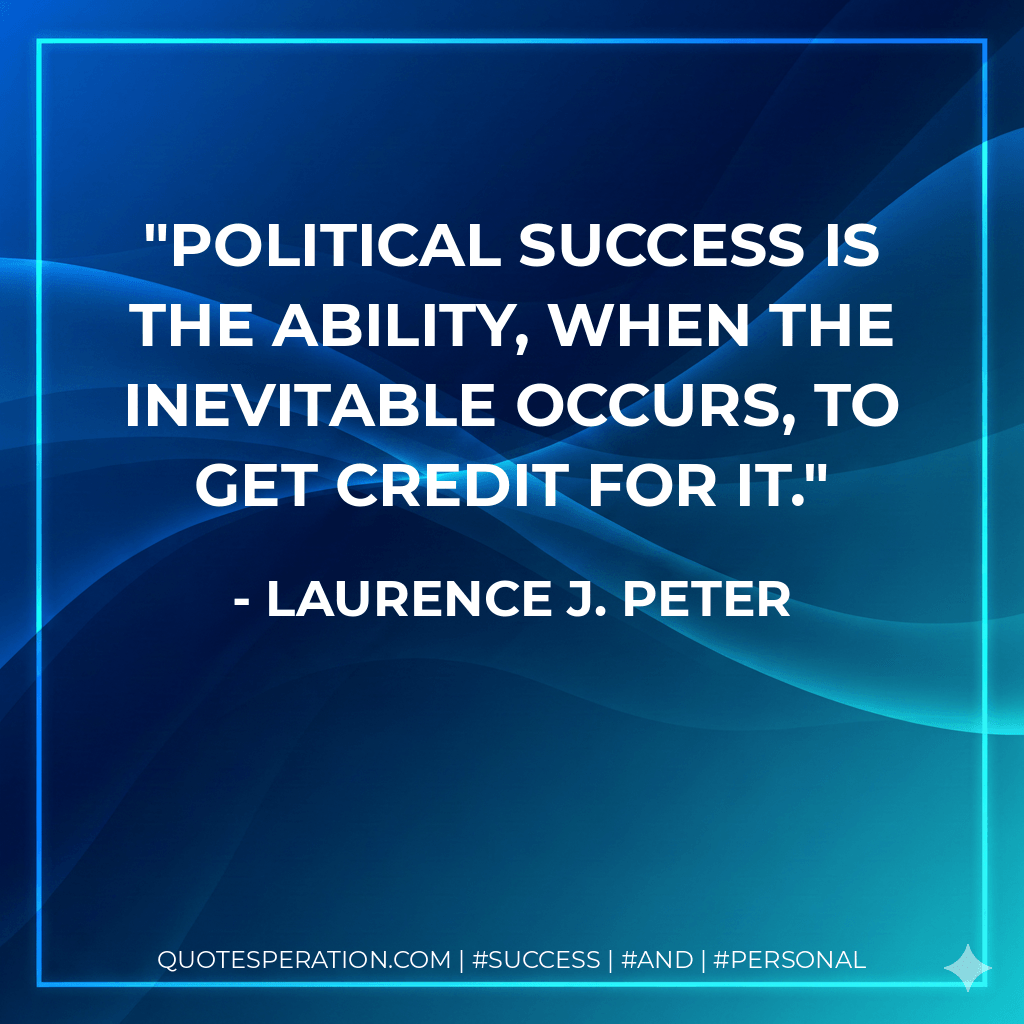
Political success is the ability, when the inevitable occurs, to get credit for it.
Because we so profoundly personalize success, we miss opportunities to lift others onto the top rung. We make rules that frustrate achievement. We prematurely write off people as failures. We are too much in awe of those who succeed and far too dismissive of those who fail. And, most of all, we become much too passive. We overlook just how large a role we all play – and by “we” I mean society – in determining who makes it and who doesn’t.
More Collections
Friendship Quotes Hub

Sports Team Confidence & Success Quotes

Persistence and Progress

Best Limited Social Circles Quotes

Best Life Quotes

Best Intense Rivalry Games Quotes
Related Articles



Patrick Wright
Software engineer and creator of Quotesperation. I curate wisdom from history's greatest minds to inspire and guide modern life. When I'm not collecting quotes, I'm writing about technology and finding connections between timeless wisdom and today's challenges.