Best Literature And Censorship Debate Quotes
Literature And Censorship Debate
Table of Contents
- Censorship and Its Consequences
- Books as a Source of Freedom and Knowledge
- The Power and Influence of Books
- Books Versus Other Media
- The Role of the Reader and Perception
- Censorship and Authority
- The Nature and Preservation of Books
- Other
Censorship and Its Consequences
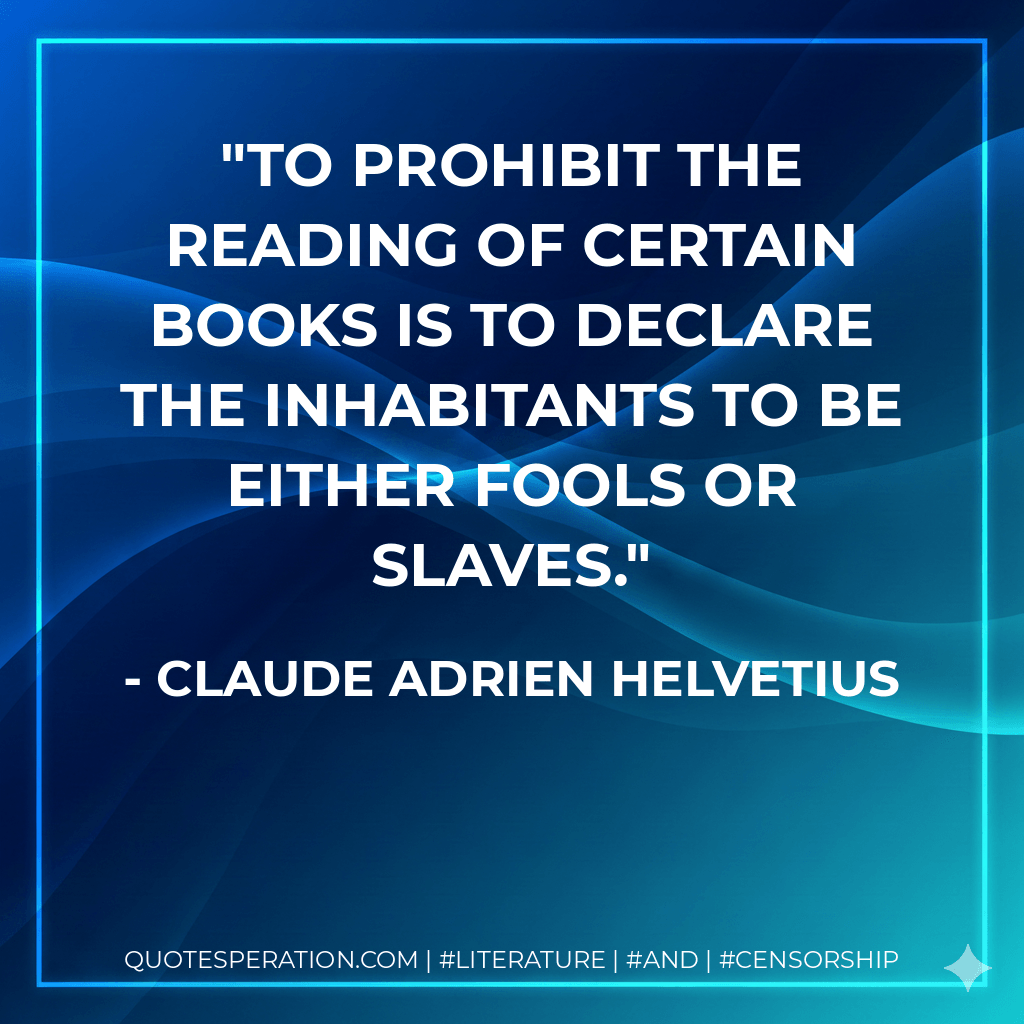
To prohibit the reading of certain books is to declare the inhabitants to be either fools or slaves.
Censors never go after books unless kids already like them. I don’t even think they know to go after books until they know that children are interested in reading this book, therefore there must be something in it that’s wrong.
I struggle each day not to let the fear of the censor poison my writing. Where the censor rules, a dull sameness creeps into books.
Because all books are forbidden when a country turns to terror. The scaffolds on the corners, the list of things you may not read. These things always go together.
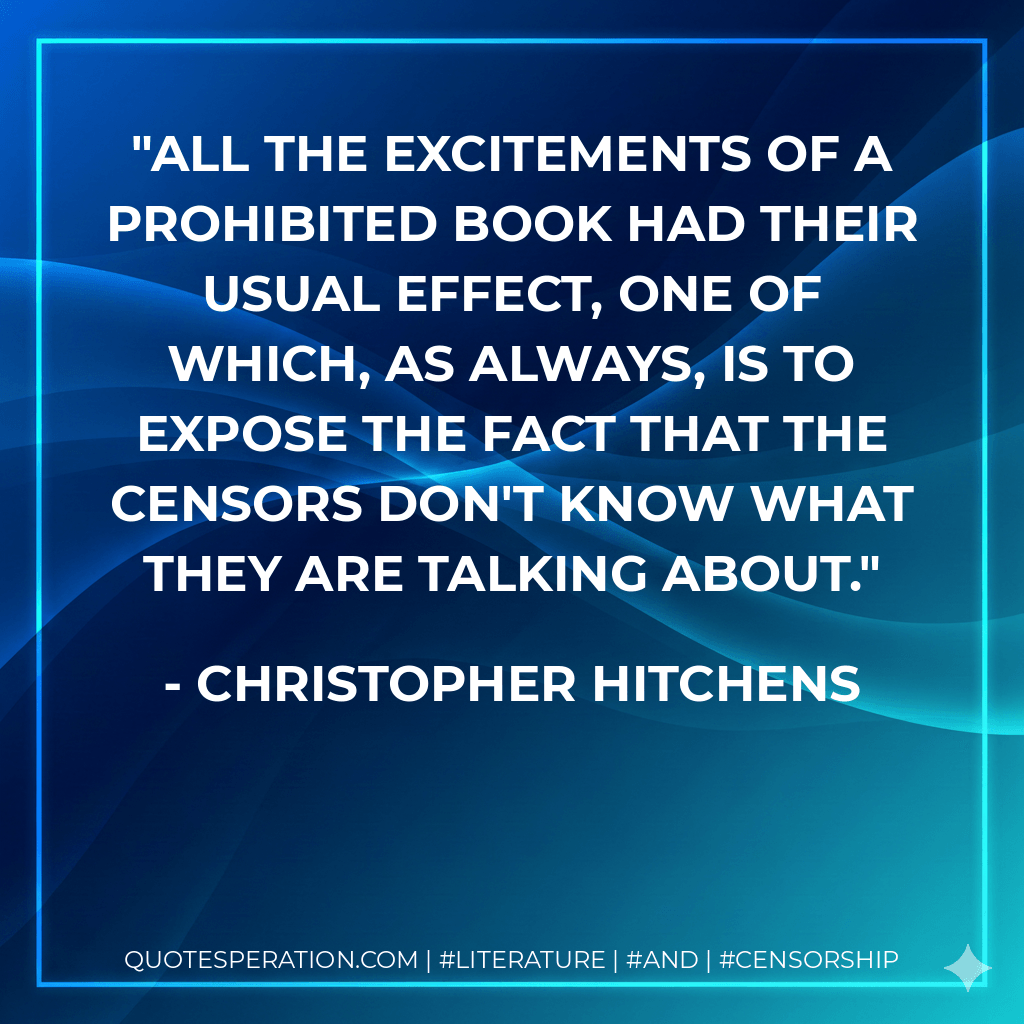
All the excitements of a prohibited book had their usual effect, one of which, as always, is to expose the fact that the censors don't know what they are talking about.
Having a book censored means something. It means you have deeply offended one or more people who felt they needed to protect unsuspecting readers from your inflammatory words, thoughts, and images.
Only in today's sick society can a man be persecuted for reading too many books.
All the excitements of a prohibited book had their usual effect, one of which, as always, is to expose the fact that the censors don’t know what they are talking about.
I don’t understand how the St. Clare’s library can ban so many books for being “inappropriate” when they have a whole row of Bibles. Harry Potter might be a wizard, but I’m sure he never hacked a woman to pieces.
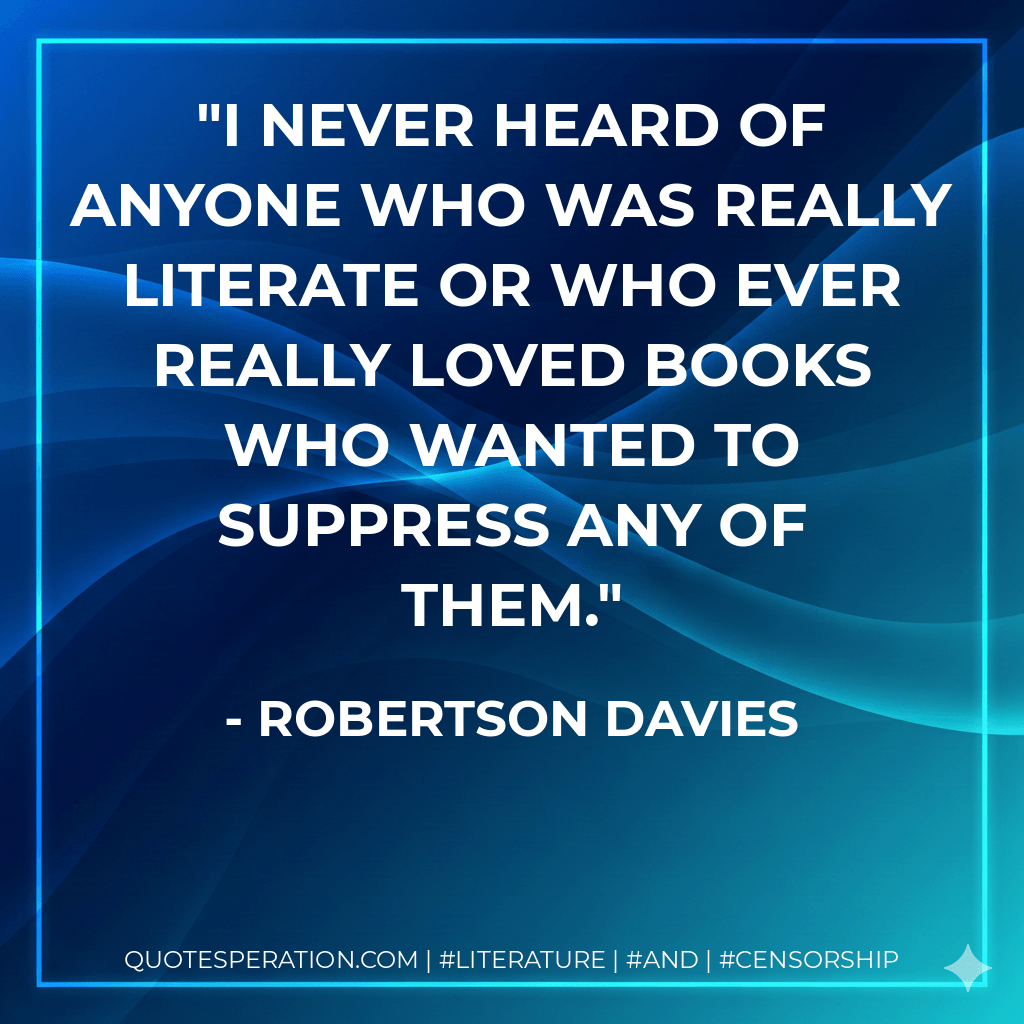
I never heard of anyone who was really literate or who ever really loved books who wanted to suppress any of them.
Books have played a role in almost every one of the world’s great civil and human rights movements, but only because people who read them decided to act. Reading brings with it responsibility.
Books as a Source of Freedom and Knowledge
Books are more than words, they’re dreams, ideas, and answers, and that is why they fear them
Books are our windows on the world. They permit us to safely experience other lives and ways of thinking and feeling. Books give us a glimmer of the complexity and wonder of life. All this, the censor would deny us.
Books are messengers of freedom. They can be hidden under a mattress or smuggled into slave nations.
Books are a refuge, a sort of cloistral refuge, from the vulgarities of the actual world.
Books themselves are freedom. Freedom to think, to believe, to dream.
Books alone are liberal and free; they give to all who ask; they emancipate all who serve them faithfully.
The Power and Influence of Books
The Potter books in general are a prolonged argument for tolerance, a prolonged plea for an end to bigotry. And I think it's one of the reasons that some people don't like the books, but I think that's it's a very healthy message to pass on to younger people that you should question authority and you should not assume that the establishment or the press tells you all of the truth.
The silent influence of books, is a mighty power in the world; and there is a joy in reading them known only to those who read them with desire and enthusiasm. Silent, passive, and noiseless though they be, they yet set in action countless multitudes, and change the order of nations.
To Kill A Mockingbird' is one of the great American books. It covers some important topics like censorship, literacy and gender, which are still very much prevalent today as they were during that time.
Books can capture injustices in a way that stays with you and makes you want to do something about them. That's why they are so powerful.
The book was an instrument of both repression and liberation.
Books have played a role in almost every one of the world’s great civil and human rights movements, but only because people who read them decided to act. Reading brings with it responsibility.
Books Versus Other Media
The books must be read, not seen in a movie.
Books and movies are different art forms with different rules. And because of that, they never translate exactly.
Movies can't ruin books. They can only ruin movies.
A movie is not a book. If the source material is a book, you cannot be too respectful of the book. All you owe to the book is the spirit.
Movies can’t ruin books. They can only ruin movies.
The Role of the Reader and Perception
Few people ask from books what books can give us. Most commonly we come to books with blurred and divided minds, asking of fiction that it shall be true, of poetry that it shall be false, of biography that it shall be flattering, of history that it shall enforce our own prejudices. If we could banish all such preconceptions when we read, that would be an admirable beginning.
Are they not criminals, books that have wasted our time and sympathy; are they not the most insidious enemies of society, corrupters, defilers, the writers of false books, faked books, books that fill the air with decay and disease?
If I pick up a book with spaceships on the cover, I want spaceships. If I see one with dragons, I want there to be dragons inside the book. Proper labeling. Ethical labeling. I don't want to open up my cornflakes and find that they're full of pebbles... You need to respect the reader enough not to call it something it isn't.
All books can be indecent books, though recent books are bolder.For filth, I'm glad to say, is in the mind of the beholder. When correctly viewed, everything is lewd. I could tell you things about Peter Pan,And the Wizard of OZ, there's a dirty old man!
Obscenity is not a quality inherent in a book or picture, but is solely and exclusively a contribution of the reading mind, and hence cannot be defined in terms of the qualities of a book or picture.
Censorship and Authority
We are of opinion that instead of letting books grow moldy behind an iron grating, far from the vulgar gaze, it is better to let them wear out by being read.
I think serious readers of books are 5% of the population. If there are good TV shows or a World Cup or anything, that 5% will keep on reading books very seriously, enthusiastically. And if a society banned books, they would go into the forest and remember all the books. So I trust in their existence. I have confidence.
The censors don't bother with fantasy books, especially old ones. They can't understand them. They think it's all kids' stuff. They'd die if they knew what The Chronicles of Narnia were really about.
Because all books are forbidden when a country turns to terror. The scaffolds on the corners, the list of things you may not read. These things always go together.
I think the Harry books are actually very moral, but some people just object to witchcraft being mentioned in a children's book.
The Nature and Preservation of Books

A book is a fragile creature, it suffers the wear of time, it fears rodents, the elements and clumsy hands. so the librarian protects the books not only against mankind but also against nature and devotes his life to this war with the forces of oblivion.
Books themselves need no defense. Their spokesmen come and go, their readers live and die, they remain constant.
Books are menaced by books. Any excess of information produces silence.
In approved places, every story serves a purpose. But forbidden books are so much more. Some of them are webs; you can feel your way along their threads, but just barely, into strange and dark corners. Some of them are balloons bobbing up through the sky: totally self-contained, and unreachable, but beautiful to watch. And some of them – the best ones – are doors.
Other
Yet few people ask from books what books can give us. Most commonly we come to books with blurred and divided minds, asking of fiction that it shall be true, of poetry that it shall be false, of biography that it shall be flattering, of history that it shall enforce our own prejudices. If we could banish all suchpreconceptions when we read, that would be an admirable beginning.
Usually people don't see beyond the surface of things and cannot understand more other than the obvious; they are used to judging a book by its cover, and that is why they don't hesitate to bully.
A book has been taken. A book has been taken? You summoned the Watch," Carrot drew himself up proudly, "because someone's taken a book? You think that's worse than murder?"The Librarian gave him the kind of look other people would reserve for people who said things like "What's so bad about genocide?
Readers, censors know, are defined by the books they read.

This is because white people need to show off the books that they have read. Just as hunters will mount the heads of their kills, white people need to let people know that they have made their way through hundreds or even thousands of books.
You're not allowed to say anything about books because they're books, and books are, you know, God.
Books did not discriminate, at least not explicitly.
I believe that we should only read those books that bite and sting us. If a book does not rouse us with a blow then why read it?
Just as hunters will mount the heads of the kills, white people need to let people know that they have made their way to hundreds or even thousands of books. After all, what's the point of reading a book if people don't know you've read it. It's like a tree falling in the forest.
It's not the tales of Stephen King that I've read,I need protection from the things in my head . . .
It's not the books by Stephen King that I read,I need protection from the things in my head . . .
What I discovered this freak me out. That the people will check out a book with naked woman, but won't check out a book without this WHY??What are the differences?
Books were something that happened to readers. Readers were the victims of books.
This book is irrelevant to Goodreads because you can’t buy it on Amazon. Also it talks about oppression, censorship etc. and no one really likes reading about that because it’s boring. Yet, let me tell you anyway.The title of this book is The Image of Everyday Life in Press during the Martial Law, which is a little bit ridiculous because what could be read in Press those days when it was so heavily censored?
the way dwarfs think about books and words and runes...well, you wouldn't believe it, sir. W--they think the world was written, sir. All words have enormous power. Destroying a book is worse than murder to a deep-downer.I've rather gathered that, said Blackboard Monitor Vimes.
Seek diverse authors, not just diverse books.If you want to truly decolonize your library seek more than a Black/Brown face on the cover of the book.
In books I found explicitly, flamboyantly, everything censored in life.
I see, these books are probably law books, and it is an essential part of the justice dispensed here that you should be condemned not only in innocence but also in ignorance.
One of the hindrances to the growth of literary appreciation in the library profession is the compulsion we are under to read the latest books, whatever they are, and to keep in touch with all contemporary expression, no matter how inept, in order to answer our inquiring readers.
Books were despised by the Viking Tribes, as they were seen as a horrible civilizing influence and a threat to the barbarian culture.
Should books not have been there, hearsay would have been the best reading material!
It's not the tales of Stephen King that I've read, I need protection from the things in my head . . .
I think that children's books should be censored not for references to sex but for references to diseases. I mean, who didn't think after reading 'Madeline' that they were going to get appendicitis?
Think books aren't scary? Well, think about this: You can't spell "Book" without "Boo!
Why wouldn't - how couldn't - an author care about how his or her books look?
Books have been handed down from generation to generation, as the true teachers of piety and the love of God, that represent him as so merciless and tyrannical a despot, that, if they were considered otherwise than through the medium of prejudice, they could inspire nothing but hatred. It seems that the impression we derive from a book, depends much less on its real contents, than upon the temper of mind and preparation with which we read it.
I've tried to reduce profanity but I reduced so much profanity when writing the book that I'm afraid not much could come out. Perhaps we will have to consider it simply as a profane book and hope that the next book will be less profane or perhaps more sacred.
And nobody ever picked up on it, and, of course, they wouldn't, So maybe these books do serve some purpose.
A dreary censorship, and self-censorship, has been imposed on books by the centralization of the book industry.
![[If a book were] very innocent, and one which might be confided to the reason of any man; not likely to be much read if let alone, but if persecuted, it will be generally read. Every man in the United States will think it a duty to buy a copy, in vindication of his right to buy and to read what he pleases. - Thomas Jefferson](/_vercel/image?url=https:%2F%2Flakl0ama8n6qbptj.public.blob.vercel-storage.com%2Fquotes%2Fquote-1789588.png&w=1536&q=100)
[If a book were] very innocent, and one which might be confided to the reason of any man; not likely to be much read if let alone, but if persecuted, it will be generally read. Every man in the United States will think it a duty to buy a copy, in vindication of his right to buy and to read what he pleases.
Recently while browsing in a secondhand bookstore I bought a paperback copy of The Intellectual and the City, but I was unable to read it. When I got home I discovered that the original owner had highlighted the entire book - literally. Every line on every page had been drawn through with a bright green Magic Marker. It was a terrifying example of a mind that had lost all power of discrimination.
The readers of these books spent a lot of time with books, they know them inside and out, ... They have very strong opinions how they should look on the screen. If you don't execute a movie they approve of, they can turn on you very quickly.
Nor did anyone censor any of my book. It is the most creative freedom you can have, in this, the 21st century, I can assure you.
Authors have a greater right than any copyright, though it is generally unacknowledged or disregarded. They have a right to the reader's civility. There are favorable hours for reading a book, as for writing it, and to these the author has a claim. Yet many people think that when they buy a book they buy with it the right to abuse the author.
All books can be indecent books, though recent books are bolder. For filth, I'm glad to say, is in the mind of the beholder. When correctly viewed, everything is lewd. I could tell you things about Peter Pan and the Wizard of OZ, there's a dirty old man!
If we're going to object to depicting magic in books, then we are going to have to reject C.S. Lewis. We're going to have to get rid of ... ... A lot of classic children's literature is not going to be allowed to survive.
I turned down all the requests for the rights to the books, for years, mostly because they wanted the rights to the characters, and to turn it into a TV series. This would have allowed them to do anything they wanted with the characters, and that just wasn't an option for me.
If he can give his readers no reason why they should read his book, except that the events happened to him, it is not a valid book.
Books and opinions, no matter from whom they came, if they are in opposition to human rights, are nothing but dead letters.
Contrary to popular belief, editors and agents are gagging for good books.
That text-books be permitted in Catholic schools such as will not offend the religious views of the minority, and which from an educational standpoint shall be satisfactory to the advisory board.
Books must be read as deliberately and reservedly as they were written.
[T]he German censorship forbade or mutilated my every book, which was like sticking pins into my soul...
You’re not allowed to say anything about books because they’re books, and books are, you know, God.

It was well said of a certain German book that ‘er lasst sich nicht lesen” – it does not permit itself to be read.
Books are written so their authors can be heard, not so that they remain silent.
The referee said it was not acceptable, but the Press considered they could not refuse to publish a book by a professor of the university.
Those who upload this work up on any site without the author’s express permission are pirates and have stolen from the author. As such, those persons will likely end up in the level of hell where little devils shove stolen books into said persons’ unmentionable places for all eternity. Ye’ve been warned.
I turned down all the requests for the rights to the books, for years, mostly because they wanted the rights to the characters, and to turn it into a TV series. This would have allowed them to do anything they wanted with the characters, and that just wasn’t an option for me.
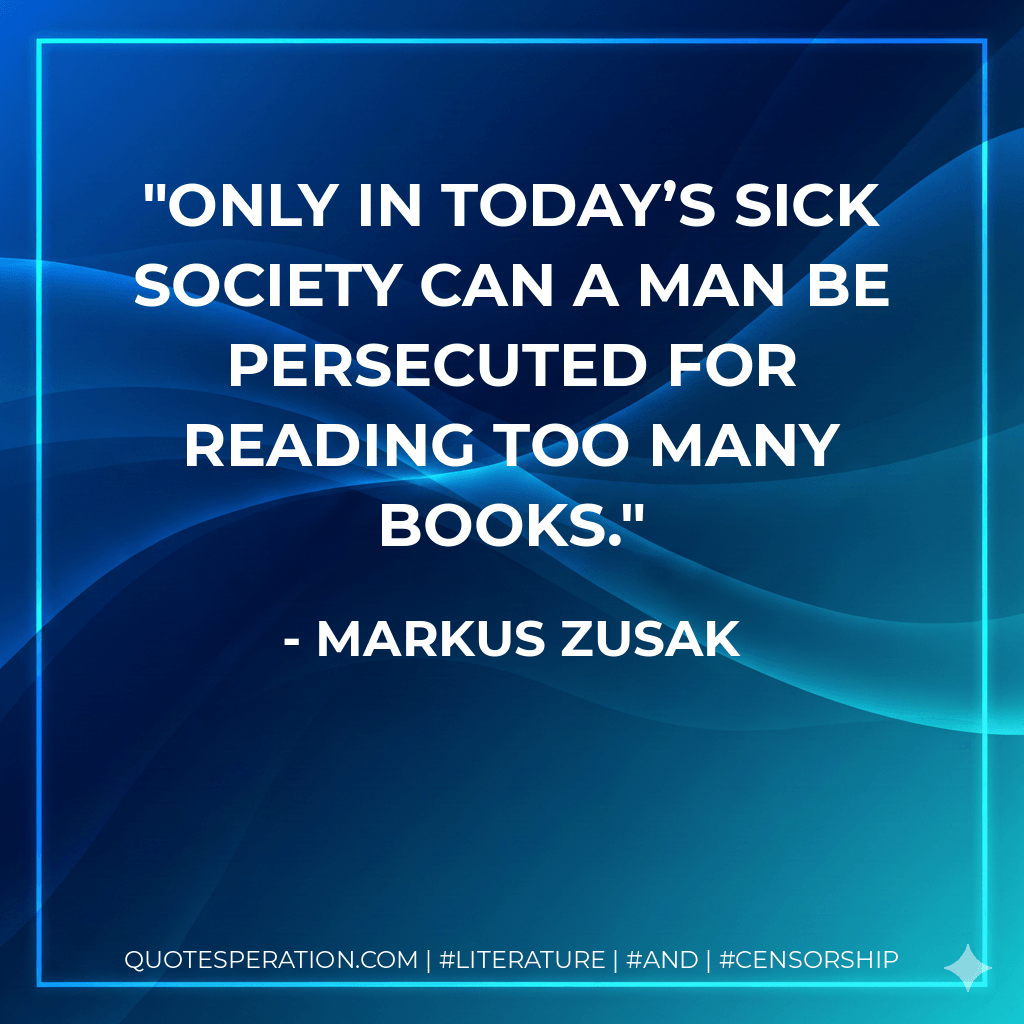
Only in today’s sick society can a man be persecuted for reading too many books.
When I was a boy in the late 1950s, the public library refused to stock books by Edgar Rice Burroughs. They were regarded as vulgar, ill-written potboilers.
More Collections
Friendship Quotes Hub
Sports Team Confidence & Success Quotes
Persistence and Progress

Best Limited Social Circles Quotes
Best Life Quotes
Best Intense Rivalry Games Quotes
Related Articles
Patrick Wright
Software engineer and creator of Quotesperation. I curate wisdom from history's greatest minds to inspire and guide modern life. When I'm not collecting quotes, I'm writing about technology and finding connections between timeless wisdom and today's challenges.