Best Mortality Acceptance Process Quotes
Mortality Acceptance Process
Table of Contents
- Facing Mortality with Acceptance
- Mortality as a Motivation to Live Fully
- Cultural and Societal Views on Mortality
- Mortality and the Aging Process
- The Paradox and Irony of Mortality
- Mortality and Its Philosophical Implications
- Fear, Denial, and Acceptance of Death
- Death as a Natural Part of Life
- Mortality’s Impact on Relationships
- Mortality and Dignity in Death
- Other
Facing Mortality with Acceptance
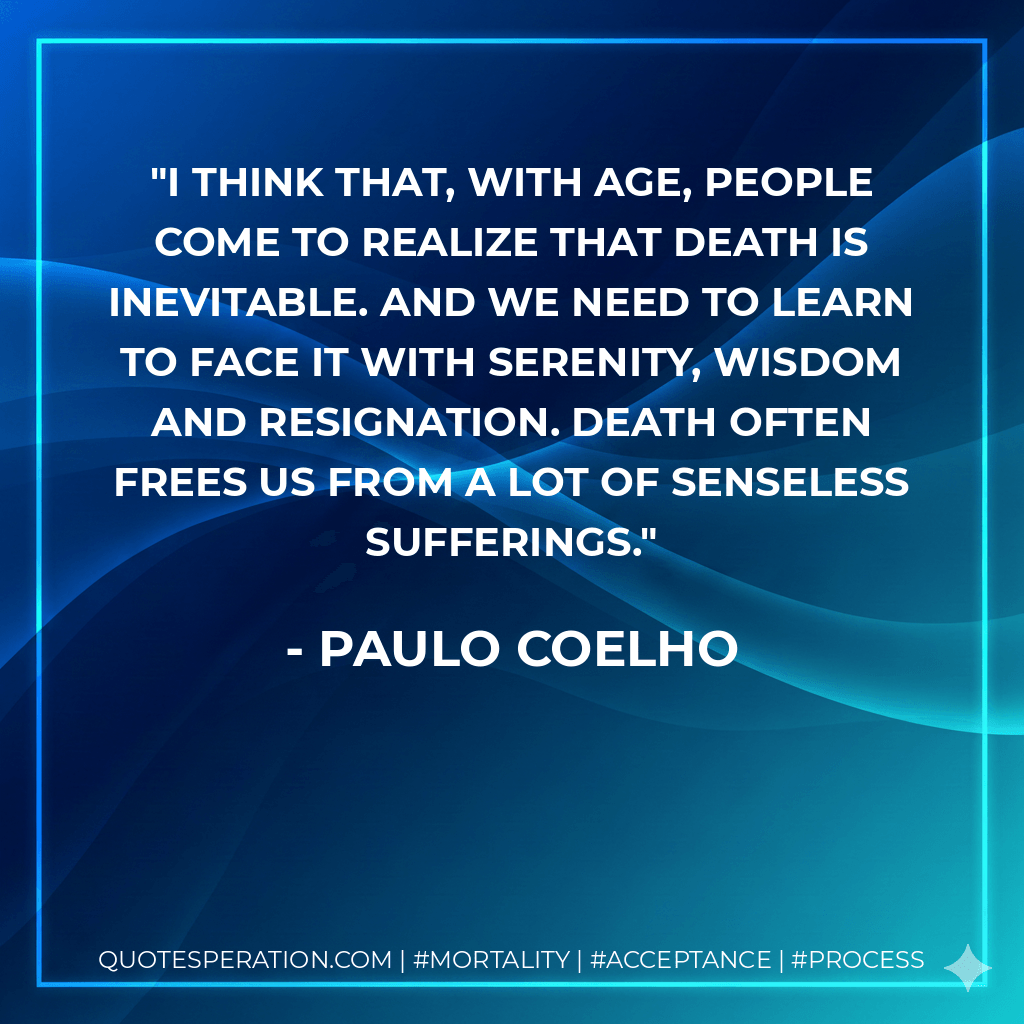
I think that, with age, people come to realize that death is inevitable. And we need to learn to face it with serenity, wisdom and resignation. Death often frees us from a lot of senseless sufferings.
Awareness of mortality exerts a unique power to focus the mind and heart on essentials.
When we can see with an open heart our own mortality, we can help others in a way that changes their lives forever
It behooves me to remember as I advance in age that death is an inevitable part of the life cycle rather than a medical failure.
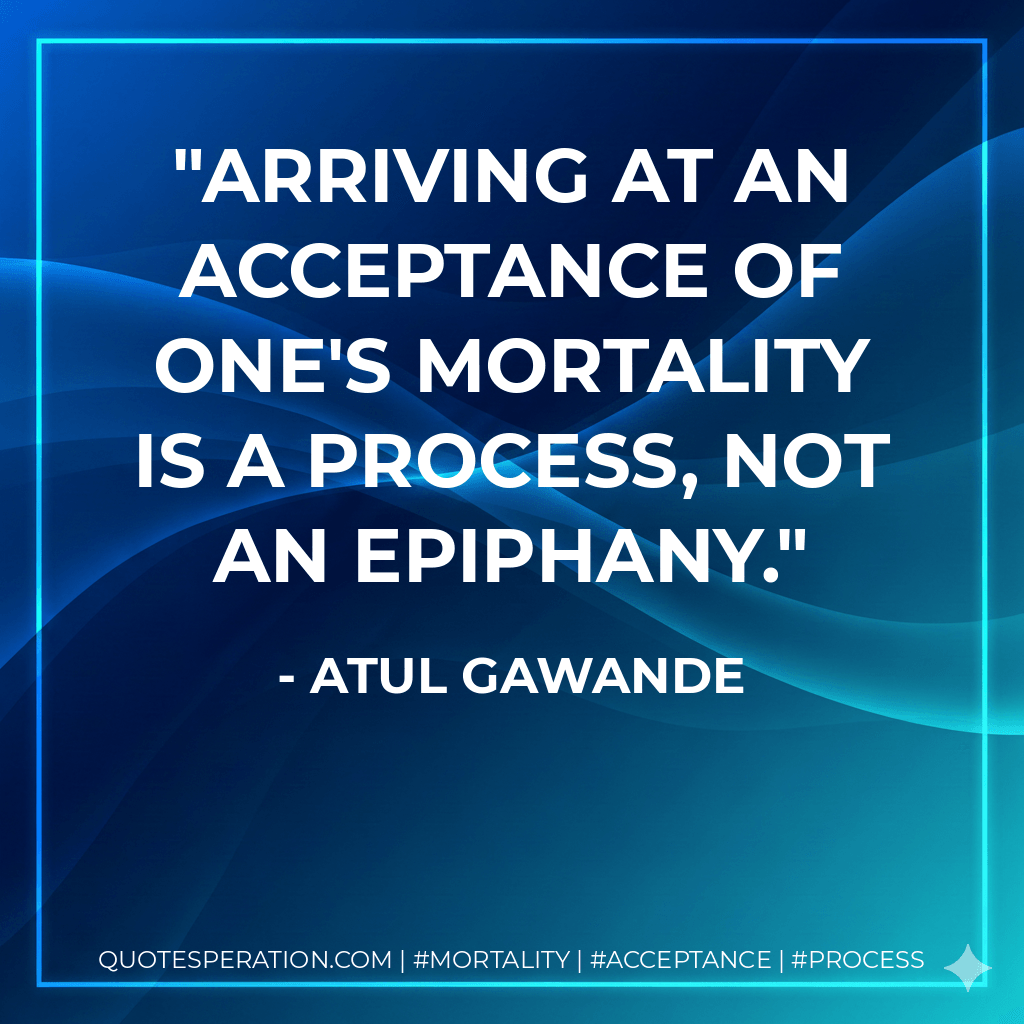
Arriving at an acceptance of one's mortality is a process, not an epiphany.
We need to be reminded that there is nothing morbid about honestly confronting the fact of life's end, and preparing for it so that we may go gracefully and peacefully.
knowledge of our own mortality is the greatest gift God ever gives us.
Mortality is a proper object to invite our pity, and privation of life alone sufficient to move compassion in the living.
We do have trouble dealing with death, but it's the one thing that is guaranteed we are all going to have to do, and we are going to have to face it many times before we die ourselves.
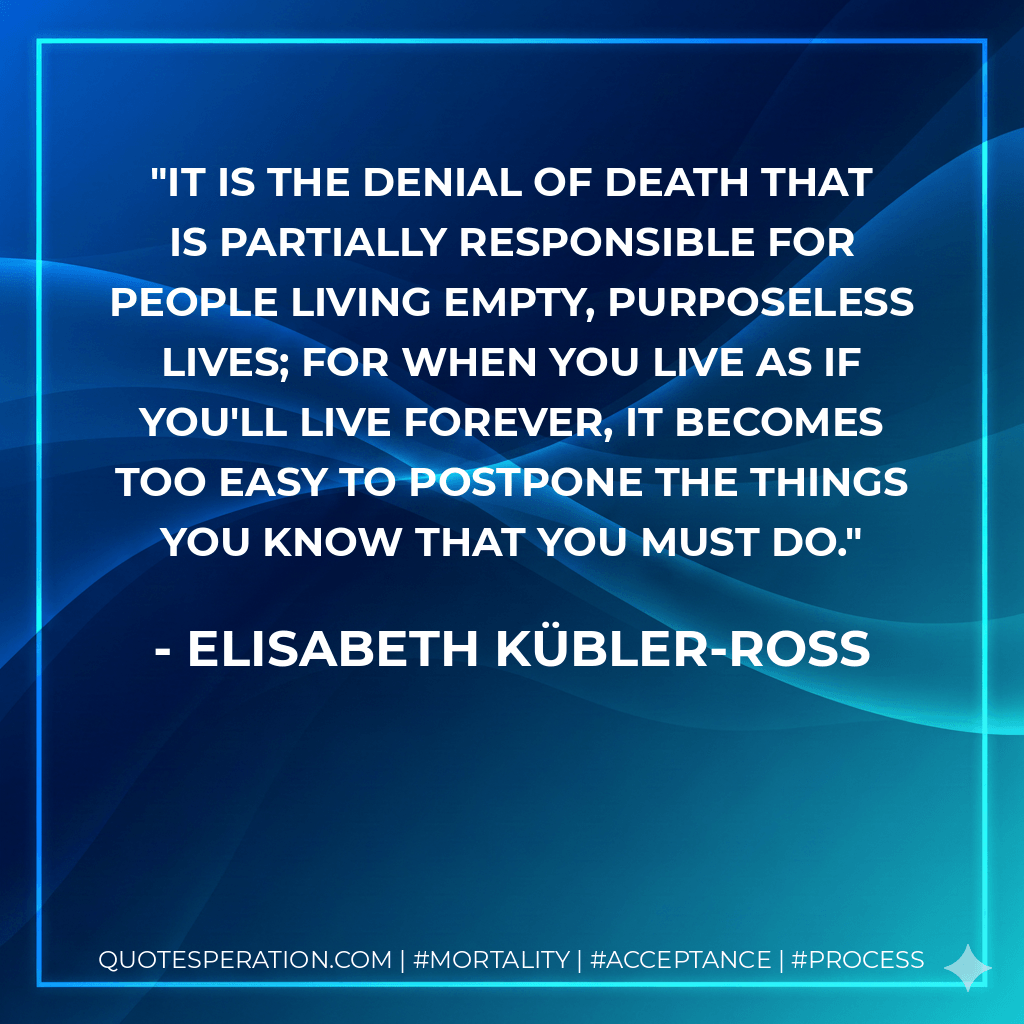
It is the denial of death that is partially responsible for people living empty, purposeless lives; for when you live as if you'll live forever, it becomes too easy to postpone the things you know that you must do.
It's peculiar to me,' she said, 'that everybody pays so much attention to living and so little to dying. Why are these high-powered scientists always screwing around trying to prolong life instead of finding pleasant ways to end it? There must be a hell of a lot of people in the world like me--who want to die but haven't got the guts.
Acceptance of death when it arrives is one thing, but to allow it to upstage the joys of living is ingratitude.
Mortality as a Motivation to Live Fully
Mortality is a gift—a fire under our asses to feel, to experience, to live. But as with all gifts, there is a catch, and the catch is the end, and the end is the gift.
We will all grow old. We will all suffer illnesses. We will all feel the pain of losing loved ones. We will all perish. Do we need further persuading to live our lives fully and gloriously?
We all age. We all suffer illnesses. We all feel the pain of losing loved ones. We will all perish. Do we need further persuading to live our lives fully and gloriously?
When you think about it, it's all well and good living a life so clean, it would even put a saint to shame, but sure god knows you might as well live it up, enjoy your few cigarettes, your few drinks, your desserts, or whatever your vice may be. Death doesn't discriminate or favour those who live healthy lives. It will take anyone, anytime, so you might as well go with a smile on your face.
I think that there is something beautiful about mortality. It makes our decisions mean more.
Maybe, if we just accepted our deaths, we might finally start to live.
Death is there to keep us honest and constantly remind us we are free.
Mortality is the great rescuer, it finally takes you out of everything, and that makes life good.Read Carl Jung. It makes life richer because this is it; none of us know where we go and this is the fun of it.
There is no cure for birth and death save to enjoy the interval. The dark background which death supplies brings out the tender colours of life in all their purity.
The prospect of death is nature's way of encouraging us to strive for greatness.
The curse of mortality. You spend the first portion of your life learning, growing stronger, more capable. And then, through no fault of your own, your body begins to fail. You regress. Strong limbs become feeble, keen senses grow dull, hardy constitutions deteriorate. Beauty withers. Organs quit. You remember yourself in your prime, and wonder where that person went. As your wisdom and experience are peaking, your traitorous body becomes a prison.
Tis only when faced with our own mortality that we truly realize what it means to be alive,
Cultural and Societal Views on Mortality
A society that believes in nothing can offer no argument even against death. A culture that has lost its faith in life cannot comprehend why it should be endured.
Our culture's quest to hide death behind a facade of denial has made fools and pretended immortals of us all. Perhaps it would be more helpful and liberating to begin each day by repeating the words of Crazy Horse, "Today is a good day to die.
A culture of death denial. This denial takes many forms. Our obsession with youth, the creams and chemicals and detoxifying diets pushed by those who would sell the idea that the natural aging of our bodies is grotesque. Spending over $100 billion a year on anti-aging products as 3.1 million children under 5 starve to death. The denial manifests in our technology and buildings, which create the illusion that we have less in common with road kill than with the sleek lines of a MacBook.
There is something about this generation living now, that we don't accept death.
As a culture, we are not comfortable with mortality. We do not accept it the way other cultures do. We cling to youth, and we don't want to die. It's like, 'Well, too bad, we do.'
One of our problems as Americans is that we treat death as if it's an option instead of a reality. We tend to believe that technology can conquer everything. But no matter how healthy you are or how much medical care you get, you're still a mortal.
Americans continue treating death as if it's an option instead of a reality.
People assume that somehow fame and wealth will keep mortality at bay.
There's the constant concern with what happens to you when you die. Every society thinks about that and makes things to deal with that.
Society doesn't like to deal with death, but it is a natural part of living.
In these dangerous times, where it seems the world is ripping apart at the seams, we can all learn how to survive from those who stare death squarely in the face every day, and we should reach out to each other and bond as a community, rather than hide from the terrors of life at the end of the millennium.
If you're growing up in times of peace and live in a country where there's plenty of food and good healthcare, you grow up without any relationship with death.
Mortality and the Aging Process
Mortality is a most curious Experience: In our youthful beginnings we eagerly sacrifice our health and bodies to have even the slightest worldly gain... Then in our aging twilight we hurriedly sacrifice every penny of our hard won wealth in hopes of hanging onto even the slightest bit of of our once bountiful health. Curious indeed...
We really feel the fact of our mortality after we turn forty years old.
Death grows friendlier as we grow older.
As we go through life our relationship with our own mortality and our inevitable demise increases.
I think that one of the many advantages of death accruing over a long period of time is that you do have time to meet a lot of other people who are going through similar situations and one of the great delights of our life actually was sitting around in labs waiting for the results of tests and talking to other people who were waiting to find out whether their cancer numbers were going in the right direction or not.
I know that there are people who believe that if they get to the stage where life is absolutely intolerable because of pain and indignity... they would like to end their life before nature intended, and we think they should have the choice to do so.
Mortality is the face of people who do not believe in their own power and essence.
I think at the prospect of bringing children into the world, your mortality comes very much to the forefront, absolutely.
When people get a chance to come close to death without having it touch them personally, they never miss the opportunity.
People go through life blindly, ignoring death like revellers at a party feasting on fine foods. They ignore that later they will have to go to the toilet, so they do not bother to find out where there is one. When nature finally calls, they have no idea where to go and are in a mess.
We are born dead, and we are becoming more and more contented with our condition. We are acquiring the taste for it.
Awareness of death is the very bedrock of the entire path. Until you have developed this awareness, all other practices are obstructed.
The Paradox and Irony of Mortality
We are frightfully concerned with our own deaths, sometimes so much so that we forget the real purpose of our lives
Ignorance of mortality is a comfort.
The advantage of mortality is clear to us, but not to them, and that is why those left behind suffer. They miss the company of their loved ones, but it is the feeling that the deceased no longer exist that hurts the most. This is the cost mortals must pay. Let me put it to you this way: Mortality is better than immortality, but only the immortal have the ability to see this, and there lies both the irony and the cost of human happiness.
Mortality is but a stepping-stone to a more glorious existence in the future.
No one wants to live in a wheelchair unable to talk, only winking once for yes and twice for no. It's perfectly reasonable that there will come a point where the balance of judgment of life over death swings the other way.
The death rate is the same for us as for anybody ... one person, one death, sooner or later.
Maybe if I was more patient with certain deaths, I would be more ready for the lives that come after them.
One of the uncovenanted benefits of living for a long time is that, having so many more dead than living friends, death can appear as a step backwards into the joyous past ...
But from another, deeper perspective: we shouldn't involve outselves in lines of development where the ultimate victory condition is emulating dead people. There's no appeal in that. It's bad for us. That kind of inherent mournfulness is just not a good way to be human.
I do not believe that we can stop perfecting new ways of dying until we have found new ways of living. Every new life-way ought to prevent a new death-way.
Why don't people take the trouble to let you know that they are alive? It is so much more important. The whole system is wrong. No sooner do I die, than all the flowers I have ever longed for in life pour in.
When we are healthy, wealthy and powerful, we forget about our mortality. It’s only when irreparable cracks set in that we come back to reality.
Mortality and Its Philosophical Implications
Sometimes people are not killed by the disease they are infected with, but are killed by their own negativity towards life and everything. Be positive in life , then you will live longer.
... "The world is afflicted with death and decay, therefore the wise do not grieve, knowing the terms of the world," says an old Buddhist teaching. In other words: Get used to it.
Awareness of death is the very bedrock of the entire path. Until you have developed this awareness, all other practices are obstructed.
knowledge of our own mortality is the greatest gift God ever gives us.
Mortality has its compensations; one is that all evils are transitory, another that better times may come.
There is no cure for birth and death save to enjoy the interval. The dark background which death supplies brings out the tender colours of life in all their purity.
Mortality is a gift—a fire under our asses to feel, to experience, to live. But as with all gifts, there is a catch, and the catch is the end, and the end is the gift.
To keep faith in mortal life, then, is to remain vulnerable to a pain that no strength can finally master. Mortality is not only intrinsic to what makes life meaningful, but also makes life susceptible to lose meaning and become unbearable. The point is not to overcome this vulnerability but to recognize that it is an essential part of why our lifes matter and why we care. (49)
Mortality is one of the greatest gifts ever bestowed. After a long and fruitful life, we are able to rest.
Not only is our beliefs about death as diverse as life itself, we now know the only secure thing in life is death.
Your relationship to mortality is your own.
لقد اكتشفت انا -كما يجب أن تكون اكتشفت أنت منذ زمن بعيد - كم هو ضروري ان يموت بعض الناس …من أجل أن يعيش البعض الآخر..انها حكمة قديمة ..أهم ما فيها الآن …أنني أعيشهاI have discovered what you have probably discovered a long time ago: how inevitable it is for some people to die for some others to live.. The most significant thing about this ancient wisdom is that I’m living it now..
Fear, Denial, and Acceptance of Death
I am not ascare to die. I am only ascare that after death I be alone. Maybe because of suicide, I go to the hell? If hell all hot and crowded and noiseful, like Christian minister on TV say, then I not care because it will be just like India. But if hell cold and quiet, with lot of snow and leaf-empty trees, and people who smile with string-thin lips, then I ascare. Because it seems so much like my life in Am'rica.
Of course, we avoid death. To know something is inevitable is one thing. To accept, to truly feel it... that's different.
It is the denial of death that is partially responsible for people living empty, purposeless lives; for when you live as if you'll live forever, it becomes too easy to postpone the things you know that you must do.
Society doesn't like to deal with death, but it is a natural part of living.
None of us really either know the circumstances of our death or are likely to exert as much control over it as we would like to, but we can certainly have a little more say in it if we are terminally ill than we have at the moment. That's the element of dignity, but sure, life is very hard to organise even when you are fit and healthy.
I know dying has got to be a process that no one really wants to go through but it's just not fair for the survivors to have to make this decision.
If you stay in the mainstream of life, you let in the suffering of the world that invariably enters all of our lives by the time we're in our middle years, when we've experienced a few deaths and read a few headlines.
Treat Death as it treats us: with utter indifference.
But if we can't summon the empathy to imagine what our dead would have asked of us, or the selflessness to give it, then we must accept the desperately sad verdict that each generation's hopes will die with it, and no cumulative progress is possible for the human will.
For someone so young, I think an awful lot about mortality.
We do not look for reason for logic in the passionate entreaties of those who are sick unto death; we are stung with the recollection of a thousand slighted opportunities of fulfilling the wishes of those who will soon pass away from among us: and do they ask us for the future happiness of our lives, we lay it at their feet, and will it away from us.
Death is always around the corner, but often our society gives it inordinate help.
Death as a Natural Part of Life
How we deal with death is at least as important as how we deal with life.
Some people, sweet and attractive, and strong and healthy, happen to die young. They are masters in disguise teaching us about impermanence.
It is not the weariness of mortality, but the strength of divinity, which we have to recognize in all mighty things; and that is just what we now never recognize, but think that we are to do great things by help of iron bars and perspiration. Alas! we shall do nothing that way but lose some pounds of our own weight.
As young one we learned life is a opportunity and when we grow older we learned something more precious death is a gift
A long disease seems to be a halting place between life and death, that death itself may be a comfort to those who die and to those who are left behind.
Intruding upon a dimension rightfully ours, modern medicine robs us of the dignity of what people in the past regarded as most precious: that final moment of death.
When someone dies, we think that’s it for them. But it’s not really set up that way. It’s not fixed. Death like life is temporary.
First, I have culled evidence that physical death is not the end of the road for any of us. I know this message is critical because I've seen people consumed by fear of death or suffering unbearable grief after losing a loved one. Some can draw into a shell, ceasing all efforts to reach their potential, or even give up on life.
One of the advantages or disadvantages of the way in which we live in these modern days is that we are ceasing to feel. That is to say we do not permit ourselves to be affected by either death or misfortune, provided these natural calamities leave our own persons unscathed.
The heart of the matter is that some people like to cause injury or death to living things. And many of those who do not are indifferent to those who do.
While we are young the idea of death or failure is intolerable to us; even the possibility of ridicule we cannot bear.
Personally, I don't endorse the notion of mortality. It's fine for other folk, but I disapprove of the concept for me and my loved ones.
Mortality’s Impact on Relationships
As I grew older, I came to realize that death had been easy for my mother; to fear death, you must first have something to tether you to life. But she had not. It was as if she had been preparing for her death the entire time I knew her. One day she was alive; the next, not.And as Sybil said, she was lucky. For what more could we presume to ask from death — but kindness?
Or were we like people who have died before their time and are given a second chance by some minor deity, but with so many provisos that the new life feels like a deferred death?
In these dangerous times, where it seems that the world is ripping apart at the seams, we all can learn how to survive from those who stare death squarely in the face every day and [we] should reach out to each other and bond as a community, rather than hide from the terrors of life at the end of the millennium.
You cannot avoid mortality. But you can choose your way of meeting it. And that is the most that any man can hope for.
But if we can't summon the empathy to imagine what our dead would have asked of us, or the selflessness to give it, then we must accept the desperately sad verdict that each generation's hopes will die with it, and no cumulative progress is possible for the human will.
I know dying has got to be a process that no one really wants to go through but it's just not fair for the survivors to have to make this decision.
If anything, it wakes young people up to a sense of mortality and how your life can end at a moment's notice.
Each time we allow our interest to take a back sit in favor of others, which is a form of death.
People may have to die, but morbidity will live forever.
We don't want people to think they make a will or bequest and then once they die it's going to be ignored or not followed.
Why don't people take the trouble to let you know that they are alive? It is so much more important. The whole system is wrong. No sooner do I die, than all the flowers I have ever longed for in life pour in.
Too many people die early, either tragically or natural death, because they did not treat their lives with any sense of value.
Mortality and Dignity in Death
If the push towards life sustaining technology were balanced with options for comfort care in both medical school training and the healthcare culture, more people would have the chance to transition to death with dignity and grace.
I believe it’s imperative to bring the light of support and knowledge to patients and families when death is approaching.
Acceptance of death when it arrives is one thing, but to allow it to upstage the joys of living is ingratitude.
None of us really either know the circumstances of our death or are likely to exert as much control over it as we would like to, but we can certainly have a little more say in it if we are terminally ill than we have at the moment. That's the element of dignity, but sure, life is very hard to organise even when you are fit and healthy.
No one wants to live in a wheelchair unable to talk, only winking once for yes and twice for no. It's perfectly reasonable that there will come a point where the balance of judgment of life over death swings the other way.
I know that there are people who believe that if they get to the stage where life is absolutely intolerable because of pain and indignity... they would like to end their life before nature intended, and we think they should have the choice to do so.
Probably most dying patients, even when suffering greatly, would choose to live as long as possible. That courage and grace should be protected and honored, and we should put every effort into treating their symptoms.
Perhaps it is only when we realize and celebrate the intrinsic value of every human life that celebrity - true celebrity - shines most brightly. On our deathbeds, none of us will speak of the jobs we’ve held or the stuff we’ve acquired in our lifetimes; here bull markets and Nielsen ratings are irrelevant. A life-threatening illness jettisons pretension in no time flat. Death is the great equalizer. Death dares us to define what really matters.
Since we're coming into a rebirth, and there's a consciousness of health, because the disease that is death, we are able to overcome that.
It is vital to avoid mediocrity - living a life of deadness in someone else's threadbare world.
It's very advanced of you to have accepted my mortality so fatalistically.
An awareness of mortality is a heavy price to pay for sentience
Other
In the end we all come to be cured of our sentiments. Those whom life does not cure death will.
Sensible people get the greater part of their own dying done during their own lifetime
Personally I don’t endorse the notion of mortality. It’s fine for other folk, but I disapprove of the concept for me and my loved ones. Seems unfair that we’re not allowed to vote on the matter and not one of us is excused. Who made up that rule?" - Kinsey Millhone
Life and death issues are a universal concern. A person can learn about life by investigating the psychological and social aspects related to dying.
Do you seek out peril? One would think that years of being a mortal would have made you more aware of mortality.
Even fear faded, incipient mortality giving way to the kind of drawn-out academic detachment that rendered “certain death” as “incipient mortality.
The question of dying becomes a wise reminder. It cures us of our innocence of the future.
This probably has to do with the aging of the population and more people confronting these situations. The poll found that people who have participated in decisions about end-of-life or had loved ones with illnesses in the last five years are much more likely to have thought about end-of-life treatments or to have living wills.
According to a new survey, people who get divorced die early. People who stay married live longer. The difference is they just wish they were dead.
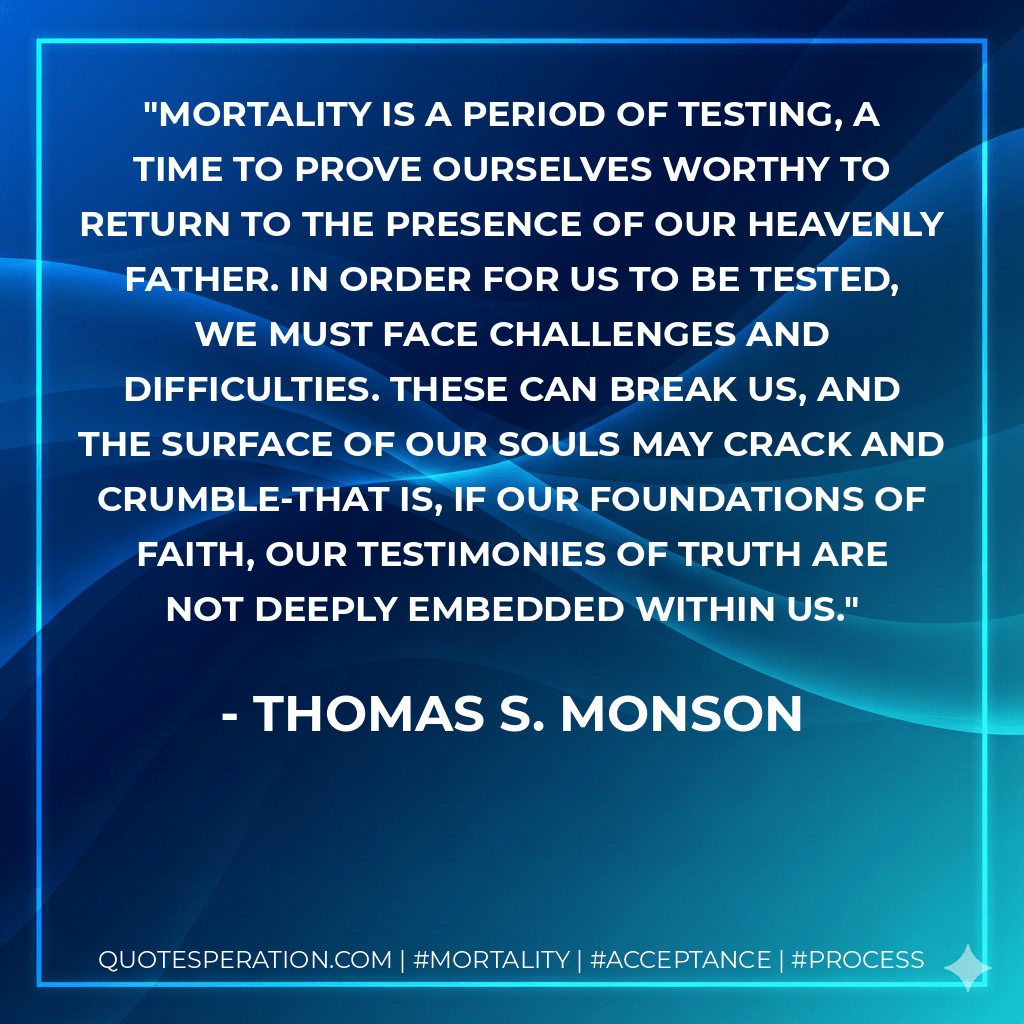
Mortality is a period of testing, a time to prove ourselves worthy to return to the presence of our Heavenly Father. In order for us to be tested, we must face challenges and difficulties. These can break us, and the surface of our souls may crack and crumble-that is, if our foundations of faith, our testimonies of truth are not deeply embedded within us.
If we were not so single-minded about keeping our lives moving and for once could do nothing, perhaps a huge silence might interrupt this sadness of never understanding ourselves and of threatening ourselves with death Perhaps the world can teach us as when everything seems dead but later proves to be alive.
There exists a gap between what patients expect with regard to end of life care and what actually happens,
You realize mortality is everywhere.
More Collections
Friendship Quotes Hub
Sports Team Confidence & Success Quotes
Persistence and Progress
Best Limited Social Circles Quotes
Best Life Quotes

Best Intense Rivalry Games Quotes
Related Articles
Patrick Wright
Software engineer and creator of Quotesperation. I curate wisdom from history's greatest minds to inspire and guide modern life. When I'm not collecting quotes, I'm writing about technology and finding connections between timeless wisdom and today's challenges.